When we consider that the ionosphere surrounding our planet is electrically positive charged whilst the earth's surface carries a negative charge, we must conclude that this amounts to a prevailing electrical tension within the earth/ionosphere cavity. This tension is discharged when thunderstorms develop in this cavity. In physics two concentric electrically charged balls, one placed inside the other, are called ball condensers, or capacitors.
The inside of the ionosphere layer is used in wireless information transfer to bounce off radio waves emitted by transmitters on the earth's surface. In this way the information can be transferred over large distances.
The physicist and inventor Nikola Tesla was the first to carry out wireless energy experiments at Colorado Springs, USA, which produced such powerful electrical tensions that they resulted in the creation of artificial lightning. These lightning flashes also produced radio waves. Due to their extremely low frequency these waves could penetrate the earth without resistance and thereby Tesla discovered the resonance frequency of the earth. Unfortunately Tesla was before his time and his discoveries were not taken seriously.
It wasn't until more than half a century later in 1952, when the German physicist Professor W.O.Schumann of the Technical University of Munich predicted that there are electromagnetic standing waves in the atmosphere, within the cavity formed by the surface of the earth and the ionosphere. This came about by Schumann teaching his students about the physics of electricity. During a lesson about ball condensers he asked them to calculate the frequency between the inner and outer ball, meaning the earth and ionosphere layer. They came up with a calculation of 10Hz.
This was confirmed in 1954 when measurements by Schumann and König detected resonances at a main frequency of 7.83 Hz. In the years following this discovery, several investigators worldwide have researched "Schumann resonance" and a number of properties and characteristics have now been established.
Schumann Resonance Properties
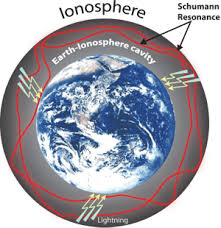
The spherical earth-ionosphere cavity is created by the conductive surface of the earth and the outer boundary of the ionosphere, separated by non-conducting air. Electromagnetic impulses are generated by electrical discharges such as lightning, the main excitation source, and spread laterally into the cavity. Lightning discharges have a "high-frequency component", involving frequencies between 1 kHz and 30 kHz, followed by a "low-frequency component" consisting of waves and frequencies below 2 kHz and gradually increasing amplitude. This produces electromagnetic waves in the very low frequency (VLF) and extremely low frequency (ELF) ranges.
ELF waves at 3 Hz to 300 Hz are propagated as more or less strongly attenuated waves in the space between the earth and the ionosphere, which provides a waveguide for the signals. Certain wavelengths circumnavigate the earth with little attenuation due to the fact that standing waves are formed within the cavity, the circumference of which is "approximately equal to the wavelength which an electromagnetic wave with a frequency of about 7.8 Hz would have in free space" (König, 1979, p34). It is the waves of this frequency and its harmonics at 14, 20, 26, 33, 39 and 45 Hz that form Schumann Resonances.
On a global scale the total resonant spectrum is the effect of the global lightning worldwide which is estimated at an average of 100 strokes per second. Since there is a concentration of lightning activity during the afternoon in Southeast Asia, Africa and America there are Schumann Resonance amplitude peaks at 10, 16 and 22 UT (universal time), with activity over America around 22 UT being dominant.
There are also +/-0.5 Hz variations in the center frequency, caused by a diurnal increase in ionization of the ionosphere as a result of radiation from the sun, having the effect of reducing the height of the ionosphere at 12 local time. Another factor which influences center frequency is sunspot activity.
A Tuning Fork for Life
Although the existence of the Schumann Resonance is an established scientific fact, there are very few scientists who are aware of the importance of this frequency as a tuning fork for Life. I propose that it is not merely a phenomenon caused by lightning in the atmosphere, but a very important electromagnetic standing wave, acting as background frequency and influencing biological oscillators within the mammalian brain.
At the time when Schumann published his research results in the journal `Technische Physik', Dr Ankermueller, a physician, immediately made the connection between the Schumann resonance and the alpha rhythm of brainwaves. He found the thought of the earth having the same natural resonance as the brain very exciting and contacted Professor Schumann, who in turn asked a doctorate candidate to look into this phenomenon. This candidate was Herbert König who became Schumann's successor at Munich University. König demonstrated a correlation between Schumann Resonances and brain rhythms. He compared human EEG recordings with natural electromagnetic fields of the environment (1979) and found that the main frequency produced by Schumann oscillations is very close to the frequency of alpha rhythms.

Natural electromagnetic processes in the environment (I-IV), human EEG readings in comparison. Schumann oscillations (I) and the EEG a-rhythm, as well as locally conditioned fluctuations of the electric field (II) and the EEG d-rhythm, show a noticable similarity in their temporal variation. From König, 1979.
Dr König carried out further measurements of Schumann resonance and eventually arrived at a frequency of exactly 7.83 Hz, which is even more interesting, as this frequency is one which applies to mammals. For instance, septal driving of the hippocampal rhythm in rats has been found to have a minimum threshold at 7.7 Hz (Gray, 1982).
This relationship has been explored by a number of investigators. For further information see Natural electromagnetic fields research on the h.e.s.e. project website.
One of the foremost researchers in this field is Dr Wolfgang Ludwig, who has been investigating Schumann Resonance and its place in nature for many years.
The Research of Dr. Wolfgang Ludwig
It was Dr Wolfgang Ludwig who carried out further measurements whilst writing his thesis on the Schumann Resonance. His aim was to measure what kind of natural signals actually exist in a healthy environment. He became aware of the fact that due to manmade electromagnetic signals within the atmosphere, the accurate measurement of Schumann waves was almost impossible in the city. For this reason he decided to take measurements out at sea where, due to good electrical conductivity, the Schumann waves are stronger. He than had the idea to take underground measurements in mines. Here he recognized that the magnetic field of the earth fluctuated too. This was also investigated by Dr Robert Becker in his book `Electricity and Vitality: The spark of Life'.
Dr Ludwig came up with an excellent idea to take accurate measurements. When taking measurements at the earth's surface, the reading is the result of two signals, one coming from above and one from below. But subsequently taking measurements below ground makes it possible to come up with exact readings by separating the two.
YIN and YANG
During his research Dr Ludwig came across the ancient Chinese teachings which state that Man needs two environmental signals: the YANG (masculine) signal from above and the YIN (feminine) signal from below. This description fits the relatively strong signal of the Schumann wave surrounding our planet being YANG and the weaker geomagnetic waves coming from below, from within the planet, being the YIN signal
The Chinese teachings state that to achieve perfect health, both signals must be in balance. Dr Ludwig found that this is indeed the case. He writes in his book `Informative Medizin' that research carried out by E.Jacobi at the University of Duesseldorf showed that the one sided use of Schumann (YANG) wave simulation without the geomagnetic (YIN) signal caused serious health problems. On the other hand, the absence of Schumann waves creates a similar situation. Professor R.Wever from the Max Planck Institute for Behavioural Physiology in Erling-Andechs, built an underground bunker which completely screened out magnetic fields. Student volunteers lived there for four weeks in this hermetically sealed environment. Professor Wever noted that the student's circadian rhythms diverged and that they suffered emotional distress and migraine headaches. As they were young and healthy, no serious health conditions arose, which would not have been the case with older people or people with a compromised immune system. After only a brief exposure to 7.8 Hz (the very frequency which had been screened out), the volunteers health stabilized again.
The same complaints were reported by the first astronauts and cosmonauts, who, out in space, also were no longer exposed to the Schumann waves. Now modern spacecrafts are said to contain a device which simulates the Schumann waves.
All the aforesaid points to the fact that the ancient teachings are correct. Mankind depends on two subtle environmental signals, the Yin from below and the Yang from above.
The urgent need for further research into the Schumann Resonance Effect
Although Schumann Resonance could easily be confirmed by measurements at the time of its discovery, it is no longer so obvious due to our atmosphere being filled with manmade radiation noise at different frequencies. This is almost drowning out the natural signals - signals that have been there through aeons of evolution. It is possible that these signals act like a natural tuning fork, not just for the biological oscillators of the brain, but for all processes of life.
With the advent of new wireless technology, in particular microwaves pulsed at frequencies close to Schumann Resonance as in mobile telephony, another threat is emerging. We may be creating an environment that is literally `out of tune' with Nature itself. And it is at this point that there is an urgent need for us to understand how everything alive responds to the most subtle changes in magnetic and electromagnetic fields surrounding us. For instance, we need to examine the possible interaction between magnetite crystals within cells and manmade magnetic fields in the environment.
There is a great need for independent research into the bio-compatibility between natural and manmade signals. By linking together the potential importance of Schumann Resonance and the dangers posed by manmade pulsed frequencies, it will become apparent that unless we find a way to use bio-compatible signals to power new technology, we may expose all life to dangers previously not encountered. We may have to pay a high price for this shortsightedness. Serious attention must now be paid to the possible biological role of standing waves in the atmosphere, so that we do not overlook the importance of oscillations in nature that may be central to consciousness and life itself.
The late Dr Neil Cherry, a fierce opponent of the frequencies used in mobile telephony, has also focused on the importance of Schumann Resonance in his publications 'Schumann Resonances, a plausible biophysical mechanism for the human health effects of Solar/Geomagnetic Activity' (2002), and 'Human intelligence: The brain, an electromagnetic system synchronised by the Schumann Resonance signal' (2003).
See also Sedona Anomalies
If organisms do in fact respond to, and perhaps depend on, electromagnetic fields as weak as that produced by Schumann resonance at 0.22-1.12 mV/m (from Cherry, 2002), this is of major significance for the development of present and future wireless technologies. Funding for research projects investigating the Schumann Resonance Effect is now being sought and scientists who support this call for research are invited to contact by e-mail.

Our Earth is a restless planet. Occasionally - quite often, in some regions of the world - the restlessness turns deadly. Of all natural hazards, earthquakes are the most feared. They are feared because they seem to strike so unpredictably. Yet, for centuries, and even millennia, people living in seismically active regions have noted premonitory signals. The historical records talk of changes of the water level in wells, of strange weather, of ground-hugging fog, of unusual behavior of animals (both domestic and wild) that seem to feel the approach of a major earthquake. With the advent of modern science and technology the list of premonitory signals has become even longer. Among them are
1.Sporadic emissions of low to ultralow-frequency electromagnetic radiation from the ground
2.Occasional local magnetic field anomalies reaching a strength of half a percent of the Earth's main dipole field
3.Changes in the lower atmosphere that are accompanied by the formation of haze and a reduction of moisture in the air
4.Large patches, often tens to hundreds of thousands of square kilometers in size, seen in night-time infrared satellite images where the land surface temperature seems to fluctuate rapidly
5.Passing perturbations in the ionosphere at 90 - 120 km altitude that affect the transmission of radio waves
Deciphering these signals and learning how to "read" them has remained a source of great frustration. Many seismologists have lost faith that earthquakes would ever become predictable beyond statistical probabilities, which leave uncertainties of years, even decades. Some seismologists have proclaimed categorically that, due to their chaotic nature, earthquakes are fundamentally unpredictable.
However, given so many well-supported historical and modern indicators that the Earth does indeed send out premonitory signals, the naysayers should not deter us. Maybe we do not yet understand deeply enough the nature of earthquakes and the physics of the signals that the Earth sends out. --Friedemann Freund, NASA
Introduction
The statistical average for Class 6+ quakes is one every two days somewhere in the world, most probably in the Ring of Fire. But they tend to group around the Lunar Full and New phases. It is a virtual certainty to have a Class 6+ quake every syzygy or within a day. It is generally true that you will get two or three within a three day syzygy window.
Known and hidden fractures in the earth's crust continue to threaten the world economy. Some researchers expect increased quake activity due to increased solar activity and magma plume movement arising from the cooling dynamics of earth's core. As we learn to deal with many vectors of climate change, it becomes necessary to maximize our anticipatory skills of such potentially catastrophic outcomes.
Earth is a dynamo. When the sun reaches deep into the earth, it "talks" to her and modifies the generator within her. The ionosphere is one poorly understood channel. The sun interacts magnetically with the solid Earth, reaching down into the crust, generating forces that can trigger earthquakes that either rupture or slide.
Before major earthquakes, the crust "talks" back to the ionosphere, causing perturbations. Magnetic field maxima and minima move around over the surface of the earth. The total amount of coupling changes over time. Electrochemical loops cross, increasing quake likelihood.
Earth itself acts as a magnet. Minerals in the earth’s crust contain dormant electronic charge carriers. They act like electronic crystals when energized. Squeezing, heating or stressing such rocks activates them so waves can travel through the earth for kilometers changing conductivity, generating Lorenz force interacting with tectonic force vectors, pushing the system over the edge.
ULF
Ultra-low frequency (ULF) is the frequency range of electromagnetic waves between 300 hertz and 3 kilohertz. In magnetosphere science and seismology, alternative definitions are usually given, including ranges from 1 mHz to 100 Hz, 1 mHz to 1 Hz, 10 mHz to 10 Hz. Frequencies above 3 Hz in atmosphere science are usually assigned to the ELF range. Some monitoring stations have reported that earthquakes are sometimes preceded by a spike in ULF activity. A remarkable example of this occurred before the 1989 Loma Prieta earthquake in California. On December 9, 2010, geoscientists announced that the DEMETER satellite observed a dramatic increase in ULF radio waves over Haiti in the month before the magnitude 7.0 Mw 2010 earthquake. Researchers are attempting to learn more about this correlation to find out whether this method can be used as part of an early warning system for earthquakes. --Wikipedia, Ulta-Low Frequency
Ultra-low frequency (0.01-10 Hz) magnetic field anomalies prior to and following M > 6.5 earthquakes have
been reported from a number of different regions of the world. Continuous recording of the magnetic and electric
field before, during and after, and spatially close to, a significant earthquake, is required to demonstrate the reality or
absence of ULF EM signals. ULF spectrum contains the highest frequency signals that can reach the Earth’s surface with little attenuation. Magnetic storms can create higher than usual noise levels.
Meaningful analysis of ULF EM signals can only be done using continuous recordings at multiple sites, in order
to remove natural variations in the external (solar) field. Records from a single station (as with the ULF EM signals
recorded prior to the Loma Prieta earthquake) are not sufficient to overcome the burden of proof required of
proposed earthquake precursors, so stations should be close enough that two stations can record EM signals from a
single earthquake. (Klemperer)
Rapid magnetic field variations lead to ULF emissions. They ionize the plasma in the atmosphere, measurably perturbing the ionosphere, the coupling mechanism. Stressed rocks are active charge carriers which turns them into batteries. The driving force is deep magma and tectonic strain. Electric currents, up to millions of amperes, start to flow like in a semiconductor battery, perturbing earthquakes. Currents up to millions of amperes flow along stress gradients, fluctuating and emitting EM radiation. Therefore, Earth emits powerful broadband EM waves prior to quakes, in microhertz to about 20 hz. extremely low frequencies (ULF).
The earth hosts waves much like the ocean; they are amplified during quakes. Fault mechanics describes the behavior of geologic faults, elements of rock under stress. Triggering can occur by shifting stresses, building strain prior to slippage, or by dynamic change caused by passing seismic waves. Subduction along tectonic plate boundaries is one persistent force leading to seismic activity. Interplate earthquakes result from the motion of tectonic plates. If rock is modeled as discrete elements in a critical state, a single disturbance can influence a wide area.
There are still areas of North America rebounding from the weight that pressed down in the Ice Age. In places such as the New Madrid fault an incident could disrupt the interior of the US with catastrophic results. Deep sea avalanches from potential quakes and vulcanism, such as Cumbre Vieja, are another detectable vector. Injections of fresh or salt water into fault zones exacerbates their instability.
There are both electric and magnetic components to earthquakes, beneath the planet's surface magnetics. [Ben, add more on magnetic component]
Tectonic strain creates a piezoelectric effect that is observable and quantifiable prior to seismic displacement events and those not involving major seismic activity. Thus, normal alterations in tectonic (structural) stresses occur within the Earth's crust and are mediated by piezoelectric-like effects. Earthquake lightning, fracture-related luminosities or "earth lights" are one natural phenomena associated with piezoelectrics.
"In a study published in “Nature,” USGS seismologist Fred Pollitz and colleagues analyzed the unprecedented increase in global seismic activity triggered by the Magnitude-8.6 East Indian Ocean quake of April 11, 2012, and in a recently published study in the “Proceedings of the National Academy of Sciences,” seismologist Volkan Sevilgen and his USGS colleagues investigated the near-cessation of seismic activity up to 250 miles away caused by the 2004 M9.2 Sumatra earthquake.
While aftershocks have traditionally been defined as those smaller earthquakes that happen after and nearby the main fault rupture, scientists now recognize that this definition is wrong. Instead, aftershocks are simply earthquakes of any size and location that would not have taken place had the main shock not struck."
http://earthsky.org/science-wire/rare-great-earthquake-triggers-large-aftershocks-all-over-the-globe
Not all faults produce surface traces, and some fault complexes are active at varying depths at different times. Earthquake observation is also one of the most valuable diagnostic precursors to magma movement and volcanic events. Improved detection and prediction might be particularly valuable in identifying aftershocks and in areas prone to "earthquake storms". In earthquake swarms multiple event potentials need to be pin-pointed and notified quickly for emergency mitigation, evacuation, or disaster relief. We might also improve detection of remotely-triggered earthquakes, kindled by very large earthquakes.
Currently, there is no reliable system in effect for the prediction and locating of earthquake potential. Life and property might be saved by such a system, comparable to tsunami warning of volcanic activity alerts. In fact, this methodology could be added to protocols already in place for such warnings, improving them considerably. Recognized in NASA documents, Lonetree has previously made significant contributions to the methodology of monitoring and detecting Schumann Resonance, geomagnetic flux, and space weather.
Electrical engineer, Benjamin Lonetree brings the pragmatism of a true benchman to the challenge of geophysical signal monitoring. Such practitioners prefer to make and improve their own gear in accordance with intuition and knowledge gained from direct experience. Thus, Lonetree wraps his own coils and commissioned the creation of custom software to operate his system. Commerciality is only secondary, or incidental.
As experimentalists, benchmen learn how to refine their systems and readings over time and their proofs are demonstrable and repeatable, when circumstances arise. In this case the construction of equipment and the reading of instrumentation is fully teachable. Lonetree has shared his material via social media, in peer-reviewed journals, and backchannels for a number of years. His methodology is an improvement and upgrade of standard detection, not blue sky research, although it has been largely a solo effort.
Since precursors are likely non-seismological, the short-term earthquake prediction requires a new multi-disciplinary science.
Earthquake & Atmospheric Perturbation
Ionospheric perturbation is correlated with earthquakes by Friedemann Freund

The inside of the ionosphere layer is used in wireless information transfer to bounce off radio waves emitted by transmitters on the earth's surface. In this way the information can be transferred over large distances.
The physicist and inventor Nikola Tesla was the first to carry out wireless energy experiments at Colorado Springs, USA, which produced such powerful electrical tensions that they resulted in the creation of artificial lightning. These lightning flashes also produced radio waves. Due to their extremely low frequency these waves could penetrate the earth without resistance and thereby Tesla discovered the resonance frequency of the earth. Unfortunately Tesla was before his time and his discoveries were not taken seriously.
It wasn't until more than half a century later in 1952, when the German physicist Professor W.O.Schumann of the Technical University of Munich predicted that there are electromagnetic standing waves in the atmosphere, within the cavity formed by the surface of the earth and the ionosphere. This came about by Schumann teaching his students about the physics of electricity. During a lesson about ball condensers he asked them to calculate the frequency between the inner and outer ball, meaning the earth and ionosphere layer. They came up with a calculation of 10Hz.
This was confirmed in 1954 when measurements by Schumann and König detected resonances at a main frequency of 7.83 Hz. In the years following this discovery, several investigators worldwide have researched "Schumann resonance" and a number of properties and characteristics have now been established.
Schumann Resonance Properties
The spherical earth-ionosphere cavity is created by the conductive surface of the earth and the outer boundary of the ionosphere, separated by non-conducting air. Electromagnetic impulses are generated by electrical discharges such as lightning, the main excitation source, and spread laterally into the cavity. Lightning discharges have a "high-frequency component", involving frequencies between 1 kHz and 30 kHz, followed by a "low-frequency component" consisting of waves and frequencies below 2 kHz and gradually increasing amplitude. This produces electromagnetic waves in the very low frequency (VLF) and extremely low frequency (ELF) ranges.
ELF waves at 3 Hz to 300 Hz are propagated as more or less strongly attenuated waves in the space between the earth and the ionosphere, which provides a waveguide for the signals. Certain wavelengths circumnavigate the earth with little attenuation due to the fact that standing waves are formed within the cavity, the circumference of which is "approximately equal to the wavelength which an electromagnetic wave with a frequency of about 7.8 Hz would have in free space" (König, 1979, p34). It is the waves of this frequency and its harmonics at 14, 20, 26, 33, 39 and 45 Hz that form Schumann Resonances.
On a global scale the total resonant spectrum is the effect of the global lightning worldwide which is estimated at an average of 100 strokes per second. Since there is a concentration of lightning activity during the afternoon in Southeast Asia, Africa and America there are Schumann Resonance amplitude peaks at 10, 16 and 22 UT (universal time), with activity over America around 22 UT being dominant.
There are also +/-0.5 Hz variations in the center frequency, caused by a diurnal increase in ionization of the ionosphere as a result of radiation from the sun, having the effect of reducing the height of the ionosphere at 12 local time. Another factor which influences center frequency is sunspot activity.
A Tuning Fork for Life
Although the existence of the Schumann Resonance is an established scientific fact, there are very few scientists who are aware of the importance of this frequency as a tuning fork for Life. I propose that it is not merely a phenomenon caused by lightning in the atmosphere, but a very important electromagnetic standing wave, acting as background frequency and influencing biological oscillators within the mammalian brain.
At the time when Schumann published his research results in the journal `Technische Physik', Dr Ankermueller, a physician, immediately made the connection between the Schumann resonance and the alpha rhythm of brainwaves. He found the thought of the earth having the same natural resonance as the brain very exciting and contacted Professor Schumann, who in turn asked a doctorate candidate to look into this phenomenon. This candidate was Herbert König who became Schumann's successor at Munich University. König demonstrated a correlation between Schumann Resonances and brain rhythms. He compared human EEG recordings with natural electromagnetic fields of the environment (1979) and found that the main frequency produced by Schumann oscillations is very close to the frequency of alpha rhythms.
Natural electromagnetic processes in the environment (I-IV), human EEG readings in comparison. Schumann oscillations (I) and the EEG a-rhythm, as well as locally conditioned fluctuations of the electric field (II) and the EEG d-rhythm, show a noticable similarity in their temporal variation. From König, 1979.
Dr König carried out further measurements of Schumann resonance and eventually arrived at a frequency of exactly 7.83 Hz, which is even more interesting, as this frequency is one which applies to mammals. For instance, septal driving of the hippocampal rhythm in rats has been found to have a minimum threshold at 7.7 Hz (Gray, 1982).
This relationship has been explored by a number of investigators. For further information see Natural electromagnetic fields research on the h.e.s.e. project website.
One of the foremost researchers in this field is Dr Wolfgang Ludwig, who has been investigating Schumann Resonance and its place in nature for many years.
The Research of Dr. Wolfgang Ludwig
It was Dr Wolfgang Ludwig who carried out further measurements whilst writing his thesis on the Schumann Resonance. His aim was to measure what kind of natural signals actually exist in a healthy environment. He became aware of the fact that due to manmade electromagnetic signals within the atmosphere, the accurate measurement of Schumann waves was almost impossible in the city. For this reason he decided to take measurements out at sea where, due to good electrical conductivity, the Schumann waves are stronger. He than had the idea to take underground measurements in mines. Here he recognized that the magnetic field of the earth fluctuated too. This was also investigated by Dr Robert Becker in his book `Electricity and Vitality: The spark of Life'.
Dr Ludwig came up with an excellent idea to take accurate measurements. When taking measurements at the earth's surface, the reading is the result of two signals, one coming from above and one from below. But subsequently taking measurements below ground makes it possible to come up with exact readings by separating the two.
YIN and YANG
During his research Dr Ludwig came across the ancient Chinese teachings which state that Man needs two environmental signals: the YANG (masculine) signal from above and the YIN (feminine) signal from below. This description fits the relatively strong signal of the Schumann wave surrounding our planet being YANG and the weaker geomagnetic waves coming from below, from within the planet, being the YIN signal
The Chinese teachings state that to achieve perfect health, both signals must be in balance. Dr Ludwig found that this is indeed the case. He writes in his book `Informative Medizin' that research carried out by E.Jacobi at the University of Duesseldorf showed that the one sided use of Schumann (YANG) wave simulation without the geomagnetic (YIN) signal caused serious health problems. On the other hand, the absence of Schumann waves creates a similar situation. Professor R.Wever from the Max Planck Institute for Behavioural Physiology in Erling-Andechs, built an underground bunker which completely screened out magnetic fields. Student volunteers lived there for four weeks in this hermetically sealed environment. Professor Wever noted that the student's circadian rhythms diverged and that they suffered emotional distress and migraine headaches. As they were young and healthy, no serious health conditions arose, which would not have been the case with older people or people with a compromised immune system. After only a brief exposure to 7.8 Hz (the very frequency which had been screened out), the volunteers health stabilized again.
The same complaints were reported by the first astronauts and cosmonauts, who, out in space, also were no longer exposed to the Schumann waves. Now modern spacecrafts are said to contain a device which simulates the Schumann waves.
All the aforesaid points to the fact that the ancient teachings are correct. Mankind depends on two subtle environmental signals, the Yin from below and the Yang from above.
The urgent need for further research into the Schumann Resonance Effect
Although Schumann Resonance could easily be confirmed by measurements at the time of its discovery, it is no longer so obvious due to our atmosphere being filled with manmade radiation noise at different frequencies. This is almost drowning out the natural signals - signals that have been there through aeons of evolution. It is possible that these signals act like a natural tuning fork, not just for the biological oscillators of the brain, but for all processes of life.
With the advent of new wireless technology, in particular microwaves pulsed at frequencies close to Schumann Resonance as in mobile telephony, another threat is emerging. We may be creating an environment that is literally `out of tune' with Nature itself. And it is at this point that there is an urgent need for us to understand how everything alive responds to the most subtle changes in magnetic and electromagnetic fields surrounding us. For instance, we need to examine the possible interaction between magnetite crystals within cells and manmade magnetic fields in the environment.
There is a great need for independent research into the bio-compatibility between natural and manmade signals. By linking together the potential importance of Schumann Resonance and the dangers posed by manmade pulsed frequencies, it will become apparent that unless we find a way to use bio-compatible signals to power new technology, we may expose all life to dangers previously not encountered. We may have to pay a high price for this shortsightedness. Serious attention must now be paid to the possible biological role of standing waves in the atmosphere, so that we do not overlook the importance of oscillations in nature that may be central to consciousness and life itself.
The late Dr Neil Cherry, a fierce opponent of the frequencies used in mobile telephony, has also focused on the importance of Schumann Resonance in his publications 'Schumann Resonances, a plausible biophysical mechanism for the human health effects of Solar/Geomagnetic Activity' (2002), and 'Human intelligence: The brain, an electromagnetic system synchronised by the Schumann Resonance signal' (2003).
See also Sedona Anomalies
If organisms do in fact respond to, and perhaps depend on, electromagnetic fields as weak as that produced by Schumann resonance at 0.22-1.12 mV/m (from Cherry, 2002), this is of major significance for the development of present and future wireless technologies. Funding for research projects investigating the Schumann Resonance Effect is now being sought and scientists who support this call for research are invited to contact by e-mail.
Our Earth is a restless planet. Occasionally - quite often, in some regions of the world - the restlessness turns deadly. Of all natural hazards, earthquakes are the most feared. They are feared because they seem to strike so unpredictably. Yet, for centuries, and even millennia, people living in seismically active regions have noted premonitory signals. The historical records talk of changes of the water level in wells, of strange weather, of ground-hugging fog, of unusual behavior of animals (both domestic and wild) that seem to feel the approach of a major earthquake. With the advent of modern science and technology the list of premonitory signals has become even longer. Among them are
1.Sporadic emissions of low to ultralow-frequency electromagnetic radiation from the ground
2.Occasional local magnetic field anomalies reaching a strength of half a percent of the Earth's main dipole field
3.Changes in the lower atmosphere that are accompanied by the formation of haze and a reduction of moisture in the air
4.Large patches, often tens to hundreds of thousands of square kilometers in size, seen in night-time infrared satellite images where the land surface temperature seems to fluctuate rapidly
5.Passing perturbations in the ionosphere at 90 - 120 km altitude that affect the transmission of radio waves
Deciphering these signals and learning how to "read" them has remained a source of great frustration. Many seismologists have lost faith that earthquakes would ever become predictable beyond statistical probabilities, which leave uncertainties of years, even decades. Some seismologists have proclaimed categorically that, due to their chaotic nature, earthquakes are fundamentally unpredictable.
However, given so many well-supported historical and modern indicators that the Earth does indeed send out premonitory signals, the naysayers should not deter us. Maybe we do not yet understand deeply enough the nature of earthquakes and the physics of the signals that the Earth sends out. --Friedemann Freund, NASA
Introduction
The statistical average for Class 6+ quakes is one every two days somewhere in the world, most probably in the Ring of Fire. But they tend to group around the Lunar Full and New phases. It is a virtual certainty to have a Class 6+ quake every syzygy or within a day. It is generally true that you will get two or three within a three day syzygy window.
Known and hidden fractures in the earth's crust continue to threaten the world economy. Some researchers expect increased quake activity due to increased solar activity and magma plume movement arising from the cooling dynamics of earth's core. As we learn to deal with many vectors of climate change, it becomes necessary to maximize our anticipatory skills of such potentially catastrophic outcomes.
Earth is a dynamo. When the sun reaches deep into the earth, it "talks" to her and modifies the generator within her. The ionosphere is one poorly understood channel. The sun interacts magnetically with the solid Earth, reaching down into the crust, generating forces that can trigger earthquakes that either rupture or slide.
Before major earthquakes, the crust "talks" back to the ionosphere, causing perturbations. Magnetic field maxima and minima move around over the surface of the earth. The total amount of coupling changes over time. Electrochemical loops cross, increasing quake likelihood.
Earth itself acts as a magnet. Minerals in the earth’s crust contain dormant electronic charge carriers. They act like electronic crystals when energized. Squeezing, heating or stressing such rocks activates them so waves can travel through the earth for kilometers changing conductivity, generating Lorenz force interacting with tectonic force vectors, pushing the system over the edge.
ULF
Ultra-low frequency (ULF) is the frequency range of electromagnetic waves between 300 hertz and 3 kilohertz. In magnetosphere science and seismology, alternative definitions are usually given, including ranges from 1 mHz to 100 Hz, 1 mHz to 1 Hz, 10 mHz to 10 Hz. Frequencies above 3 Hz in atmosphere science are usually assigned to the ELF range. Some monitoring stations have reported that earthquakes are sometimes preceded by a spike in ULF activity. A remarkable example of this occurred before the 1989 Loma Prieta earthquake in California. On December 9, 2010, geoscientists announced that the DEMETER satellite observed a dramatic increase in ULF radio waves over Haiti in the month before the magnitude 7.0 Mw 2010 earthquake. Researchers are attempting to learn more about this correlation to find out whether this method can be used as part of an early warning system for earthquakes. --Wikipedia, Ulta-Low Frequency
Ultra-low frequency (0.01-10 Hz) magnetic field anomalies prior to and following M > 6.5 earthquakes have
been reported from a number of different regions of the world. Continuous recording of the magnetic and electric
field before, during and after, and spatially close to, a significant earthquake, is required to demonstrate the reality or
absence of ULF EM signals. ULF spectrum contains the highest frequency signals that can reach the Earth’s surface with little attenuation. Magnetic storms can create higher than usual noise levels.
Meaningful analysis of ULF EM signals can only be done using continuous recordings at multiple sites, in order
to remove natural variations in the external (solar) field. Records from a single station (as with the ULF EM signals
recorded prior to the Loma Prieta earthquake) are not sufficient to overcome the burden of proof required of
proposed earthquake precursors, so stations should be close enough that two stations can record EM signals from a
single earthquake. (Klemperer)
Rapid magnetic field variations lead to ULF emissions. They ionize the plasma in the atmosphere, measurably perturbing the ionosphere, the coupling mechanism. Stressed rocks are active charge carriers which turns them into batteries. The driving force is deep magma and tectonic strain. Electric currents, up to millions of amperes, start to flow like in a semiconductor battery, perturbing earthquakes. Currents up to millions of amperes flow along stress gradients, fluctuating and emitting EM radiation. Therefore, Earth emits powerful broadband EM waves prior to quakes, in microhertz to about 20 hz. extremely low frequencies (ULF).
The earth hosts waves much like the ocean; they are amplified during quakes. Fault mechanics describes the behavior of geologic faults, elements of rock under stress. Triggering can occur by shifting stresses, building strain prior to slippage, or by dynamic change caused by passing seismic waves. Subduction along tectonic plate boundaries is one persistent force leading to seismic activity. Interplate earthquakes result from the motion of tectonic plates. If rock is modeled as discrete elements in a critical state, a single disturbance can influence a wide area.
There are still areas of North America rebounding from the weight that pressed down in the Ice Age. In places such as the New Madrid fault an incident could disrupt the interior of the US with catastrophic results. Deep sea avalanches from potential quakes and vulcanism, such as Cumbre Vieja, are another detectable vector. Injections of fresh or salt water into fault zones exacerbates their instability.
There are both electric and magnetic components to earthquakes, beneath the planet's surface magnetics. [Ben, add more on magnetic component]
Tectonic strain creates a piezoelectric effect that is observable and quantifiable prior to seismic displacement events and those not involving major seismic activity. Thus, normal alterations in tectonic (structural) stresses occur within the Earth's crust and are mediated by piezoelectric-like effects. Earthquake lightning, fracture-related luminosities or "earth lights" are one natural phenomena associated with piezoelectrics.
"In a study published in “Nature,” USGS seismologist Fred Pollitz and colleagues analyzed the unprecedented increase in global seismic activity triggered by the Magnitude-8.6 East Indian Ocean quake of April 11, 2012, and in a recently published study in the “Proceedings of the National Academy of Sciences,” seismologist Volkan Sevilgen and his USGS colleagues investigated the near-cessation of seismic activity up to 250 miles away caused by the 2004 M9.2 Sumatra earthquake.
While aftershocks have traditionally been defined as those smaller earthquakes that happen after and nearby the main fault rupture, scientists now recognize that this definition is wrong. Instead, aftershocks are simply earthquakes of any size and location that would not have taken place had the main shock not struck."
http://earthsky.org/science-wire/rare-great-earthquake-triggers-large-aftershocks-all-over-the-globe
Not all faults produce surface traces, and some fault complexes are active at varying depths at different times. Earthquake observation is also one of the most valuable diagnostic precursors to magma movement and volcanic events. Improved detection and prediction might be particularly valuable in identifying aftershocks and in areas prone to "earthquake storms". In earthquake swarms multiple event potentials need to be pin-pointed and notified quickly for emergency mitigation, evacuation, or disaster relief. We might also improve detection of remotely-triggered earthquakes, kindled by very large earthquakes.
Currently, there is no reliable system in effect for the prediction and locating of earthquake potential. Life and property might be saved by such a system, comparable to tsunami warning of volcanic activity alerts. In fact, this methodology could be added to protocols already in place for such warnings, improving them considerably. Recognized in NASA documents, Lonetree has previously made significant contributions to the methodology of monitoring and detecting Schumann Resonance, geomagnetic flux, and space weather.
Electrical engineer, Benjamin Lonetree brings the pragmatism of a true benchman to the challenge of geophysical signal monitoring. Such practitioners prefer to make and improve their own gear in accordance with intuition and knowledge gained from direct experience. Thus, Lonetree wraps his own coils and commissioned the creation of custom software to operate his system. Commerciality is only secondary, or incidental.
As experimentalists, benchmen learn how to refine their systems and readings over time and their proofs are demonstrable and repeatable, when circumstances arise. In this case the construction of equipment and the reading of instrumentation is fully teachable. Lonetree has shared his material via social media, in peer-reviewed journals, and backchannels for a number of years. His methodology is an improvement and upgrade of standard detection, not blue sky research, although it has been largely a solo effort.
Since precursors are likely non-seismological, the short-term earthquake prediction requires a new multi-disciplinary science.
Earthquake & Atmospheric Perturbation
Ionospheric perturbation is correlated with earthquakes by Friedemann Freund


