Showing posts with label nervous. Show all posts

Monday, September 25, 2017

What is Earthing?

Studies now show that just standing on the earth barefoot has amazing health benefits as we drain off free-radicals and the electric charge we carry with us. This phenomena is also known as "earthing".

Think of it this way. The earth is a giant car battery with a liquid metal core. It carries a strongly negative charge. And anything above the ground (such as in the air or insulated from the ground) carries a positive charge. This is why lightning strikes oocur, and why we need to “ground” or protect all of our electrical and electronic equipment, to keep them from sparking or short circuiting.

In essence, to ground something is to plug it back in to the earth, which is actually the third prong on our electrical outlets (called a ground).

Human beings, and all organisms for that matter, are electrical in nature as well. We get ekgs, mri’s, and all sorts of electrical tests to measure our health, hearts, and bodies; our nervous system works on electrical impulses, and even the heart beats with an electrical charge (which is why you may get a pacemaker if it starts getting out of tune).

We are electrical in nature, and like electrical equipment and electronics needs to be properly grounded to function well (if you’ve ever listened to an ungrounded radio you know what I mean, you’ll hear tons of static and background noise until it’s grounded), we need to be grounded for proper health and well-being and for proper functioning of our bodies.

At no point in our history have we been this disconnected or insulated from the earth. We wear insulated rubber-soled shoes rubber does not conduct electricity, but insulates or prevents its conduction or transmission),, drive insulated cars with rubber tires, and live in insulated homes; AND we even practice YOGA on insulated rubber mats.

This insulation allows us to build up a charge throughout the day, particularly as we’re swimming a sea of electrical transmisions and wires (in our phones, our appliances, our walls, beneath our feet (look at the electrical cords down by your computer) and all around us. So we’re insulated from the ground, AND surrounded by electricity.

What does this mean? Well, as you’ve seen in the winter-time (when you may inadvertently, or DELIBERATELY zap the person standing next to you) we carry a HUGE charge on and in our bodies.

And that charge turns out to be quiet harmful to our bodies. It disrupts our nervous system, confuses our minds (like that noise on the ungrounded radio going on through our brains), creates inflammation throughout the body (free radicals are positively charged particles with no way to be drained) and raises our cortisol levels (those pesky fight-or-flight stress hormones that keep us on edge, can put us in a panic, and wreak havoc on entire system, and in particular our blood-pressure, when they’re constantly being produced and have no way to drain).


All of these things occur, or build up, because we’re ungrounded and have no way to drain them. However, once we go barefoot outside, such as when we’re barefoot running or barefoot walking, they instantly begin to drain as we plug back in to the earth. However, most of us can't spend 24/7 in direct contact to the Earth. We're sitting at our computers at work for 9 or more hours per day, then we're commuting in our insulated cars, and next thing you know you're busy at home taking care of the family. Fortunately, there are Earthing products that help ground us even when we're indoors. Direct contact to the Earth is always preferred, but if you can't make it happen all the time, these products are the next best thing.  You can find out more about Earthing products by clicking here. 

We’ve all felt that amazing “ahhhhhhhh” sensation of stress and pressure draining away at the end of the day when we slip off our shoes and go barefoot through the grass or on the beach.

That sensation isn’t just in our heads, it’s real. When we connect with the earth barefoot, we’re LITERALLY draining that tension away, because we’re draining off that positive electrical build-up we’ve generated in our bodies.

Studies show this helps with reducing blood pressure, inflammation, helping regulate our sleep and other body functions, levelize blood-sugar levels, and preliminary studies show even helps with many auto-immune system diseases.

These are HUGE health benefits, and all available to us if we simply slip off our shoes and feel the earth beneath our feet.

Friday, June 30, 2017

Heal Your Mind, Rewire Your Brain

Free first page

download Heal Your Mind, Rewire Your Brain : Applying the Exciting New Science of Brain Synchrony for Creativity, Peace and Presence book
Heal Your Mind, Rewire Your Brain: Applying the Exciting New Science of Brain Synchrony for Creativity, Peace and Presence Paperback – July 15, 2010,by Patt Lind-Kyle  (Author)

LOOK INSIDE CLICK HERE GET TO READ PAGES 27 - 32.

"Understanding how your mind can heal your brain."

Hope for brain injury.

What is "brain?"
-Chemicals and electrical signals in that lump of
meat that sits in our skulls.
-A part of the nervous system that is distributed
throughout the body.

What is "Mind?"
An embodied relational process that regulates the flow of information and energy. -Dan Seigel

Mindfulness is the mind's ability to be gently aware of this process.

Two key ways the mind can help the brain rewire:
Neuroplasticity

Neurogenesis

What is neuroplasticity?
"Neuro" Greek for nervous system "Plasticity" means plastic or malleable (like clay, it can be shaped).
Thus neuroplasticity is having a malleable nervous system (brain) - for better or worse (eg. kindling vs the dalai lama).

What is neurogenesis?
"Neuro" = Brain/Nervous system
"Genesis" = to be born
Neurogenesis is the birth of new brain cells.

Yes it's possible!

What is Reptilian Brain?
Image result for reptilian brain

Image result for reptilian brain

Image result for reptilian brain


Image result for reptilian brain

Image result for reptilian brain

What is the job of the reptilian brain?
"The reptilian brain was the first part of the 
modern brain to develop in evolution. It 
operates behind the scenes, regulating our 
survival needs: food, oxygen, heart rate, 
blood pressure and reproduction, among 
many others.
The brainstem is like a bodyguard who's always
watching your back, constantly scanning the
environment for potential threats. The reptilian
brain also decides whether you will move into 
fight or flight."

What is the limbic brain?
The emotional brain or the "seat of the
unconscious" holds the amygdala and the
hippocampus.
The amygdala (size and shape of an almond)
can often be overactive in MTBI and PTSD. It
plays a role in emotional learning as well as
procedural memory.

The Hippocampus
The hippocampus regulates cortisol, a hormone
that is elevated by stress and fear/anxiety.
Too much stress leads to imbalances in cortisol
that can be related to the shrinking or lessoning
of the hippocampus (atrophy).

The Unhappy Hippocampus and the
Overactive Amygdala
The hippocampus is responsible for memory to
have a sense of past, present and future.
It is the seat of declarative/explicit memory
(factual information).
It is important in filtering what information is
important and what is irrelevant.

Image result for brain mirror view brain waves

Image result for brain mirror view brain waves

Image result for brain mirror view brain waves


The Hippocampus and Neurogenesis
 We once thought that the brain cells one is
born with were all that you had to work with and
that they died off as one aged.

By tagging thymadine with a dye we have
discovered that the hippocampus is where new
brain cells are first born.

Even in 90 years olds and even with brain
injury.


The Power of the Mind
By using our mind (spirit/will) to
effort calming ourselves the new
cells born in the hippocamus can
help the brain forge new pathways
(neuroplasticity).

How to help new cells not do the
same old thing.

One way in which the mind can help heal the
brain can be found in developing a strong skill
set of mindful based tools.

Mindfulness is one powerful way to help the
brain (part of the nervous system) to regulate
cortisol levels and achieve homeostasis.

The Mindful Brain: A Key
Having mastery over ways to be calm is one
way to help new brain cells being born in the
hippocampus not be drenched in cortisol so
that they do the same ole thing.

Mindfulness is a key to reverse atrophy in the
hippocampus so it can be robust and an ally.

Mindfulness assists the emotional
brain in regulating.

A happy hippocampus:
-helps with working memory,
-differentiation between the past and present
-filtering important vs ineffective information
-keeps the amygdala from going bonkers
-constructs a resilient narrative

How to develop a mind that can help
heal the brain:

1. Research shows changes in the brain after
ten hours of focusing on the breath in short
sittings (fifteen minutes).

2. Being successful does not require being
focused. Rewiring happens each time we bring
the wandering mind back to the breath.

PT for the brain!

When your mind wanders come back
to the breath.

Inhale 1 2 3 4 5
Exhale 1 2 3 4 5

Being with the Breath
Inhale (count), hold, exhale (count). 

Don't feel defeated every time you
catch your mind wandering.

That's the important part. When you catch
yourself and come BACK to the breath you
strengthen the brain muscle.

Brain muscle?

Mindfulness exercises help strengthen muscles
for positive neuroplasticity like the insula which
is part of the prefrontal cortex.

The dalai lama has Arnold Shwartzeneger
muscles in the insula.

The neocortex embraces the
emotional and reptilian brain.

When the limbic brain is flooded then the
neocortex cannot be accessed.

When this happens guess what we lose?

Executive function.

Executive Function tasks include:

Planning
Working Memory
Attention
Problem Solving
Verbal Reasoning
Inhibition
Mental Flexibility
Task Switching

Executive function is sometimes
called a non-cognitive skill.

This is because emotional regulation (noncognitive
skill) is the balance between a happy
hippocampus and a hearty prefrontal cortex.

Multiple variables that can make
executive function difficult to use.

1. Developmental obstacles (eg SES factors)
2. Attachment (e.g. caregivers with depression,
substance abuse, a hx of trauma)
3. PTSD/dissociation
4. MTBI/TBI

These are all ways the brain can be injured

Indeed MTBI and PTSD symptoms
are often the same.

Common examples of PTSD include:
AVOIDANCE
-Avoiding things that bring up memory such as
movies or tv that have images that remind you
of something
-Avoiding peole with red beards or hamburger
joints if something distressing happened. 

The dark side of neuroplasticity

The limbic system can kindle. Or one fear
based or avoidant thought re-enforces another.

This can lead to isolation because men with red
beards and hamburger joints can lead to
avoiding all men with facial hair and all public
eatery.

Thus fear and anger can wire our brains in a
way that is a disservice to our well being.

Thankfully our mind does not only exist in the
brain but just as much in the heart.

And there is a lot of of science to this statement
specific to the vagal nerve and to
neuropeptides such as oxytocin and
vassopresin but let me cut to the chase.

The Heart is an Intelligence
Processing Center

It's electromagnetic field is measured at five
times greater then that of the brain!

http://www.youtube.com/watch?
v=1XqPhoRKPWw

One amazing tool of mindfulness practice is
cultivating heart intelligence.

For example, the heart may have a habit of
racing when introduced to a stressor. (Low
heart rate variance [HRV]).

By working with the breath and slowing down a
frantic brain the heart's intelligence can be
accessed (High HRV).

Mindfulness repatterns the heart.

Research finds the more steady and even your
attention can make the heart the more willpower
rather then impulsivity can guide your
life.

Will power is intrinisic to agency (person-hood),
volition (choice). These "non-cognitive skills"
are at the "heart" of executive function.

The Reflective Self

Becoming heart centered means we are able to
feel with others in a way science calls "Flow"
that is at the heart of healthy relationships.

The mind is responsbile for flow. The brain and
heart are the minds "helpers."

Lovingkindness

Another major way the mind can
heal the brain with the heart's help is
through a practice called loving
kindness.

What is lovingkindness?

Lovingkindness is a practice in which we wish
others and ourselves well being. Practiced by
the dalai lama.

You don't have to be the dalai lama
to know this kind of happiness.

Research (Richard Davidson) shows that eight
minutes a day of loving kindness practice
rewires the brain.

Let's practice together now.

Sharing my experience of rewiring

I was first introduced to the ways the mind can
heal the brain through a neuro-scientist named
Dr. Jeffrey Schwartz. Dr. Schwartz discovered,
with brain imaging, the ways in which 21 days
of mindfulness based behavioral therapy and
his own process called "The Four Steps" could
rewire the brain.

The seed was planted

I was so impacted by Dr. Schwartz I gave up a
successful career in the film industry to study
psychology, particularly the field of trauma.

Thus I came into my experience with
a deep certainty that I was not stuck.

This is the first step to share with you:
To believe in your own potential to transform
and to perservere in trying and trying and
trying.

Here are are some keys tools that helped me
rewire.

Somatic Experiencing

Created by Peter Levine, this is a form of
therapy that helps the nervous system calm
and heal. It is not talk therapy. It is a subtle
and powerful tool.

The person I worked with:

There are different styles and ways to offer S.E.
My experience was lying on a massage table
and being well nurtured by someone named
Sally Thomas, an OT who was trained in a four
year program by Peter Levine. I asked Sally to
be available today so that, if you are interested
you can connect with her. Sally, will you stand
up?

Neurofeedback

Neurofeedback is a kind of therapy in which
electrodes are put on your head. They do not
stimulate you, they read your brainwaves.

Then you listen to tones and watch a computer
screen for feedback This feedback teaches
your brain when it's in it's optimal zone. 

The qEEG controversy.

There are lots of ways to do neurofeedback but
if you have TBI you know your brain is not
typical. Thus it is important to take great care
before you start altering the electromagnetic
field of your brain.

It's important to have your brain
imaged with a qEEG.

Although many wonderful programs exist that
are automatic, when using neurofeedback with
TBI, though it is an expense, it is not safe or
wise to work with a practitioner who is not
reviewing your qEEG and tailoring treatment to
your own unique brain's needs.

Crystal Bowl Meditation

I also utilzyed a form of sound therapy in which
someone played large bowls for one hour each
week to help me repattern my nervous system.
Crystal bowls are not just sound therapy.
Being lined with crushed quartz they have a
strong electromagnetic vibration. Not for the
faint of heart but very powerful.

Crystal Bowl Resource

I asked Kelly Maccinnis to be here today so
that you can find him as a resource.

Kelly plays weekly at Om Time and Body
Dynamics. He has a table out in the resource
area.

So, as we conclude let's revisit
where we began.

We began by taking a moment to connect with
one another. We then talked about the ways
the brain can wire/connect in new and
constructive ways you can direct with your
mind.
Revisiting Mind

Mind REGULATES information and energy.
This is a Relational Embodied Process. -Dan Siegel

MINDFULNESS

By following the guidelines of mindfulness practice (slowing down, focusing on the breath), the brain can learn to make new
CONNECTIONS.

LOVING KINDNESS

By becoming heart centered we get out of our
miserable egos and learn how to be more fully
and vitally connected to the world around us.

Having a "broken brain" does not
mean having a diminished heart.

If anything, those who have been through the
hardship of TBI have a much bigger and more
generous heart.

Loving kindness helps us CONNECT to the
world around us in constructive and meaningful
ways.

As you can see, it is all about
CONNECTION.

Suffering comes from a sense of isolation.

As we conclude, look around you. Think back
to the beginning of this presentation when you
connected with a neighbor.

As you go into your day, connect with one
another with a generous spirit. See what new
connections might be possible.

Yes, you can teach your old brain new tricks! Breakthroughs in the scientific understanding of how the brain works have shown us that our brains are constantly rewiring themselves in response to events in our lives. This handbook applies this new science in practical ways, by giving us a training program to re-pattern our behavior and thereby change the ways our brain is wired. It interrupts our suffering, sharpens our mental abilities and corrects our cognitive imbalances. As we learn these mental skills, the neural patterns of our brains begin to change and we literally reprogram the neural networks through which information and energy flows. If you've heard about neuroplasticity, epigenetics, psychoneuroimmunology and other scientific advances, but didn't know how you could apply these breakthroughs to improve your life, you will find Heal Your Mind, Rewire Your Brain a treasure trove of resources. It provides a clear, step-by-step program that shows you how to correct the imbalances of the stressed-out brain, and install a peaceful state of mind.

Heal Your Mind, Rewire Your Brain: Applying the
Exciting New Science of Brain Synchrony for
Creativity, Peace and Presence
Author: Patt Lind-Kyle
Publisher: Energy Psychology Press
ISBN: 978-1-60415-056-8

The Brain : Is there a more fascinating and complex organ in the body? Often studied and just as often misunderstood, science, medicine and psychology have made great strides in the study of the brain.

Author Patt Lind-Kyle offers the reader a fascinating and indepth look at the last decade of the scientific breakthroughs in brain studies. The reader is given a better understanding of how the brain works and how it is constantly evolving. New studies have shown that by using mental training practices, we can transform our life and increase our emotional balance and wellbeing.

The first part of the book serves as a strong starting point to understanding the human brain, how it developed and how it affects all aspects of our lives. Part two teaches the reader meditations and tools to deal with challenges and changes. You will get a thorough understanding of brain wave patterns, the key neurotransmitter chemicals and the various brain centers.


The author has presented this work in an engaging and well organized style. Written with the layperson, student and professional in mind, it will be of tremendous aid to understanding how to help your mind work for you, your needs and areas you may feel weak in. Anyone with an interest in how our brain works and how thought processes can change our lives will thoroughly enjoy this book, and find a vast amount of new knowledge.

Author Lind-Kyle takes the reader on an extensive neuro-anatomy expedition; introduces Enneagram personality typing, and some eastern thought, before getting into the actual meditation exercises she recommends to alter brain wave function. Carefully omitting the word yoga, Lind-Kyle explains the physiology of meditation by exploring its chemical and physical substrates. The last third of the book explores the meditation exercises that Lind-Kyle recommends for balancing brain patterns based on her work with meditation techniques and the electroencephalograph. The author recommends the methods to reduce stress, alter obsessive thoughts and correct personality anomalies.
The scientifically minded will be annoyed at her continued use of the word evolution both as a word to describe the true Darwinian “survival of the fittest” and the chemical changes that take place in the individual human brain as a result of learning. They will also be put off by Lind-Kyle’s reference to DNA and genes as separate units of heredity. However, anyone truly interested in neuroplasticity and meditation will be fascinated by the effort to bring healing and change to the average person.


Easy to understand, explains evolution, function, and patterns of different areas of the brain, neurotransmitters' impact on behavior, electro-chemical processes, and the mind-brain relationship. "The mind is what the brain does." Still reading . 

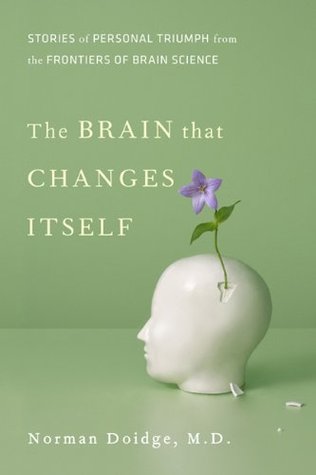
The Brain That Changes Itself: Stories of Personal Triumph from the Frontiers of Brain Science
by Norman Doidge

An astonishing new science called neuroplasticity is overthrowing the centuries-old notion that the human brain is immutable. Psychiatrist and psychoanalyst, Norman Doidge, M.D., traveled the country to meet both the brilliant scientists championing neuroplasticity and the people whose lives they've transformed people whose mental limitations or brain damage were seen as unalterable. We see a woman born with half a brain that rewired itself to work as a whole, blind people who learn to see, learning disorders cured, IQs raised, aging brains rejuvenated, stroke patients learning to speak, children with cerebral palsy learning to move with more grace, depression and anxiety disorders successfully treated, and lifelong character traits changed. Using these marvelous stories to probe mysteries of the body, emotion, love, sex, culture, and education, Dr. Doidge has written an immensely moving, inspiring book that will permanently alter the way we look at our brains, human nature, and human potential.
The Brain That Changes Itself: Stories of Personal Triumph from the Frontiers of Brain Science

Tuesday, June 20, 2017

Cell Biology

Image result for cells images
Image result for cells imagesImage result for cells images


A cell is chemical system that is able to
maintain its structure and reproduce.
Cells are the fundamental unit of life. All
living things are cells or composed of cells.

Image result for cytoplasm


The interior contents of cells is the
cytoplasm. The cytoplasm is isolated from
the surrounding environment by the
plasma membrane g y p. 
There are two fundamentally different
forms of cells.

Image result for Cells and organelles
 Prokaryotic cells - relatively simple cells -
lack nuclear membrane and many 
organelles -bacteria and their relatives are
all prokaryotic


Image result for cytoplasm
Eukaryotic cells - more complex cells - have a nucleus and many organelles - all cells of plants, animals, fungi, and protists.


Image result for cells size dimensions

Most cells are small
Prokaryotic: 1-10 µm
Eukaryotic: 10 - 100 µm
(1 µm = .001 mm)


What are the types of cells?
Blood and immune system cells
Erythrocyte (red blood cell)
Megakaryocyte (platelet precursor)
Monocyte (white blood cell )
Connective tissue macrophage (various types)
Epidermal Langerhans cell.
Osteoclast (in bone)
Dendritic cell (in lymphoid tissues)
Microglial cell (in central nervous system)

Cells and organelles.

Organelles, Macromolecules, & Atoms .

Why are cells small?
As cell size increases the volume increases much faster than the surface area. 

Cells obtain nutrients, gain information
and rid waste through their plasma 
membrane. 

As cell size increases, a cell’s ability to
exchange with its environment becomes
limited by the amount of membrane
area that is available for exchange.

Robert Hooke - 1665 - using an early
microscope viewed cork and saw many 
repeating box-like structures and called
them “cells.”

What he saw were spaces surrounded by walls that once contained living cells. Since Hooke’s first observations what is known about cells has increased greatly.

Cell Theory
• Cells are the fundamental unit of life -
nothing less than a cell is alive.
• All organisms are constructed of and by cells.
• All cells arise from preexisting cells.
Cells contain the information necessary
for their own reproduction. No new cells
are originating spontaneously on earth today.
• Cells are the functional units of life. All
biochemical processes are carried out by cells.
• Groups of cells can be organized and
function as multicellular organisms
• Cells of multicellular organisms can
become specialized in form and function
to carry out sub-processes of the multicellular
organism.

Prokaryotic cell structure
small, with a plasma membrane surrounded by a rigid cell wall
in many the cell wall is made of _____________ - a carbohydrate
cross-linked with polypeptides cell wall may be covered with a capsule made of polysaccharides few or no membrane enclosed spaces within the cytoplasm no nucleus - DNA is in a region called the nucleoid.
DNA is circular and naked (has no protein associated with it)

Bacteria often have flagella with a single protein core (flagellin)
that they can use to move in a rotary corkscrew like fashion.

The rotary motor of prokaryotic flagella is powered by proton flow
through the cell membrane.

Rotating structures are rare in nature.

Membrane enclosed spaces allow cell
functions to be compartmentalized
and isolated from other functions.
Prokaryotes lack membrane enclosed
spaces in their cytoplasm.

Some prokaryotes are photosynthetic.
The biochemical machinery for
trapping light energy is contained
within a highly folded plasma membrane.

Eukaryotic cell structure larger, with a typical plasma membrane - some with a cell wall.
Many _________________________ and
other interior spaces enclosed by membranes:
Nucleus, Endoplasmic reticulum, Golgi apparatus,
Mitochondria, Chloroplasts, Lysosomes,Vacuoles, Vesicles.
Cytoplasm with a cytoskeleton - protein tubules and fibers
cell wall found in plants (cellulose), fungi (chitin), some protists.

Cellular Organelles
Nucleus - the largest and most obvious
membrane bound compartment -
controls cell activities contains the
nucleolus - a darkened region where
ribosomal RNA is synthesized contains
chromosomes - consist of DNA
wrapped around proteins.

Nucleus is surrounded by the nuclear
envelope - a double membrane.
Nuclear membrane has nuclear pores
that control entry and exit of materials.

Chromosome - “colored body” consists of
both DNA and protein - seen as
chromosomes when highly condensed in
preparation for cell division. At other
times the DNA and protein are threadlike
and called __________.

The most common proteins are histones.
DNA is coiled around histones in a
regular pattern that produces structures
called nucleosomes.

Endoplasmic reticulum (ER) - a web-like
series of membranes within the cytoplasm
in the form of flattened sheets, sacs, tubes,
creates many membrane enclosed spaces -
spreads throughout the cytoplasm - has
connections with the outer membrane of
the nucleus and the plasma membrane 
interior space is called the ______

Functions:
-circulation and transport
-storage of proteins and minerals
-synthesis of lipids, carbohydrates, and proteins
-A large surface area for enzyme action.

Two types of ER - rough and smooth:

rough ER - studded with ribosomes site of synthesis of many proteins all ribosomes on rER are actively involved in protein synthesis -

smooth ER - site for synthesis of steroids
and other lipids Ca++ storage in muscles 
detoxification of drugs, toxins, alcohol
(especially in liver).

The highly convoluted surface provides a
large surface area for enzymatic activities.
Many enzymes are imbedded in the
membranes.

Ribosomes - protein synthetic machinery 
• two subunits - large and small - each made of protein and ribosomal RNA (rRNA)
• subunits associate when they are synthesizing proteins
• protein synthesis occurs on ribosomes that are free-floating in the
cytoplasm and on ribosomes attached to ER
• rRNA is synthesized in the nucleolus 

Golgi Apparatus -
a collection of membranes associated with
the ER composed of flatten sacs called ___
______concentrates and packages proteins
 synthesized on the ER

The Golgi is functionally associated with the ER.

Proteins synthesized on the ER are concentrated internally and transport vesicles are budded off.

Transport vesicles fuse with the Golgi, dump their contents into the Golgi.

Golgi packages proteins in vesicles so that they may be excreted from the cell, or used within the cell.

Secretory vesicles - used for excretion - leave the Golgi and move to plasma membrane where they fuse and dump their contents outside - seen in many glands.

The Golgi Apparatus also forms lysosomes.
Lysosomes - vesicles filled with digestive
enzymes - used for intracellular digestion.

Particles can be taken into cell by phagocytosis and vesicle fused
with lysosome.

The components of organelles can be
recycled after digestion by lysosomes.

Microbodies: Peroxisomes and
Glyoxisomes vesicles that form through
growth and division within the cytoplasm
Glyoxisomes are found in plants - contain
enzymes that convert fats into carbohydrates.
Peroxisomes - used for removing reactive compounds from the
cytoplasm - create H2O2 as a byproduct and degrade it with the enzyme catalase.

Mitochondria - cellular powerhouses - the site of much of the
energy harvest by cells have double membrane structure inner membrane folded into inward projections called cristae two spaces within the mitochondrion - the matrix and the intermembrane space.

Mitochondria -
• The site of oxygen consumption within cells
• Have their own DNA that is similar to prokaryotic DNA
• Have their own ribosomes that are
similar in construction to prokaryotic ribosomes
• Synthesize many, but not all, of their own proteins
• Mitochondria replicate by binary fission - similar to prokaryotic cell division

Chloroplasts - sites of photosynthesis - in
nearly all plants and some protists trap
light energy and convert it into chemical
energy have double membrane structure -
inner space is the stroma.

Within the stroma have a series of stacks
of flattened membrane structures called 
thylakoids - the stacks are called grana.
 The light energy trapping molecules of 
photosynthesis are found in the membranes of
the thylakoids.

Chloroplasts have their own DNA, similar to prokaryotic DNA.
Can synthesize many of their own proteins using prokaryote-like ribosomes'
Synthesize many, but not all, of their own proteins.
Replicate through division similar to prokaryotic cell division.
Chloroplasts can take on other functions.

____________ synthesize and store starch in roots and tubers.

____________ have pigments and give fruits ripened color.

Centrioles - are part of specialized region
of the cell called the centrosome (cell
center) found in animals and most protists.
The centrioles are involved in the 
production of microtubules.
Microtubules have many functions 
including moving chromosomes during
cell division centriole structure - 9 triplets
of microtubules surrounding a hollow core -________________similar to the basal
body of flagella

Cytoskeleton - scaffolding of proteins that
transport materials, position and move
organelles, maintain and change cell shape,
and organize enzymes into functional associations 3 components - actin filaments, microtubules, and intermediate filaments.

All are polymers of smaller protein subunits - lengthen through addition of polymer subunits, shorten through
actin filaments - involved in cell movements and in membrane
deformations - smallest components of the cytoskeleton.

microtubules - hollow tubes made of
proteins called tubulins responsible for cell
movements and movements of organelles
within the cytoplasm, movement of
chromosomes during cell division -
largest components of the cytoskeleton.

intermediate filaments- 8 stranded protein fibers - play a role in
cell structure, anchoring organelles and in transport of materials within the cytoplasm anchor neighboring cells to each other in tissues.

Flagella and Cilia - cellular appendages can propel cells or propel materials over the cell surface cells that have flagella have few (usually 1 or 2) cells that have cilia have many - covering the surface flagella move with whip-like movements to propel the cell
cilia have a more regular stroke and groups of cilia appear to
move in unison, resulting in a wave-like motion flagella 5 to 20x longer than cilia

Structure has basal body with 9 + 0 structure of microtubules
flagellum is membrane bound with pairs of microtubules in a 9+2
pattern.

Each pair of tubules has short arms of another protein - dynein -
that extend to neighboring tubules movement of the flagellum is produced by sliding of the microtubule pairs 

Plant Cells have, in addition to the collection of organelles found
in other groups, a central vacuole for storage and for producing
________ pressure inside the the cell.

The central vacuole is usually filled with water and solutes. A high solute concentration draws water into the vacuole, expanding the vacuole and the cell.

Because plant cells are enclosed by a cell
wall, the expansion of the vacuole can 
exert pressure on the cell without causing
the cell to burst.

Plants have cell walls made of cellulose.

During cell division plant cells build
dividing walls between the two new
cells called the cell plate. An adhesive
layer - the middle lamella - is laid down
between the new cell walls.

Cell walls can be thickened through the
addition of materials to the inside of the
primary cell wall.

Where did Eukaryotic Cells come from?
The oldest rocks with evidence of fossil
cells date to 3.5 billion years. The oldest
rocks with cells large and complex enough
to be eukaryotic date to 1.0 billion years.
For 2.5 billion years only prokaryotic cells
existed on earth.
The best hypothesis for the origin of
eukaryotic cells was proposed by Lynn
Margulis in the early 1970s. This
hypothes is now called the ___________
 ___________. 

Eukaryotic cells appear to be the product
of a collaboration among different types
of prokaryotic cells. Some prokaryotic
cells became the host for other prokaryotic
cells that lived inside them. Some of the 
complex organelles of eukaryotes provide
evidence for this theory.

Mitochondria and chloroplasts appear to
be the direct descendants of energy
producing bacteria. Mitochondria are the
descendants of bacteria that were capable
of oxidative respiration.

Chloroplasts are the descendants of
photosynthetic bacteria.

Evidence:
Both have their own DNA and ribosomes
that are similar to those found in
prokaryotes. Both make many of their
own proteins and both multiply in a
fashion similar to prokaryotic cell division.
Both are double membrane organelles -
the inner membrane descended from the
ancestral guest cell, and the outer
membrane descended from the vacuole
membrane that was formed around the
guest.
Other organelles may also be the product
of endosymbiosis.
Some centrioles and basal bodies have
naked DNA as part of their structure.
There are many modern examples of
endosymbiosis involving organisms that
can live together or live independently.
The same was probably true of the
ancestors of endosymbiotic organelles
in the distant past.