Showing posts with label meditation. Show all posts

Thursday, July 13, 2017

Guided Imagery for Health and Life Success

Try five minutes of guided imagery meditation technique.

Don’t let your mind-body connection lie dormant, but tap into its healing powers! Guided imagery calls upon your mental faculties (visualization and imagination) and your physical senses (taste, sound, smell, touch, sight) to activate relaxation and healing, and to promote stress-free, successful living. Studies have shown its impact on lowering cholesterol, blood sugar, and high blood pressure…alleviating pain and headaches…mitigating stress and anxiety…stimulating creativity and learning…and promoting weight loss and healing.

How Guided Imagery Works
Image result for garden meadow
You can use guided imagery to promote relaxation by envisioning a peaceful place. Everyone’s sanctuary is different, so get in touch with what soothes you best—is it a garden meadow, a beach, or a mountaintop? Relaxing with guided imagery helps to accelerate healing, learning, and creativity…and to still turbulent emotions or nervousness.
Image result for a beach
You can use guided imagery to enhance your goals, whether it’s to lose weight or to quit smoking. As a right-brained activity, guided imagery accesses your emotions, laughter, musical sensitivities, abstract thinking, intuition, and empathy, and unlocks subconscious desires that bring your goals front and center, giving you the propulsion needed to succeed.

Image result for mountaintop

You can use guided imagery to activate the healing processes in your body. Visualize your immune cells wiping out cancerous cells in your body…or imagine that the inflammation that’s causing your chronic pain is dissolving.

Image result for garden meadow

How to Practice Guided Imagery

Find a quiet, comfy spot free from distraction where you can take five minutes to unplug.

Image result for a beach

Set an intention for your guided imagery session. If it’s to heal, then focus on the specific area that needs the TLC. Imagery is specific and unique, so be creative with the images that work for you. Whether you’re bathing you body in healing golden light, or envisioning immune system soldiers attacking toxins and foreign particles, take your time and really color in the visuals with details. Involve your senses and try to feel physically what you are imagining mentally.

Image result for mountaintop

It is natural for distracting thoughts to butt in. Acknowledge them, and let them pass. Do not dwell or try to analyze the thought; instead, pull yourself back to the imagery.

Image result for a beach

Using music—also a personal preference—can help you stay focused and can enhance the imagery.

Image result for garden meadow


Don’t bounce back to life too quickly after your guided imagery session. Allow your mind and body to stay connected and ease back into the grind.


Image result for mountaintop

Image result for a beach

Image result for garden meadow

Friday, June 30, 2017

Heal Your Mind, Rewire Your Brain

Free first page

download Heal Your Mind, Rewire Your Brain : Applying the Exciting New Science of Brain Synchrony for Creativity, Peace and Presence book
Heal Your Mind, Rewire Your Brain: Applying the Exciting New Science of Brain Synchrony for Creativity, Peace and Presence Paperback – July 15, 2010,by Patt Lind-Kyle  (Author)

LOOK INSIDE CLICK HERE GET TO READ PAGES 27 - 32.

"Understanding how your mind can heal your brain."

Hope for brain injury.

What is "brain?"
-Chemicals and electrical signals in that lump of
meat that sits in our skulls.
-A part of the nervous system that is distributed
throughout the body.

What is "Mind?"
An embodied relational process that regulates the flow of information and energy. -Dan Seigel

Mindfulness is the mind's ability to be gently aware of this process.

Two key ways the mind can help the brain rewire:
Neuroplasticity

Neurogenesis

What is neuroplasticity?
"Neuro" Greek for nervous system "Plasticity" means plastic or malleable (like clay, it can be shaped).
Thus neuroplasticity is having a malleable nervous system (brain) - for better or worse (eg. kindling vs the dalai lama).

What is neurogenesis?
"Neuro" = Brain/Nervous system
"Genesis" = to be born
Neurogenesis is the birth of new brain cells.

Yes it's possible!

What is Reptilian Brain?
Image result for reptilian brain

Image result for reptilian brain

Image result for reptilian brain


Image result for reptilian brain

Image result for reptilian brain

What is the job of the reptilian brain?
"The reptilian brain was the first part of the 
modern brain to develop in evolution. It 
operates behind the scenes, regulating our 
survival needs: food, oxygen, heart rate, 
blood pressure and reproduction, among 
many others.
The brainstem is like a bodyguard who's always
watching your back, constantly scanning the
environment for potential threats. The reptilian
brain also decides whether you will move into 
fight or flight."

What is the limbic brain?
The emotional brain or the "seat of the
unconscious" holds the amygdala and the
hippocampus.
The amygdala (size and shape of an almond)
can often be overactive in MTBI and PTSD. It
plays a role in emotional learning as well as
procedural memory.

The Hippocampus
The hippocampus regulates cortisol, a hormone
that is elevated by stress and fear/anxiety.
Too much stress leads to imbalances in cortisol
that can be related to the shrinking or lessoning
of the hippocampus (atrophy).

The Unhappy Hippocampus and the
Overactive Amygdala
The hippocampus is responsible for memory to
have a sense of past, present and future.
It is the seat of declarative/explicit memory
(factual information).
It is important in filtering what information is
important and what is irrelevant.

Image result for brain mirror view brain waves

Image result for brain mirror view brain waves

Image result for brain mirror view brain waves


The Hippocampus and Neurogenesis
 We once thought that the brain cells one is
born with were all that you had to work with and
that they died off as one aged.

By tagging thymadine with a dye we have
discovered that the hippocampus is where new
brain cells are first born.

Even in 90 years olds and even with brain
injury.


The Power of the Mind
By using our mind (spirit/will) to
effort calming ourselves the new
cells born in the hippocamus can
help the brain forge new pathways
(neuroplasticity).

How to help new cells not do the
same old thing.

One way in which the mind can help heal the
brain can be found in developing a strong skill
set of mindful based tools.

Mindfulness is one powerful way to help the
brain (part of the nervous system) to regulate
cortisol levels and achieve homeostasis.

The Mindful Brain: A Key
Having mastery over ways to be calm is one
way to help new brain cells being born in the
hippocampus not be drenched in cortisol so
that they do the same ole thing.

Mindfulness is a key to reverse atrophy in the
hippocampus so it can be robust and an ally.

Mindfulness assists the emotional
brain in regulating.

A happy hippocampus:
-helps with working memory,
-differentiation between the past and present
-filtering important vs ineffective information
-keeps the amygdala from going bonkers
-constructs a resilient narrative

How to develop a mind that can help
heal the brain:

1. Research shows changes in the brain after
ten hours of focusing on the breath in short
sittings (fifteen minutes).

2. Being successful does not require being
focused. Rewiring happens each time we bring
the wandering mind back to the breath.

PT for the brain!

When your mind wanders come back
to the breath.

Inhale 1 2 3 4 5
Exhale 1 2 3 4 5

Being with the Breath
Inhale (count), hold, exhale (count). 

Don't feel defeated every time you
catch your mind wandering.

That's the important part. When you catch
yourself and come BACK to the breath you
strengthen the brain muscle.

Brain muscle?

Mindfulness exercises help strengthen muscles
for positive neuroplasticity like the insula which
is part of the prefrontal cortex.

The dalai lama has Arnold Shwartzeneger
muscles in the insula.

The neocortex embraces the
emotional and reptilian brain.

When the limbic brain is flooded then the
neocortex cannot be accessed.

When this happens guess what we lose?

Executive function.

Executive Function tasks include:

Planning
Working Memory
Attention
Problem Solving
Verbal Reasoning
Inhibition
Mental Flexibility
Task Switching

Executive function is sometimes
called a non-cognitive skill.

This is because emotional regulation (noncognitive
skill) is the balance between a happy
hippocampus and a hearty prefrontal cortex.

Multiple variables that can make
executive function difficult to use.

1. Developmental obstacles (eg SES factors)
2. Attachment (e.g. caregivers with depression,
substance abuse, a hx of trauma)
3. PTSD/dissociation
4. MTBI/TBI

These are all ways the brain can be injured

Indeed MTBI and PTSD symptoms
are often the same.

Common examples of PTSD include:
AVOIDANCE
-Avoiding things that bring up memory such as
movies or tv that have images that remind you
of something
-Avoiding peole with red beards or hamburger
joints if something distressing happened. 

The dark side of neuroplasticity

The limbic system can kindle. Or one fear
based or avoidant thought re-enforces another.

This can lead to isolation because men with red
beards and hamburger joints can lead to
avoiding all men with facial hair and all public
eatery.

Thus fear and anger can wire our brains in a
way that is a disservice to our well being.

Thankfully our mind does not only exist in the
brain but just as much in the heart.

And there is a lot of of science to this statement
specific to the vagal nerve and to
neuropeptides such as oxytocin and
vassopresin but let me cut to the chase.

The Heart is an Intelligence
Processing Center

It's electromagnetic field is measured at five
times greater then that of the brain!

http://www.youtube.com/watch?
v=1XqPhoRKPWw

One amazing tool of mindfulness practice is
cultivating heart intelligence.

For example, the heart may have a habit of
racing when introduced to a stressor. (Low
heart rate variance [HRV]).

By working with the breath and slowing down a
frantic brain the heart's intelligence can be
accessed (High HRV).

Mindfulness repatterns the heart.

Research finds the more steady and even your
attention can make the heart the more willpower
rather then impulsivity can guide your
life.

Will power is intrinisic to agency (person-hood),
volition (choice). These "non-cognitive skills"
are at the "heart" of executive function.

The Reflective Self

Becoming heart centered means we are able to
feel with others in a way science calls "Flow"
that is at the heart of healthy relationships.

The mind is responsbile for flow. The brain and
heart are the minds "helpers."

Lovingkindness

Another major way the mind can
heal the brain with the heart's help is
through a practice called loving
kindness.

What is lovingkindness?

Lovingkindness is a practice in which we wish
others and ourselves well being. Practiced by
the dalai lama.

You don't have to be the dalai lama
to know this kind of happiness.

Research (Richard Davidson) shows that eight
minutes a day of loving kindness practice
rewires the brain.

Let's practice together now.

Sharing my experience of rewiring

I was first introduced to the ways the mind can
heal the brain through a neuro-scientist named
Dr. Jeffrey Schwartz. Dr. Schwartz discovered,
with brain imaging, the ways in which 21 days
of mindfulness based behavioral therapy and
his own process called "The Four Steps" could
rewire the brain.

The seed was planted

I was so impacted by Dr. Schwartz I gave up a
successful career in the film industry to study
psychology, particularly the field of trauma.

Thus I came into my experience with
a deep certainty that I was not stuck.

This is the first step to share with you:
To believe in your own potential to transform
and to perservere in trying and trying and
trying.

Here are are some keys tools that helped me
rewire.

Somatic Experiencing

Created by Peter Levine, this is a form of
therapy that helps the nervous system calm
and heal. It is not talk therapy. It is a subtle
and powerful tool.

The person I worked with:

There are different styles and ways to offer S.E.
My experience was lying on a massage table
and being well nurtured by someone named
Sally Thomas, an OT who was trained in a four
year program by Peter Levine. I asked Sally to
be available today so that, if you are interested
you can connect with her. Sally, will you stand
up?

Neurofeedback

Neurofeedback is a kind of therapy in which
electrodes are put on your head. They do not
stimulate you, they read your brainwaves.

Then you listen to tones and watch a computer
screen for feedback This feedback teaches
your brain when it's in it's optimal zone. 

The qEEG controversy.

There are lots of ways to do neurofeedback but
if you have TBI you know your brain is not
typical. Thus it is important to take great care
before you start altering the electromagnetic
field of your brain.

It's important to have your brain
imaged with a qEEG.

Although many wonderful programs exist that
are automatic, when using neurofeedback with
TBI, though it is an expense, it is not safe or
wise to work with a practitioner who is not
reviewing your qEEG and tailoring treatment to
your own unique brain's needs.

Crystal Bowl Meditation

I also utilzyed a form of sound therapy in which
someone played large bowls for one hour each
week to help me repattern my nervous system.
Crystal bowls are not just sound therapy.
Being lined with crushed quartz they have a
strong electromagnetic vibration. Not for the
faint of heart but very powerful.

Crystal Bowl Resource

I asked Kelly Maccinnis to be here today so
that you can find him as a resource.

Kelly plays weekly at Om Time and Body
Dynamics. He has a table out in the resource
area.

So, as we conclude let's revisit
where we began.

We began by taking a moment to connect with
one another. We then talked about the ways
the brain can wire/connect in new and
constructive ways you can direct with your
mind.
Revisiting Mind

Mind REGULATES information and energy.
This is a Relational Embodied Process. -Dan Siegel

MINDFULNESS

By following the guidelines of mindfulness practice (slowing down, focusing on the breath), the brain can learn to make new
CONNECTIONS.

LOVING KINDNESS

By becoming heart centered we get out of our
miserable egos and learn how to be more fully
and vitally connected to the world around us.

Having a "broken brain" does not
mean having a diminished heart.

If anything, those who have been through the
hardship of TBI have a much bigger and more
generous heart.

Loving kindness helps us CONNECT to the
world around us in constructive and meaningful
ways.

As you can see, it is all about
CONNECTION.

Suffering comes from a sense of isolation.

As we conclude, look around you. Think back
to the beginning of this presentation when you
connected with a neighbor.

As you go into your day, connect with one
another with a generous spirit. See what new
connections might be possible.

Yes, you can teach your old brain new tricks! Breakthroughs in the scientific understanding of how the brain works have shown us that our brains are constantly rewiring themselves in response to events in our lives. This handbook applies this new science in practical ways, by giving us a training program to re-pattern our behavior and thereby change the ways our brain is wired. It interrupts our suffering, sharpens our mental abilities and corrects our cognitive imbalances. As we learn these mental skills, the neural patterns of our brains begin to change and we literally reprogram the neural networks through which information and energy flows. If you've heard about neuroplasticity, epigenetics, psychoneuroimmunology and other scientific advances, but didn't know how you could apply these breakthroughs to improve your life, you will find Heal Your Mind, Rewire Your Brain a treasure trove of resources. It provides a clear, step-by-step program that shows you how to correct the imbalances of the stressed-out brain, and install a peaceful state of mind.

Heal Your Mind, Rewire Your Brain: Applying the
Exciting New Science of Brain Synchrony for
Creativity, Peace and Presence
Author: Patt Lind-Kyle
Publisher: Energy Psychology Press
ISBN: 978-1-60415-056-8

The Brain : Is there a more fascinating and complex organ in the body? Often studied and just as often misunderstood, science, medicine and psychology have made great strides in the study of the brain.

Author Patt Lind-Kyle offers the reader a fascinating and indepth look at the last decade of the scientific breakthroughs in brain studies. The reader is given a better understanding of how the brain works and how it is constantly evolving. New studies have shown that by using mental training practices, we can transform our life and increase our emotional balance and wellbeing.

The first part of the book serves as a strong starting point to understanding the human brain, how it developed and how it affects all aspects of our lives. Part two teaches the reader meditations and tools to deal with challenges and changes. You will get a thorough understanding of brain wave patterns, the key neurotransmitter chemicals and the various brain centers.


The author has presented this work in an engaging and well organized style. Written with the layperson, student and professional in mind, it will be of tremendous aid to understanding how to help your mind work for you, your needs and areas you may feel weak in. Anyone with an interest in how our brain works and how thought processes can change our lives will thoroughly enjoy this book, and find a vast amount of new knowledge.

Author Lind-Kyle takes the reader on an extensive neuro-anatomy expedition; introduces Enneagram personality typing, and some eastern thought, before getting into the actual meditation exercises she recommends to alter brain wave function. Carefully omitting the word yoga, Lind-Kyle explains the physiology of meditation by exploring its chemical and physical substrates. The last third of the book explores the meditation exercises that Lind-Kyle recommends for balancing brain patterns based on her work with meditation techniques and the electroencephalograph. The author recommends the methods to reduce stress, alter obsessive thoughts and correct personality anomalies.
The scientifically minded will be annoyed at her continued use of the word evolution both as a word to describe the true Darwinian “survival of the fittest” and the chemical changes that take place in the individual human brain as a result of learning. They will also be put off by Lind-Kyle’s reference to DNA and genes as separate units of heredity. However, anyone truly interested in neuroplasticity and meditation will be fascinated by the effort to bring healing and change to the average person.


Easy to understand, explains evolution, function, and patterns of different areas of the brain, neurotransmitters' impact on behavior, electro-chemical processes, and the mind-brain relationship. "The mind is what the brain does." Still reading . 

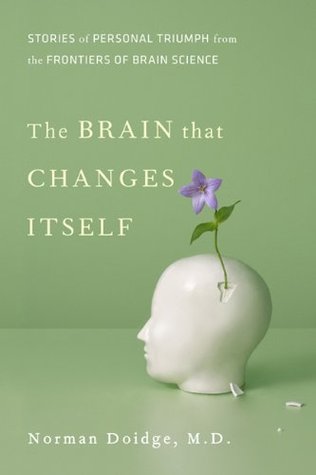
The Brain That Changes Itself: Stories of Personal Triumph from the Frontiers of Brain Science
by Norman Doidge

An astonishing new science called neuroplasticity is overthrowing the centuries-old notion that the human brain is immutable. Psychiatrist and psychoanalyst, Norman Doidge, M.D., traveled the country to meet both the brilliant scientists championing neuroplasticity and the people whose lives they've transformed people whose mental limitations or brain damage were seen as unalterable. We see a woman born with half a brain that rewired itself to work as a whole, blind people who learn to see, learning disorders cured, IQs raised, aging brains rejuvenated, stroke patients learning to speak, children with cerebral palsy learning to move with more grace, depression and anxiety disorders successfully treated, and lifelong character traits changed. Using these marvelous stories to probe mysteries of the body, emotion, love, sex, culture, and education, Dr. Doidge has written an immensely moving, inspiring book that will permanently alter the way we look at our brains, human nature, and human potential.
The Brain That Changes Itself: Stories of Personal Triumph from the Frontiers of Brain Science

Tuesday, January 3, 2017

Here Are My Keys To Success

MY KEYS TO SUCCESS, for you. Day in, Day out.

1.First, Power Pack Your Morning. get Up Early.

2. Second, Prioritize Your Health. You need to exercise, Drink Your Water, Do Stretching. 

3. Third, TAKE TIME FOR FOR GRATITUDE, MEDITATION, AND PRAYER.

4. Fourth, Work Hard. Nobody say you got a short day or an easy day. 

5. Fifth, WORK SMART AND GET ORGANISED. Have a routine, do things in batches and be focused. Have systems and processes.  

6. Lastly, FIND WHAT WORKS FOR YOU. 

4 Powerful Ways To Reprogram Your Subconscious Mind to ASPIRE TO GREA

4 Powerful Ways To Reprogram Your Subconscious Mind to ASPIRE TO GREATNESS !!!


It’s the evening before your 7-day Caribbean
cruise to Antigua. As you pack your suitcase, you
are filled with anticipation of all the fun and 
adventurous things you and your six friends will
do while cruising on the ship and indulging in 
the sights and activities on the Antiguan Island.

Beep, beep, beep…the alarm reads 5:00 AM. You
jump excitedly out of bed and shower and dress 
within record time. Screeching outside your doors
are the tires of the yellow cab destined to the 
airport. As the driver zips and whizzes through 
traffic, you conference in the group to ensure
everyone is en route to the airport.

Seven hours after the ship sets sail, you and your
friends sense something has gone awry as you 
watch the staff move in a hurried fashion on the
upper and lower decks. On your way to the rest-
room you overhear a crewman saying to another,
“Can you believe the ship is off course? They 
better hurry and reprogram the system so the
ship can get back on course.” Like the ship,
many of you are off course. Why? Because of 
the faulty programming in your subconscious
mind. Before you get offended, we all have 
faulty programming. To get to the place you 
desire to be in life, you must reprogram your 
subconscious mind for success!

“You are like a captain navigating a ship. He 
must give the right orders, and 
likewise, you must give the right orders
(thoughts and images) to your 
subconscious mind which 
controls and governs all your experiences.” ~ Dr. Joseph Murphy

So, what is the subconscious mind?

The subconscious is the part of your mind that is
not immediately accessible by your conscious 
mind; it functions below your normal level of 
waking consciousness. Envision your sub-cons
-cious as a huge filing cabinet that stores files 
such as: every wonderful and traumatic 
experience you have ever had, habits, skills, and
every visual image you have ever seen. In 
contrast, the conscious part of your mind is 
responsible for logic, generating thoughts, being
proactive and deciding which path to take. In 
your conscious mind, all of these functions are 
completely under your control, unlike your sub-
conscious mind. The conscious mind makes 
decisions and gives orders to the subconscious 
mind. Therefore, the subconscious will carry out
the directive based on what is programmed, not
necessarily what you are requesting. Yes…
know, it sounds a bit scary….keep reading.

Your subconscious mind carries out the instruc-
tions of your conscious mind without questioning. 
Within your subconscious lies all your beliefs 
(including limited beliefs) and habits (what you 
do every day). Our beliefs and habits control our
everyday life. Were you aware that 88% of your
mind is comprised of the subconscious, which 
you do not actively control? On a daily basis you
only use 12% of your conscious mind. Therefore,
your subconscious mind is at the helm; it’s 
running the ship–you.

Is your ship on course?

Are you sailing in the right direction?

Is your subconscious mind programmed to help
you achieve success in every area of your life?

How to Reprogram Your Subconscious Mind

There are several ways to reprogram the sub-cons
-cious mind. We will explore four powerful and 
effective strategies within this article. These 
strategies are affirmationsvisualization
meditation and positive self-talkLimited 
beliefs and negative habits can be reprogrammed
by using affirmations. The subconscious mind 
learns through repetition. An affirmation is
definitive statement asserting
that something exists or is true. Every 
belief and habit you possess was formed through
repetitionand we can implant new ones the 
same way. The first step toward implanting new
beliefs and developing new habits is to know 
exactly what you really want to have, do and be. 
So, let’s explore affirmations!

Strategy 1: Affirmations

Affirmations are an effective way to plant positive
messages into your subconscious. It is one of the
most effective ways to change a limited or 
negative belief. You must be careful of what you
affirm as it becomes a self-fulfilling prophecy. If 
you continuously say “this is never going 
to work,” then it is highly probable that things 
never will.

Repetition of an affirmation changes the neural
pathways in your brain over time to produce the 
new belief. Dr. Mona Lisa Schulz, MD, PhD, a 
practicing neuro-psychiatrist and associate 
professor of psychiatry at the University of 
Vermont School of Medicine says, “We can 
rewire the patterns in our brain 
with cognitive behavioral therapy or 
affirmations. Affirmations change the way 
our brains are wired and the brain lights up
differently.”

Here are some examples of affirmations:

1. I am a genius and use my mind, talents, gifts
and abilities to produce wealth.

2. I am living a life of divine purpose and destiny.

3. I am emotionally, mentally and psychologically
 sound.

4. I am focused and driven to create the life I 
want and deserve the best in life.

5. I am a money magnet; money flows to me.

Strategy 2: Visualization

Visualization is a technique that involves focus-
ing on positive mental images in 
order to achieve a particular 
goal. It is the ability to vividly imagine something
—to “see” it in the mind’s eye—before it exists in
any physical reality. Steve Jobs had a clear 
mental image of what the iPhone would look like 
and its functions and features before he and his 
team began to design and build it. Visual images 
have a huge impact on your brain, both 
consciously and subconsciously. Consequently, 
visualization is a great way to program/reprogram 
your subconscious mind.

{Note: Visualization does not guarantee success.
It also does not replace hard work and practice. 
But when combined with diligent effort (and, I 
would add, a strong support network), it is a 
powerful way to achieve positive, behavioral 
change and create the life you desire.}

Here’s a powerful example of visualization in motion:

Dr. Lee Pulos, a Sports Psychologist, Olympic 
Team Trainer, and the author of “The Power 
of Visualization,” describes an experiment 
the Soviets did with their 1980 Olympic Team 
and its highly skilled, world-class athletes.The 
athletes were divided into four groups using 
varying degrees of physical and visualization 
exercises. Below is a chart illustrating the 
methods used. ( Click here For further learning
on Power Of  Visualization)

Groups [% of Method Used]
(Physical Practice) {Visualization}
Group A (100%) {0%}
Group B (75%) {25%}
Group C (50%) {50%}
Group D (25%) {75%}

So which team do you think won? At the end of the
Moscow Olympics and the Lake Placid Olympics,
Group D had won the most medals. There are 
countless other examples.
VISUALIZATION WORKS!

Strategy 3: Meditation

Meditation plays a vital role in reprogramming the
subconscious mind, because it helps to still the 
mind. In this state, your brain becomes more 
receptive; it becomes fertile ground for whatever
you want to “implant” into the mind. Your 
conscious mind engages in the activities of writing
powerful goals, creating a vision state, and develo
-ping affirmations. To have those seeds take root 
and flourish into reality, we have to get those 
words and images soaked deep into our sub-cons
-cious mind. Placing yourself in a meditative state
is an excellent way to help that process. Regular
meditation trains your mind to hold its focus 
without getting distracted. Over time, meditation
helps you to become laser focused.

Strategy 4: Positive Self-Talk

Several years ago, I read a powerful book, titled
"What to Say When You Talk To Yourself,
by Shad Helmstetter about the power of the 
mind and using positive self-talk as a tool to
reprogram the subconscious mind.

On a daily basis, we spend more time talking to
ourselves than any other person. Whether it’s a
verbal tirade, an analytical discussion or the 
incessant chatter that takes place within our 
mind. Our self-talk dictates our mood, behavior
and guides our choices and decisions. Perhaps
the most powerful influence on your attitude and
emotions is what you say to yourself, and believe.
As I always say, “It is not what happens
to you that really matters, but what you say 
to yourself about what happened.” 
Your response to the event or situation is what 
determines your thoughts and feelings and 
ultimately, your actions. By effectively managing
your self-talk, you can begin to live your life on 
a higher level and create the life you truly want 
and deserve.

Your subconscious mind will believe whatever 
you tell it most. Therefore, you must spend time
each day intentionally speaking positive self-talk
to yourself. It is only through repetition that your
subconscious mind will adopt its new 
programming.Then and only then, will you begin
to change the autopilot of your mind to think 
these new thoughts automatically.

So, how can reprogramming your subconscious 
mind help you to ASPIRE TO GREATNESS? 
Well, I am so glad you asked . Here’s the quick 
answer, “EVERYTHING.” Everything begins and
ends in your mind. If you want to LIVE…DO…BE on 
a higher level, you must cultivate a mindset that 
will support that. So, let’s start reprogramming 
our subconscious mind for success!

Based on what you have read today, please review
the four strategies and share in the comments 
section below, what you WILL commit to do with
-in the next 24 hours to help you ASPIRE TO 
GREATNESS! Come on now…no procrastination.

Procrastination is for losers and you are a winner .

Thank you for sharing and have a FANSPIRING day my friend.

Always Aspiring,

Your Sister and Friend


Rosalynd