Showing posts with label knee. Show all posts

Tuesday, October 10, 2017

Anatomy of the Lower Limbs

Image result for The skeletal structure displaying various pathologies.

The skeletal structure displaying various pathologies. 

The function of all of the muscles in the lower limb originating below the knee is to move the foot. These muscles insert on any one or several of the 26 bones of the foot. 

Bones of the Foot
 The 26 bones of the foot, separated into the three main sections of the foot: Forefoot, Midfoot, Hindfoot, is summarized below: 

Image result for bones of the right foot

(From toes to heel) ⇧
Bones of the Right Foot
Distal Phalanges
Middle Phalanges
Proximal Phalanges

1st Metatarsal
2nd Metatarsal
3rd Metatarsal
4th Metatarsal
5th Metatarsal

Medial Cuneiform
Middle Cuneiform
Lateral Cuneiform
Navicular
Cuboid

CALCANEOCUBOID JOINT
TALONAVICULAR JOINT
Combined articulations make up 
the MIDTARSAL JOINT

Talus

Calcaneus


Related image

Image result for bones of the right foot lateral view

⇧Bones of Right Foot (Lateral View)

Joints of the Foot
Image result for forefoot

The forefoot.
 The forefoot consists of five metatarsals starting with the first to the fifth; and five toes, each of which consists of three bones (except for the big toe which consists of two). The bones of
each toe are the proximal phalanx, the middle phalanx, and the distal phalanx (except the big toe which has only proximal and distal). Between each of these bones is a joint which allows for the
movement necessary of each section of the foot.
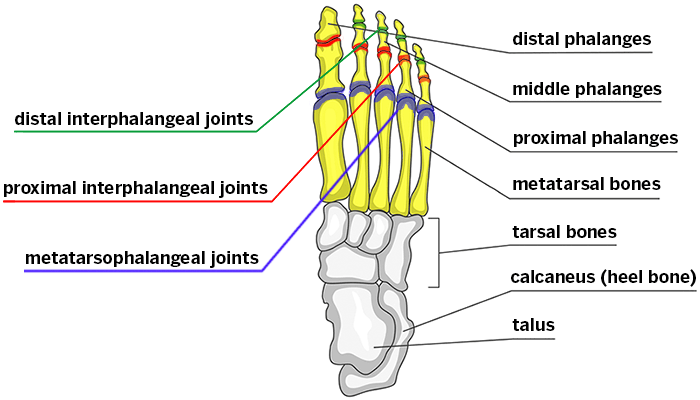
Image result for forefoot

The joints of the forefoot are:
1. MTP joint - metatarsal phalangeal joint - between the metatarsal and the  proximal phalanx of the adjacent toe.

2. PIP joint - proximal interphalangeal joint - between the proximal phalanx and the middle phalanx of each toe.

3. DIP joint - distal interphalangeal joint - between the middle phalanx and the distal phalanx of each toe.

4. The big (“great”) toe has only one joint between its two phalanges and therefore this joint is called the great (or “big” ) toe interphalangeal  joint.

Metatarsal head is the end of the metatarsals, which articulate with the joints of the adjacent bones (generally used to describe the distal metatarsal head, the portion that articulates with the proximal
phalanx of the adjacent toe.)

Image result for Midfoot

Image result for forefoot

The midfoot:
The Midfoot consists of five bones with numerous articular surfaces (surfaces which articulate by
way of joints with other bones).
 1. navicular
 2. cuboid
3. three cuneiform bones: medial, middle and lateral
Distally, the fourth and fifth metatarsals articulate with the cuboid bone. The first, second and third metatarsals articulate with each of their respective cuneiform bones. Each of these has an
individual joint capsule but all are wrapped in one big capsule as well to form the tarso-metatarsal joint (the “Lis Franc joint”).

Image result for Midfoot

Image result for Midfoot

Proximally, the talonavicular and calcaneocuboid joints, together form the combined articulations of the midtarsal joint (of “Chopart”).

Image result for Hindfoot
The Hindfoot
The tibia articulates with the dome of the talus and thereby transmits the forces of the leg to the ankle. This is commonly called the “Tibialtalar joint” or simply the “Ankle joint”. In turn, the
talus articulates with the calcaneus, the main weight-bearing (and the largest) bone of the foot by way of the subtalar joint.

Image result for Hindfoot

The subtalar joint, known as the “agility joint”, is a key joint in the ankle. It has three surfaces of articulation with three separate facet joints. A great deal of the movement in the ankle happens in this joint - the rest of the movement happens at the tibialtalar joint.

The plantar fascia is an important stabilizer in the foot where a great deal of foot pathology begins. The plantar fascia originates from the plantar surface of the calcaneus and attaches to the plantar
surfaces of the five metatarsal heads and proximal phalanges of the toes. The plantar fascia acts as a major stabilizer of the foot (see diagram). It helps maintain the arch of the foot and is an antipronator. In its function of maintaining the congruity of the relationship between the calcaneus and the metatarsal heads, it resists the torsion movement of the forefoot in relation to the hindfoot during pronation. Most of the eversion of pronation occurs in the mid and forefoot while the calcaneus remains stable in the hindfoot. 

http://www.wefixfeet.ca/sites/default/files/anatomyofthefoot.pdf

Wednesday, January 11, 2017

312 Meridian Exercise

312 Meridian Exercise

312 Meridian Exercise was developed by Professor Zhu Zongxiang based on the principles of the meridian system.

3 refers to massaging three acupoints of hegu on the hand neiguan on the wrist and zusanli on the knee.

1 refers to abdominal breathing, actually a form of simplified qigong (breathing exercise), through which Zhu believed could exercise the meridians in the abdomen area being closely related with chronic diseases.

2 refers to the physical exercise of both legs. Zhu believed the most simple and effective exercise is squatting down and standing up.

Profesor Zhu Zongxiang


91 year old (2014) Zhu Zongxiang has the vigor and vitality of man half his age. In a few old and shabby rooms situated near a group of ancient buildings in Beijing, the old doctor has stubbornly persisted in learning more about the meridians of acupuncture for more than 30 years. He often said he was a traitor to Western medicine.

Since the 1950s, he had been teaching physiology, a basic medical subject, in Peking Union Medical College Hospital. However, a decision in 1973 changed his life.

That year, he was inspired by Premier Zhou Enlai's appeal to Chinese medical experts to make clear the theory of acupuncture. Zhou's call for action followed US President Richard Nixon's visit to China in 1972.

Zhu joined the acupuncture meridian research group of the Institute of Biophysics under Chinese Academy of Sciences.

Meridian points were discovered in China 2,500 years ago. In Huang Di Nei Jing (The Medical Classic of the Yellow Emperor), one of the most important ancient medical classics, the meridians were recorded to have the function of "promoting circulation of Xueqi (Blood and Qi) and balancing yin and yang" and "determining life and death and treating hundred diseases."

The meridians were discovered to be a general controlling system for the human body and had the function of preventing diseases and promoting health and longevity. Today, TCM doctors still insert acupuncture needles into the acupoints along the meridians to treat diseases.

However, the existence of the meridians has always been questioned by Western medicine.

To justify the theory, doctor Zhu and his colleagues had spent more than 10 years to experiment with modern methods to demonstrate its biophysical existence.

In the 1980s, the researchers successfully showed the 14 meridians in human body through biophysical methods, which are surprisingly identical to that recorded in ancient classical meridian graph.

For visitors suspicious towards his research, doctor Zhu would proudly demonstrate his two proof tests to them.

He used a mallet to tap different areas on the elbow until the patient heard a loud sound measured through a device similar to the stethoscope. Zhu then marked a red spot at that point.

A line of the red spots determined by the same method is actually showing the position of a meridian, according to Zhu.

He would then place two electrodes of a current meter on the line and stimulation of the current could be felt. When one electrode was placed off the line, one would feel nothing. It showed that the meridian line had the lowest electric impedance, according to Zhu.

Even after Zhu published his breakthrough findings, the scientific world still did not change their skeptical attitude. And the debate on meridians is ongoing and interpretations of the phenomenon vary among scientists.

In ancient times, meridians was a philosophical concept invented by ancient Chinese doctors to summarize the general functions of the human body, according to Wu Gencheng, director of Institute of Acupuncture Research, Shanghai Medical College of Fudan University. The institute had been researching acupuncture for decades.

"We believe that the meridians' functions are closely related with the nerves, but it is impossible in modern science to find the material equivalent to the meridians described in the ancient time. It is hard to imagine a new passage way in the human body," said Wu.

In a further blow to Zhu's efforts, the Institute stopped funding their research.

Zhu did not give up and established Beijing Yanhuang Meridian Center to design the meridian based exercise to promote people's health and longevity. Zhu calls it the "3-1-2" method.

According to Zhu, 3 refers to massaging three acupoints of hegu on the hand neiguan on the wrist and zusanli on the knee.

1 refers to abdominal breathing, actually a form of simplified qigong (breathing exercise), through which Zhu believed could exercise the meridians in the abdomen area being closely related with chronic diseases.

2 refers to the physical exercise of both legs. Zhu believed the most simple and effective exercise is squatting down and standing up.

"Physical exercise will involve the excitation of all the meridians spreading in the whole body," he explained.

In fact, in Zhu's views, the health benefits of all kinds of physical exercise are actually coming from the enhancement of the meridians in the process.

Daily exercises for 25 minutes will keep people young and vigorous, prevent and treat many senile and difficult diseases and relieve some common diseases, Zhu claims.

During the past 17 years, Zhu had formally trained more than 10,000 people, mostly elderly people. "Though the popularization of the exercise is slow, I obtain valuable proof information from them that the exercise is effective for health promotion," he said.

Zhang Yawen, 74, was a typical beneficiary of 312 exercises. She was a college professor and had long been inflicted by hypertension and arthritis, which often made her sleepless at night.

She claimed her health improved a lot after she followed 312 exercises for a few months. Now she has the confidence to live to 100.

Zhu conducted a study among more than 8,000 people attending his training class, 95 percent of whom suffered from chronic diseases such as hypertension, coronary heart disease, asthma, diabetes and arthritis. Most have seen major improvements after four weeks' practice.

Though Zhu had a strong wish to spread his exercise to a larger population, he still depends on opening workshops and distributing study materials to spread the word.


312 meridian exercise


16 August 2014
Hosted in Guiyang, China on 16th August 2014, the 4th World 312 Meridian Congress had received speakers from 10 countries around the world including China, India, European Union, Malaysia and Singapore. 2000 strong crowd from 30 different provinces in China attended the congress.

Guests of honour include national leaders of China to grace the event of spreading the popular 312 exercise which had attracted over 30,000,000 people worldwide.

The next congress will be held in Singapore organised by International 312 Meridian Exercise Association.


Monday, November 28, 2016

Founders : Why Jeunesse Was Founded


Jeunesse's Birthday : 09.09.09.09 (tt.dd.mm.yy)
[9:00pm.09th.(September).2009]

(video transcript)

(Wendy): We started Jeunesse for two reasons. The first was to help the distributors reach their dream and also to feed children around the world. 
(Randy): Wendy and I went out to California because I was meeting this doctor to have stem cells injections in my knee and in the process of discussing what stem cells can do for one, he mentioned that he had created a serum that he sold to his patients in his practice. And we thought that's something that a lot of people could use around the world. The rest is history as they say. It took off like a rocket.
(Wendy): My role is to make sure everything's running properly . So I worlk more with the operational side. Randy is more fun, I'm kind of boring. 
(Randy): I sure am more fun!
(Wendy): He's always telling jokes and having fun and I'm the serious one in the group. 
(Randy): It's an excellent combination. We are really, really ideally suited for each in every regard and besides that, you being my best friend helps a lot. 
(Wendy): Yeah! and we work together seven days a week, three hundred sixty five days a year.
(Randy): You are wonderful!
(Wendy): Yeah, and you're so wonderful, so we both happy.
(Randy): (smiling) Ooohhh ..... Several people have referred to Wendy and I as the mom-and-pap of Jeunesse. And they look at us as that we are the head of the family. 
(Wendy): We feel that part of our job is to take care of them. And make sure they have the best opportunity, the best products. So, it's kind of nurturing thing and we are one big family.
(Randy): Our entire approach has always been that we want to have a distributor-centric company in the distributors do well. As a by-product, the company should do well. I think our responsibility is to provide the tools for the people to go out and earn a living and build their dream. And if you think about the ripple effect that has on their family, their extended family, and the whole community that they live in, that's, that's powerful! That's very powerful. 
(Wendy): I can tell you this, that, I don't see retirement in our future. We tried three times, didn't work. But we like working. Our goal is to get to at least a billion and then beyond because that will say, we have opened in a lot of countries and a lot of people are profiting and doing well and living jeunesse and generation young. We want them to feel good, live longer, enjoy life. What makes us a success today is the same thing that will make us a success in the future.  It is the distributors. It is their passion, their love, their hard work that makes us successful. We want others to achieve whatever their dreams are , too, because we've been so lucky to achieve our dreams. That's what keep us passionate and keep us going. 


“There are a lot of players in the game of life and they all collectively have a lot to do with what happens to us."
-RANDY RAY, Founder.

Randy Ray
Founder - CEO
Chief Executive Officer

Randy Ray has a Bachelor of Science degree in Computer Science and a Bachelor of Arts degree in Psychology. He has over forty-two years of experience in the computer industry designing, selling, and installing in excess of $900,000,000 worth of computer hardware and software.  
Some prominent owners of these major systems include NASA (Space Shuttle Launch Processing System), Red Lobster Inns of America, DOT (National Wheel Rail Simulator System), Personal Blood Storage, and Intercommunity Cancer Centers of America (ICCA).

Randy received awards as Florida Businessman of the Year in both 2003 and 2004 and is listed in International Who's Who.

Randy has been involved with multi-level marketing for eighteen years, including co-owning MarketQ, Inc. with Wendy Lewis. He has provided service and support to the industry with back office software, commission processing, and full customer service.

Randy and Wendy have continuously created a unique business opportunity for thousands of distributors in countries all over the world. He has worked directly with large companies, corporations, and industry experts, implementing the latest in innovative technologies to increase efficiency and improve productivity. As a direct result of their efforts, they have experienced rapid growth on a global scale.Working together in a mutually beneficial and collaborative partnership, Randy and Wendy continue to provide new and sustainable business opportunities to people worldwide.

According to many Leadership has been described as “a process of social influence in which one person can enlist the aid and support of others in the accomplishment of a common task".


Wendy Lewis
Founder - COO
Chief Operations Officer

Wendy Lewis graduated from the University of Pennsylvania with a BA in Sociology and Mathematics, and later earned a Master's Degree in Educational Psychology, Statistics, and Measurement from Temple University.  
In 1985, Wendy and Randy formed AMSC (Automated Medical Systems Consultants). Wendy served as the President as well as the Director of Customer Operations, and was responsible for all the training and support activities. AMSC was well-known in the medical community for providing the best customer service in the network of 450 medical manager dealers. Their company was the number one medical practice management supplier in both sales and service for eight consecutive years until they sold the company in 1994.

Wendy and Randy started their multi-level marketing adventures eighteen years ago as distributors and then owners of MLM companies and support companies. Under their visionary leadership, these companies have flourished. With offices and distribution centers operating worldwide and a network of more than 500,000 distributors in 215 countries and territories, they have paid out over $122.5 million in commissions. Multi-lingual customer support, in-house shipping, on-staff professional software programmers, and a proprietary web-based Back Office system are only a few of the many examples of what they have accomplished.

Over the years, Wendy and Randy have been active donating financial assistance, fundraising, participating in hands-on volunteer work, and launching a global ecological campaign to benefit several charitable organizations. Most recently, they launched Jeunesse’s very own non-profit charity–Jeunesse Kids–which is dedicated to reaching out to children in need, both internationally and domestically.

Wendy Lewis , one of direct selling's most influential women.
(Click To See More)

Welcome To

One Team, One Family, One Jeunesse

World Of Opportunities !

To Explore and Navigate Jeunesse Global Markets Today. 

(Click Here) 


Sunday, March 2, 2008

Knee Injury; Medial Meniscus Tear :

How Water Cured Incurable Dis-Eases.

To simplify complications is the FIRST essential of success.

Knee Injury; Medial Meniscus Tear:

I thoroughly enjoyed your Wilkes-Barre seminar and commented to my friend that it was the most interesting evening I had experienced in a long time. During the question and answer period, I explained to you my experience with a knee injury, but with this letter I hope to bring more detail and my reasoning in the matter.

On October 7, 1993, while running playing tennis, I injured my left knee; I heard a pop and squish and could no longer bend the knee.
Fortunately I did not fall to the ground. I was able to hang onto the net between the courts. Because of the pain, I painfully hobbled to my car and drove to my chiropractor thinking he might be able to help. He worked on the knee for more than an hour with ultrasound and I still felt no improvement. Once again, it was excruciating to get and out my car, but I did manage and finally arrived home at about 8:30 that evening. I hobbled up to bed and took Excedrin for the pain and tried sleeping without much success.

The next morning it was even more painful so my husband drove me to the knee center in Wilkes-Barre for an examination and what we thought would be arthroscopic surgery. Dr.Cooper referred me to the MRI Center for diagnosis and they reported that I had a bucket handle tear of the lateral meniscus. Dr.Cooper suggested that surgery should be a last resort because of the delivery of complications possible. He suggested that I stay off my feet as much as possible, but could go to work and do light things around the house.

As long as I kept the left knee straight, I didn't experience intense pain, but I limped for months. I went up and down stairs one step at a time for months. I returned to limited tennis playing about three months later but was unable to run. After playing tennis, I had to wrap my knee in an ice wrap for half an hour because of the pain. The doctor prescribed two weeks of physical therapy that helped some. After about four months, I began to get the courage to try running during tennis. I could do most activities, but frequently when I ran I would get a sharp pain at the side of my knee. Thank God the body knows instinctively how to help itself and if I would raise my left foot up to my knee four or five times the pain would go away. At that point , I felt fortunate that I had found something to ease what I felt would be chronic knee pain.

My therapy continued for all of 1994 and in January 1995, I read an article in the Metro about the therapeutic effects of water. I purchased "Your Body's Many Cries for Water" book and it made sense to me. On page 45 you show a well-hydrated and a dehydrated joint comparison, and even though I was drinking close to two quarts of water a day, I reasoned that my knee pain was probably because the knee cartilage was not sufficiently hydrated because it was thinner and somewhat brittle, it had a tendency to get caught between the bones during certain knee motion. It was at that time that I decided to increased water intake to three quarts a day. After several weeks of the increased water intake, I was able to run again. I can even squats without any pain, and it is wonderful to play a vigorous game of tennis with no fear of pain, thanks only to your Water Cure.

I very much believe that water, proper nutrition, exercise, fresh air, a positive altruistic attitude and the nutrient of natural daylight and sunlight are the most effective therapies for good health and best of all, they are free; and the only side effects are a sense of accomplishment and well being.

Thanks for your help and hope this letter will be helpful to others.
Sincerely, E.D.

To simplify complications is the FIRST essential of success.
---------------------------------------
It is never too late or too early to revise and be wise again for the rest of our journey.......


I Like To Blog It, Blog it ....


Hi, how are you today? Hope you are using the watercure formula in this blog to regain your body health.
Use Water-cure.
Rather be thankful for the timely warning, and do something about it.

Drink at least 10% of your own daily water-quota (31.42 ml multiply by your present body weight(kg), every 90 minutes. Use 1/4 teaspoon of sea-salt in your daily diet, for every 1250 ml water drank.

Pain is a sign/signal produced by dehydration in the human body. Pain may be common but it is not normal.

To simplify complications is the FIRST essential of success.

 To simplify complications is the FIRST essential of success.