Dear friend, remembering you this year 2008. For one who has HEALTH has HOPE: and one who has HOPE , has EVERYTHING. WE have HEALTH, hence we have HOPE: and we have HOPE, thus we have EVERYTHING.
Friend, HEALTH is the thing that makes you feel that now, this very present moment, is the best time of the year. God guide you through this year around.
Subject: Breath Connection Program Dear friends, I like to e-share a subject which will greatly enhance and improve your over-all quality of living through a better bodily health.
Learn about the incredibly simple shallow-breathing techniques that have spared the lives of thousands of asthmatics and others suffering from related illnesses. Set to relieve you or anyone you care for, from the shackles of asthma and other bronchial or respiratory illness for life.
I believe that people must be able , and encouraged, to choose the treatment system that is right and effective for them and their individual conditions treatment should be readily available to all who need it, freely , without cost.
I promise to respect you as an individual and to offer support at every level; even if you follow the programs for only five(5) days, there has to be
sincere effort and commitment on your part - particularly if you decide to keep going for weeks, or even months. The results or improvements that can be achieved by practising the program for just a short time each day, over five (5) days, will encourage you to keep going. Soon, this program will become second nature, and you will continue to reap the benefits.
This e-sharing addresses no more than the breath of life - and no less.
Using a unique preventative health program, we now have the means by which to give our children/adults the basis of sound health for life. And all of us can experience better health now, as a result of the training offered through the program.
Question: Do the health conditions you
have outlined for the lenght of the Control Pause apply to both adults and children? Answer: Yes. Age, height, or body size have no effect on the Control Pause. Lung capacity is not an issue.
The Breath Connection Program require no medication, no special equipment or technology (no purchase required), and simply aims to re-educate people, both young and elderly; about how to breath in a balanced, healthier way.
Breath Connection Basics The exercises that form the basis of this Breath Connection Program are easy to understand and to implement, and within five(5) days you will see outstanding benefits.
The most important part of the program is the
Control Pause. It is both a
test, a
monitor, and a
tool for controlling your breathing.
Control pause is a technique that allows you to measure the level of carbon dioxide in your lungs, and hence the state of your present (and future) health. Carbon dioxide is a natural gas, and the human body's own, natural bronchodilator. In its various chemical forms,
carbon dioxide (also known as CO2 ) is responsible for maintaining the correct pH balance of the blood and is a vital regulator of the body's many systems. Points to remember :
1. Most people are inhaling more air than their bodies need. This has an adverse affect on the delicate balance between carbon dioxide and oxygen levels, triggering the compensatory defence mechanisms which we call disease. (Dis- ease is the opposite of At-ease?Food for thought) More than 200 disorders can be reversed or eased with correct breathing.
2.Your body needs a precise level of carbon dioxide for oxygen to reach its vital tissues and organs.
3.Carbon Dioxide was once considered to be a waste gas and a poison to the body. That is the problem when we do not really spent time to research and patiently observe the effect of carbon dioxide in our lives, so most of us are guilty of just accept whatever was passed down from previous generations. I encourage you into further personal research into the importance and value of carbon dioxide. Once you learn the discoveries of the various function of carbon dioxide in human body then , you shall herald a new appreciation of the important , indeed vital, role that it plays in your body health.
The key to optimum well-being is the natural balance between oxygen and carbon dioxide. 4.Much of the advice (ignorance in reality) offered by medical experts, physiotherapists, sports trainers, and even some complementary therapists to breath deeply had been based on scientific misunderstanding that have only been challenged relatively recently. Don't imagine the 'old rules' are all still valid.
5.Our CP (Control Pause) test can indicate if you are hyperventilating, whether or not you know it. Hyperventilation, or over breathing, occurs when the intake of air is greater than the physiological norm of 5 liters per minute. This lowers the level of carbon dioxide in the bloodstream, which subsequently deprives the tissues of oxygen. Hyperventilation is a breathing disorder that causes a wide range of illnesses and is not merely a symptom of these illnesses.
By definition, hyperventilation is what happens when someone habitually breathes more than four(4) to six(6) liters of air into their lungs every minute. This quantity of air is the correct amount for all adults and children - but obviously varies between three and six liters depending on whether you are a child or a large man - and leads to very quiet, gentle, and almost undetectable breathing, rather like that of a sleeping baby. Nine(9) out of 10 0f us, however, over breathe. (Do the Control Pause to find out your own CP; this simple test is designed to assess your risk of suffering from hyperventilation-related diseases.) We have become so accustomed to breathing deeply (though we do not know any better the real physiology effect upon the body in long term) that we regularly lose vital carbon dioxide when we exhale.
Studies have shown that asthmatics inhale anything between four(4) and eight(8) times the amount of air they need for optimum health, often breathing through the mouth, rather than the nose. This type of over breathing, or hyperventilation, puts tremendous strain on our body systems , such as the digestive, hormonal, circulation, cardiovascular, and elimination systems. This dysfunctional breathing can be corrected by the Breath Connection Program.
6.The Breath Connection program exercises have been responsible for a 90% improvement in the condition of people with asthma and have contributed toward further dramatic improvement in the condition of people suffering from other illnesses.
Here's how the
Control Pause(CP) is done.
The Control Pause
Four(4) to six(6) liters of air per minute are all you need to supply your blood with oxygen. More than that, particularly if you are breathing deeply or erratically, can destabilize the central nervous, cardiovascular, immune, hormonal, excretory, and digestive systems. It can also lead to general fatigue and sleeping problems. It is easy to breath more air per minute without seeming to be over breathing, and most of us do it. As a result we are all, unknowingly, damaging our health on a regular basis. Again this is due to ignorant, we do not know any better.
To discover if you are unconsciously hyperventilating, try the Control Pause (CP) test. This simple exercise is central to the Breath Connection program.
1.Sit comfortably in an upright chair close to a clock with a (ticking) second hand, or a stopwatch.
2.Relax and breath in and out gently, mouth closed.
3.Pinch your nose with your fingers, after the exhalation.
4.Keeping your mouth closed, count how many seconds you can comfortably last before you need to inhale again.
5.Don't push yourself too hard.
The accuracy of the test depends on you stopping before you reach the threshold of discomfort. 6.Remember: you are not holding your breath in , you are emptying your lungs and then counting.
7.When you breath in (use the nose only, mouth closed) again,
try not to take in large gulps of air, control your breathing, keep your mouth closed.
8.
Do not push your Control Pause above 60. These breathing exercises, like 'medication', must be administered correctly.
Result check :-
# A control pause(CP) of 50 to 60 seconds or more suggests that you are in excellent health. (Even muscular, sportive looking individuals not necessary have CP at this range.)
#Holding for 25 seconds means that your health requires attention.
# If you can only manage 10 seconds, or less, a serious hyperventilation problem exists. This might already have manifested itself as asthma or some other illness.
#Anyone with a control pause(CP) of less than 30 seconds needs to follow the exercises outline in this program. The exercises are necessary for your general health and well-being and will help to prevent the creation (etiology) of a fertile environment for more than 200 different health disorders.
Take 60 as the ideal Control Pause(CP). Now divide that number by your own CP. The answer tells you how many people you are breathing for --- or, more importantly, how severely you are threatening your health. If your CP is 20, divide that number into 60. The answer is 3, which means that you are, effectively, breathing 3 times as often as you should be, or breathing for 3 people. That's
over breathing: inhaling too much oxygen(level increased), and exhaling too much carbon dioxide(level decreased).
What is OVER BREATHING? :-It is breathing through your mouth, as many people with respiratory disorders habitually do, involves inhaling larger quantities of air than is necessary. Apart from detrimentally affecting your carbon dioxide levels and increasing the risk of breathing in allergens, mouth-inhaled air can irritate the airways, resulting in inflammation, constriction, and excessive mucus production, often leading to a blocked nose and sinusitis. When the airways are narrowed, breathing becomes laboured. This can lead to a panic attack, which causes you to gasp for air and compound the situation.
Furthermore, the
low carbon dioxide levels found in asthmatics reduce the body's ability to produce the natural form of the
hormone cortisone and this can leave the body vulnerable to allergic responses. (Have you drink you daily quota of plain water?)
A healthy body should have CP of 1 to 1.2 (60 seconds to 50 seconds). If you have ever suffered from any sort of respiratory disorder, you may feel daunted at the prospect of modifying the way you breathe -- tampering with something that seems absolutely natural. I promise you that it is
not difficult and it certainly is
not dangerous. In many societies, past and present, breathing is naturally shallow normally, that is , shallow in terms of how much air is taken in. People in such societies have never been taught to breath deeply, and so did not develop bad breathing habits such as breathing through the mouth. Everyone breathe in a much healthier way.
Dear friend , we should not assume that our 'norm' is what is right for us, particularly in light of the fact that we are, in today so-called "advanced economy", decidedly less healthy than our "rural slow backward" neighbours.
Children in particular need to be reminded to breath through their noses. Mouth closed , except during eating, drinking or talking.
Friend, try to see
correct breathing as a form of
'nutrition'. Just imagine how much harm you would be doing to yourself if you were eating for two, three, four, or more people, every meal.
You must always interrupt your CP test if you feel at all uncomfortable. Shallow breathe for a few minutes and start again without pushing yourself . Never forget that our exercises are as powerful and effective as some conventional medicines, so please follow the instructions carefully and never push yourself to get a higher Control Pause.
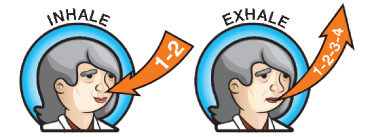
Let the CP improve naturally as you continue to practise the Breath Connection program. Shallow Breathing (SB) Shallow breathing is the opposite of deep breathing. SB involves taking in small quantities of air. The best way to achieve shallow breathing is to
be aware of your breathing and to
consciously regulate the flow in and out of the nose. Nasal breathing is the key to correct breathing. Mouth closed.
When we breathe through our mouth, we take in too much oxygen and breathe out too much carbon dioxide, which upsets the balance (or the harmony ratio) of these essential gases in our bodies. (Doubters/sceptics can try this simple test on their own: Continuously blowout hard three times and hold your breath. See how you feel now?)(A little 'dizziness' is the phenomena of lack of carbon dioxide/oxygen ratio in the lung)
It has been established that people with breathing disorders, such as asthma, often have nasal problems, too, such as sinusitis, rhinitis, or polyps. Most nasal problems --- such as asthma --- are one of the body's defence mechanism against over breathing. Breath Connection program can teach you to get rid of nasal problems, and you will also learn how to get rid of asthma, which is another facet of the same problems.
After two or three days of practicing Breath Connection, your nasal passages will open up ---and stay open --- if you continue to breathe correctly.
Unblocking your Nose It may seem impossible to consider shallow breathing, or breathing through your nose, if you have chronically blocked nasal passages. Here is the quick-fix method for unblocking your nose, which will provide relief for a few minutes, or even hours.
Once you have practiced Breath Connection for a couple of days, your nose will stay clear, and this exercise will be unnecessary.This is what you do:
1.Breath in and out normally.(mouth closed)
2.Pinch your nose with two fingers after the exhalation.
3.When you can no longer comfortably hold your breath out, let go of your nose pinching, but keep your mouth closed and carry on breathing through your nose, which will now be open.
Try to move around while pinching your nose --- the added movement will increase the carbon dioxide levels in your blood even further, and we know that
carbon dioxide is a 'natural bronchodilator'.
( Bronchodilator: a drug taken by patients with respiratory conditions such as asthma. Bronchodilators artificially dilate the bronchial tubes in order to facilitate breathing. However, by forcing a greater intake of oxygen into the lungs, these drugs further exacerbate hyperventilation, leading to a greater deterioration of the patients medical condition. There are more facts which may cause alarm if you know the real effect of their usage in the long term, anyway if you want to know more just email me, also, do some serious research on your own is better)
Sleeping Techniques Asthma becomes worse at night and in the early hours of the morning because the horizontal position of your body during sleep increase hyperventilation. This is because the natural position of our bodies is upright. Lying flat on our backs is not the optimum position for our breathing to function normally. Many parents start to worry when the baby sleeps naturally on the stomach; only if they know it is the best position to sleep naturally and safely. Even first-aiders are taught to position victims on 'recovery position - on the tummies' while awaiting for the arrival of paramedic.
When we sleep, our breathing starts out being low and shallow. However, as we slip into deeper sleep, our breathing becomes deeper and deeper. When we are lying down, our breathing increases, so that our levels of carbon dioxide go down. So, how should we sleep?
The more upright you are, the better. Sitting up is the ideal position, but we accept that it is not very comfortable --- or practical. However, if your asthma symptoms are very bad, you might want to consider it. The next best option is to position yourself on a high pile of pillows, which should rest under your head and shoulders.
Always sleep on your left side, with your legs pulled up to your chest. This fetal position has been proved to be the most effective position for sleeping, although the reason is unclear.
If you find it uncomfortable, switch to your right-hand side, which is, ultimately, much better than sleeping on your back. Lying on your back and breathing through your mouth is the worst possible way you can sleep. Children should sleep on their tummies. See the human throat anatomy and airway illustration from any simple medical book and you can see the reason why.
Just a recommendation: sleep on a hard bed, such as a futon, or one with a thin mattress, and that we should aim to reduce our time sleeping by as much as possible. The less you can sleep, the better. Drink two glasses (use 7oz glass size for adult ) before going to sleep. Your nerves system need water to cleanse and repair themselves while you are sleeping. If you still find difficulty to sleep, put a pinch of sea-salt on your tongue and leave let it melt ,after drinking a glass of plain water before going to bed.
Here are some other tips for getting a good night's sleep:
#Don't go to bed until you are so tired that you cannot do anything else but sleep.
#Don't go to bed just because it is bedtime. Wait until you are genuinely tired before retiring for the night.
#Don't go to bed during the day. If you have had a sleepless night, take a 20- to 30-minute nap, sitting in a chair.
#Make sure your mouth is closed while you sleep and tape your lips to ensure that it stays this way. I recommend a special type of tape, 3M micro pore mouth tape, which is available from pharmacists and hardware shops. This tape can be applied and removed easily and painlessly, and because it has tiny pores,or holes, you will not feel completely suffocated. I suggest that you tape your mouth with a small piece of micropore mouth tape, placed vertically over the lips, while you learn the techniques and throughout the program. Taping is not essential ,but it definitely improves your progress.
Breathing through your nose at night can reduce phlegm, prevent snoring, and provide a much more refreshing sleep. Most importantly, however, it can prevent asthma attack.
The native American mothers used their fingers to ensure that the mouths of their children were closed when they slept, until the children developed the habit of breathing through their noses. Doctors of the time noted that these children were often healthier than their Colonial contemporaries.
Taking your Pulse.
Your pulse is a sure measure of the state of your health, and it is important that you learn how to measure it. A pulse means that blood is circulating in the body.
In general, 70 beats per minute indicates that your health is good.
Up to 80 beats, it is probably fair, but 100 beats is too high.
There are very few people whose health is fine, even if they have a high pulse rate and body temperature, but don't take the risk that you may be one of them. When you normalize your breathing, your whole body system becomes more efficient and less stressed --- and so normalizes the heartbeat.
Checking your pulse rate before and after doing the Control Pause(CP) exercises will demonstrate how breathing correctly has a direct bearing on circulation. As your CP goes up, your pulse rate will come down. You will be checking your pulse regularly to ensure that this happens. It is a very good way to gauge the effect of the exercises.
The
Breath Connection program, in general, involves
(i) the
Control Pause(CP), which is used both to monitor your condition and to help control your breathing ,
(ii)
Shallow Breathing techniques, and
(iii) at various stages, taking your
pulse rate.
The program also involves learning to breath through your nose and making adjustments to your day-to-day breathing techniques in order to learn normal breathing.
In this Breath Connection, you are taught to breath less air, which is considered to be normal breathing. Abnormal breathing is the cause of many diseases: normal breathing, the Breath Connection way, will both improve your over-all health and well-being. You'll start to see changes after only a few days. Now, let's begin.
(Resources: http://
www.haleclinic.com )
God is good and righteous , all the time.
The principles behind the Buteyko Breathing Method: It is named after a Russian scientist, Prof. Konstantin Buteyko. It has been recognised medically that hyperventilation (or over breathing) causes airways and arteries to narrow. He was among the first to recognise that BREATHING LESS WOULD CAUSE THEM TO OPEN AGAIN! Simple logic, like eating too much without exercise causes weight gain and other disoders.
A working defintion of Hyperventilation:
'hyper' = too much ; 'ventilation' = lung ventilation / breathing.
- the act of breathing too large a volume of air for the body's needs , causing a reduction in carbon dioxide.
Habitual hyperventilation (sometimes know as hyperventilation syndrome) occurs as the result of breathing a larger than volume of air than the body can use, "washing" out too much carbon dioxide(CO2) over an extended period. This may be only 10% too much, or 300% too much. The more a person overbreaths, the more pressure is put on the human body. After a time, any extra stimulation (whether physical or mental) can result in the overload we know as illness.
As healthy person breaths out, the CO2 level in the blood stream will build to about 6.4% , and a chemo-receptor in the brain will trigger the next breath in . This is self regulating , to be maintained whatever the level of activity. Over time, if the habit of overbreathing develops, the chemo-receptor learns to register an unhealthy low level of CO2 as 'normal'.
However, when CO2 levels in the bloodstream are reduced below 5%, the body begins to respond in one or more of the following ways:
-It is unable to release oxygen from the red blood cells as efficiently, so the mind and body react more slowly, and memory and energy levels are affected.
-Airways may begin to close down in sinuses and lungs, in the body's instinctive attempt to prevent the loss of more CO2, with an increase in mucous production - this could result in sinusitis, asthma, snoring, bronchitis, and long term , emphysema.
-Alkali levels increase, which has a negative impact on the body immune system. Underactive and there is a tendency to catch colds, flu, etc., in extreme cases the body cannot combat cancer. Overactive, and you have auto-immune diseases such as ME, lupus, MS, allergies, diabetes, etc.
-Arteries begin closing down, and veins swell, preventing proper blood flow, increasing pulse and blood pressure. Arteries are blood vessels bringing blood away from the heart, while veins are blood vessels bringing blood back towards the heart.
-Weight changes (up or down) as the metabolism alters.
-Increases anxiety levels and andrenaline production.
The core of the Buteyko Method is to raise the public awareness of the correct and healthy way of breathing and to retrain them to breath appropriately for the level of activity they are doing. Even while you are jogging , running or swimming. They are reminded to
always breathe through the nose, and for many people, this in itself feels miraculous after years of mouth breathing.
Using this simple, natural technique will help asthma sufferers prevent and overcome attacks, restore healthy sleep and cut medication up to 60%.
For those people seeking an improvement in their overall health, it has other major benefits, too, for stress, weight loss and the heart.
Breathing right is important.