Thursday, June 7, 2012

Barefoot Dr Tan Lai Yong Inspiring Humankind

This post, we bring to you a local doctor who spent the last 15 years helping villagers in China.
At 50, doctor Tan Lai Yong counts himself fortunate that neither he nor his wife feel the pressing need to do “something significant” with the rest of their lives.
But that’s because they have already led a “full life”, having spent the last 15 years in rural China, where Tan ran a village doctors training programme and worked with disabled people.
In 1996, Tan, his wife and one-year-old daughter moved to Xishuangbanna, a small Thai-speaking town in the southern tip of Yunnan. There, he spent four years training doctors and working with the disabled before relocating to Kunming, the capital of Yunnan.
Tan then joined the Kunming Medical University and trained village doctors and hospital doctors.  He also led medical work with non-governmental organisation Bless China International, which is based in Yunnan.
“The past 15 years have been a sweet dream,” described Tan, who studied medicine in Singapore before making the leap to work in a developing country. 
Tan’s experiences have been featured in several publications. Most recently, he was interviewed for the Singapore Medical Association’s (SMA) magazine and conferred the SMA lectureship, which is awarded to distinguished people who have made significant contributions to medicine and the community.

his briefing to students, Tan tries to get them to understand and empathise with the villagers.

The doctor, who moved his family back to Singapore in 2010, is now studying full-time at the National University of Singapore Lee Kuan Yew School of Public Policy. He’s on a scholarship to do a master’s degree in Public Administration.Tan continues his outreach to the less fortunate by volunteering at local voluntary welfare organisation HealthServe, which provides help to migrants, and the disadvantaged and poor in the local community.
He also gives talks to other Singapore groups who plan to go to China to help villagers. Recently, he coordinated among 10 volunteer groups to take turns to help build a school in Longling County in the Yunnan province over two years. 
Tan acknowledged that some people may argue: Should teams be doing this, spending all this money to go overseas? Is this a kind of charity tourism?
“It is, but since they’re already doing it, it’s not my job to fight the tide and say ‘Don’t go, we are wasting people’s money,” he said. “(My job is) to say, “Since we’re doing this, let’s do this best practice, do it safely, sensitively, do it sweetly.” 
Inspiring the younger generation
When Yahoo! Singapore met with the doctor, he was at Temasek Junior College (TJC) briefing students who were going to Yunnan and Cambodia as part of the school’s overseas outreach programme.
“I love interacting with students, teaching. I would like to go into teaching of some sort (in the future),” he said. 
The TJC alumni bantered with them, shot questions at each student and prepared them for what to expect. Importantly, he provided these students with a deeper understanding of villagers they may encounter.
For instance, it’s a common saying that villagers may be poor but they are happy. That’s not necessarily true – they may be friendly and full of smiles but it doesn’t mean they are happy, he told them.
Tan has been helping TJC with its overseas community projects for the last few years.
And there will be challenges as a volunteer.
Sharing the difficulties he encountered, Tan said his Mandarin used to be so bad he even wrote his Chinese name wrongly when he was in JC. He had to get a tutor when he went to China.
As a newcomer to the community, there were times he felt “useless” because he was not part of the “information flow” and villagers also questioned his “agenda”.
They would ask, “What’s in it for you?” he said, sharing the frustration in such a situation.
And even after he managed to win over their trust, getting them to make the changes he recommended was another hurdle because they were used to the old ways of doing things. 
There are times too when a volunteer may feel moved to help someone but for practical reasons, such as budgetary constraints, it is not possible, he added.
What matters is helping in a way that is sustainable, like planting trees, he said.
“You can really tell that he believes in what he is doing,” observed 17-year-old Sarah Tan, who met Tan for the first time at the briefing.
“He’s very engaging. He knows how to connect,” she added, glad to have gleaned greater insight on the Yunnan villagers.

Tan hiking with his daughter along irrigated fields in Yunnnan. (Photo courtesy of Tan Lai Yong)

It’s apparent that Tan still has a heart for the villagers, so why did he leave China?The health conditions were changing, he told Yahoo! Singapore later.

There was growing concern over lifestyle diseases (Tan focused on infectious disease) and there was a need for stronger protocols, technical language, all of which were not his strong suits. 


In addition, he felt it was time for him to step down as team leader after one incident two years before he left.


Tan explained that his team had been debating if they should head over to “town A” or “town B” and when Tan suggested the team visit the former because he knew the mayor would back them, the team agreed.
It was a signal for Tan to step down.  
“On the basis of my connection, on the basis of my words, it swayed the decision. And I felt this was really unhealthy for the team. … If my words supercede due diligence, supercede the basic facts, sooner or later we will get into trouble,” he shared.

Tan's wife and children in their younger days. (Photo courtesy of Tan Lai Yong)
 And there was one more reason for Tan to pack his bags and head home. He wanted his children – a 13-year-old boy and 17-year-old girl – to get the chance to develop lifelong friendships in their home country, he said.
“It’s the parents’ job to invest in their children’s friendship,” believes Tan.

Wednesday, June 6, 2012

Poop "SHIT" Burger : Japanese crEATion

It’s being called the “poop burger”. Japanese scientists have found a way to create artificial meat from sewage containing human feces.
Mitsuyuki Ikeda, a researcher from the Okayama Laboratory, has developed steaks based on proteins from human excrement. Tokyo Sewage approached the scientist because of an overabundance of sewage mud. They asked him to explore the possible uses of the sewage and Ikeda found that the mud contained a great deal of protein because of all the bacteria.

 The researchers then extracted those proteins, combined them with a reaction enhancer and put it in an exploder which created the artificial steak. The “meat” is 63% proteins, 25% carbohydrates, 3% lipids and 9% minerals. The researchers color the poop meat red with food coloring and enhance the flavor with soy protein. Initial tests have people saying it even tastes like beef.
Inhabitat notes that “the meatpacking industry causes 18 percent of our greenhouse gas emissions, mostly due to the release of methane from animals.” Livestock also consume huge amounts of resources and space in efforts to feed ourselves as well as the controversy over cruelty to animals. Ikeda’s recycled poop burger would reduce waste and emissions, not to mention obliterating Dante’s circle for gluttons.

 The scientists hope to price it the same as actual meat, but at the moment the excrement steaks are ten to twenty times the price they should be thanks to the cost of research. Professor Ikeda understands the psychological barriers that need to be surmounted knowing that your food is made from human feces. They hope that once the research is complete, people will be able to overlook that ugly detail in favor of perks like environmental responsibility, cost and the fact that the meat will have fewer calories.

 You created a steak made of sh*t.  I think you can dream bigger than someday pricing it the same as regular meat.  “You mean for the price of this bone-in ribeye, I can get a corn-stuffed sh*t burger of equal size? HOW DO YOU GET AWAY WITH THESE DEALS!  Here’s twice what you’re asking, just so I don’t feel like a thief.”

 http://www.youtube.com/watch?feature=player_embedded&v=u1N6QfuIh0g

Making of Tiger Beer tour now on

After months of renovations Asia Pacific Breweries, the home of Tiger Beer, is again open to the public. Considering how expensive it is to drink in Singapore, S$16 is a bargain for a brewery tour and the chance to drink your fill of Tiger Beer at the “tasting session” that follows.

The new and improved Tiger Brewery Tour.
The tour begins in a shiny new welcome room filled with retro advertisements, collectable bottles, and other memorabilia from the brewery’s 80-year history in Singapore. Here we met the tour guide who shared some interesting factoids about their products – did you know that during World War II a low-alcohol beer called “Tiger Cub” was produced due to a shortage of ingredients?  After a video about the founding of the brewery by colonial British brew-masters striving to formulate the perfect tropical beer, the brewery tour proper begins. This is also where photography stops -- the process is apparently a secret!
We followed the tour guide into the secure area, up a staircase, and into a steamy room that smelled like bread – the brewing room! Our group, a sizeable 40some people, paused briefly on the viewing platform to gaze down at the huge vats while the guide gave an introduction to beer’s basic ingredients like hops and barley. Whether it was due to the underwhelming response or the stifling heat, we quickly moved on to the next stop on the tour.

No photos past the tiger!
With its endless flow of kegs, cans, and bottles, the automated bottling room was much more impressive.  Listening to the guide I picked up a few facts and figures like, when operating at full volume, the brewery produces 40,000 cans and 32,000 bottles of beer per hour. Of all that beer half is consumed in Singapore and half is exported around the world. After a brief Q&A session and a few minutes to fantasize about being left alone with all that beer, that concluded the formal part of the tour. Actual brewery tour running time: no more than 15 minutes.
Finally it was time for the real reason any of us signed up for the brewery tour – drinking! The beer sampling takes place in Tiger Tavern, a British-themed pub so polished it should be open every day to everyone, not just tours. We were given 45 minutes to sample all six beers produced on site  – Heineken, Guinness, Barron’s, ABC Stout, Anchor and, of course, Tiger. The glasses may be small, but you can drink as much as you want!

45 minutes of all-you-can-drink bliss.
Though the Tiger Brewery tour wasn’t as in-depth as I had expected, it was an enjoyable hour. That said, the trip out to western Singapore where the brewery is located takes much longer than that. You’d need to drink a lot of beer to make it worth your while.
Brewery tours are available weekdays at 10:00, 11:00, 13:00, 14:00, 16:00, and 17:00. While I was part of a very large group, the guide said 20 participants is typical for afternoon tours and morning groups may be as small as 2 – but who wants to drink beer at 10am?
The Asia Pacific Brewery is located at 459 Jalan Ahmad Ibrahim in western Singapore and the tour costs S$16 per person. Advance bookings are required and can be made by calling (65) 6860 3005 or emailing brewerytour@apb.com.sg. Remember to bring your passport or other form of ID!
Further virtual tour http://sg.entertainment.yahoo.com/photos/launch-of-new-tiger-brewery-tour-slideshow/1-photo-1338865705.html

Sunday, June 3, 2012

Facts About Polio


7 Trivia Facts About Polio


  • 0
    Share

It’s called the “Gold Standard of Medicine.”
I’m referring to the current vaccine schedule. But is there an apparent hidden catch? Can justification for the aggressive vaccine schedule arguably be traced back to the polio vaccine that is trotted out as proof vaccines work?
If you don’t believe me, question any parent on vaccines. The knee-jerk question in almost every case is, “What about polio?”
Well, what about it? Here I discuss 7 trivia facts for VacTruth.com readers to investigate further about polio and question the motives of those who would profit from vaccines and disease.

Trivia Fact #1 – Chemicals Used in Pesticides Increased Your Chance for Viral Infections

During World War II and into the 1950s, massive amounts of pesticides, such as DDT, heptachlor, dieldrin, TEPP, malathion, were sprayed on crops eaten by humans and livestock.
Any connection to the chemicals used in spraying the pesticide formulations and polio epidemic are regularly denied. However, the chemicals used in spraying pesticides were found to increase viral infections in hosts.[1,2]
Researcher Janis Gabliks noted in the study titled, Studies of Biologically Active Agents in Cells and Tissue Cultures, that,
“As it is recognized that residues of some agricultural insecticides persist in the body and that cells are continuously exposed to their metabolites, we investigated the possibility that these chemicals may alter certain physiological activities of cells and subsequently influence the susceptibility of hosts to virus infections.”  [1]
Parents should also know some of the same chemicals used to spray pesticides (Tween 20, Tween 80, Triton X-100, Nonoxyenol-9) are still present in childhood vaccines. [3,4]

*Note the close correlation to the spraying of pesticides and the worst polio epidemic in US History. “…Before 1940, relatively small amounts of such chemicals as nicotine, rotenone, pyrethrum, and the aresenicals (sic) were used for insect control. During and following World War II a rapid changeover to DDT, heptachlor, dieldrin, TEPP, malathion, and related compounds occurred.” [5]

Trivia Fact #2 – Milk Was Heavily Contaminated with Pesticides; Quietly Taken Off Shelves While Farmers Paid

By 1959, the total wholesale value in pesticide products had reached $290 million. The massive pesticide campaign was not without cost. [5]
According to congressional reports, many dairy farmers were devastated from pesticides contaminating milk.
Senate Report 1363 shockingly states,
“The problem which our dairy farmers are facing has been brought about by the use of chemicals approved by the Federal Government to dust crops. Some of these chemicals have been found to contaminate feeds. The contamination passes on into the milk and when the residues of pesticides is found to be of too high a level, the farmers are forced to dump their milk, taking it out of commercial channels. The result has been disastrous to the dairy farmers involved, some of which have had to go into bankruptcy.”
“There had been at that time, reasonable prospect that the problem would have diminished to a point that further extension of the authority would not have been necessary. However, as the Department testified then, several large producers had their milk removed from the market because of DDT residue. The problem had in fact not been solved. The local dairymen, the State governments involved, dairy and cotton associations, and the U.S. Department of Agriculture have been cooperating in an effort to rid us of this problem. The problem, however, still continues and it it appears that it will continue for the forseeable (sic) years to come.” [6]
When it was obvious pesticide residue levels weren’t dropping as hoped, the Dairy Indemnity Payment Program, or DIPP, officially was created through public law in 1968 to reimburse farmers whose milk was contaminated with pesticides. [6, 7]

Trivia Fact #3 – Polio Is/Was Transmitted Through Contaminated Milk

One of the major ways polio is transmitted is through contaminated milk. [8-14] Even one of the inventors of the polio vaccine, Albert Sabin, investigated the connection, [15] he was not naïve to this information.
Expert on microbiological safety of food and water, Dean O. Cliver, commented on the polio/milk connection in the book Foodborne Diseases,
“Poliomyelitis was the first reported foodborne viral disease, having been transmitted via raw milk as early as 1914. Raw milk predominated as the vehicle among the 10 outbreaks recorded through 1949, the last year in which foodborne poliomyelitis is known to occurred in the United States or other reporting, developed countries. Poliovirus transmission by this route ceased before the advent of the poliomyelitis vaccines, perhaps partly because of improved sanitation and the increased use of pasteurization of milk.” [8]
Sagar M. Goyal noted on page 1 of the book, Viruses in Foods,
“Food was first recognized as a vehicle for the transmission of viruses in 1914 when a raw milk-associated outbreak of poliomyelitis was reported (Jubb, 1915). Additional milk-borne outbreaks were recognized after this time, but with the development of a vaccine for poliovirus, no outbreaks were reported in the developed world after the early 1950s.” [9] (Emphasis is this author’s)
Other common diseases known to be spread through improper handling of contaminated milk at the time were Tuberculosis, Typhoid Fever, Scarlet Fever, Septic Sore Throat, Diphtheria, and Infantile Diarrhea. [16]
Can this be the genesis for all the raw milk controversy that is going on to this very day? Instead of promoting the proper safe handling of certified raw milk containing many healthful microorganisms, the U.S. FDA demands pasteurization that promotes other health problems.

Trivia Fact #4–Removing Your Tonsils Exposed You to the Worst Kind of Paralysis

Tonsillectomy surgery was cautioned in the presence of a polio epidemic. [17]
It was discovered if a child had his/her tonsils removed (or even a tooth extracted), they had a greater chance of getting the worst kind of polio called Bulbar Poliomyelitis. [18-20]
Given the information in Trivia Fact #3, this seems to make sense since it was common to give ice cream after a tonsillectomy.

Trivia Fact #5 – Pharmaceutical Companies Funded the writing of the “History of Poliomyelitis”

John R. Paul, M.D., an often-celebrated virologist in the fight against polio, wrote a book entitled, A History of Poliomyelitis. [21]
John Paul wielded significant influence and was, at the time, considered an authority on the subject of polio.
The pharmaceutical companies Lederle Laboratories, Merck, Sharp & Dohme, Parke, Davis & Co., Pfizer Inc.,and Smith Kline & French gave grants to help write a pharmaceutical-friendly-version of the history of polio.

Source: Personal Photo of Book

*Note: VacTruth readers should also investigate the history of the pharmaceutical companies. Geigy, now known as Novartis Pharmaceuticals, held the patent on the pesticide DDT. Novartis now manufacture vaccines.
The following quote was taken from the military handbook “DDT and Other Insecticides and Repellents” regarding spraying DDT, “The Geigy company holds the patents on the use of the compound [DDT] as an insecticide. The United States patent is No. 2,329,074, issued September 7, 1943, to Paul Müller.” [22]

Trivia Fact #6 – A Dangerous Vaccine: Americans Not Told Vaccine Caused Paralysis

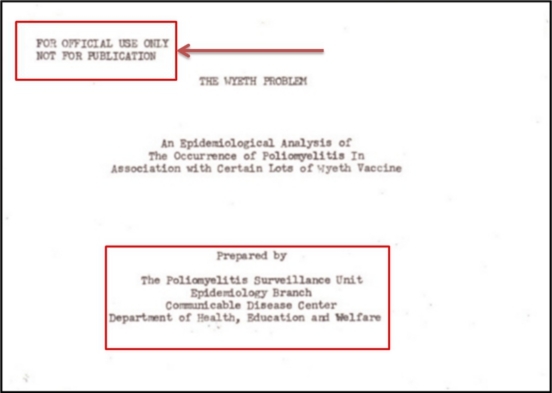
During the polio epidemic, the Poliomyelitis Surveillance Unit (PSU) investigated a possible association between the paralysis and the vaccine manufactured by Wyeth Laboratories. This incident became known as the “Wyeth Problem.”  [23,24]
The investigation was led by Neal Nathanson and was summarized in two reports. Marked across the top of the reports are the words, “For Official Use Only – Not for Publication.
Why?
One plausible explanation is if Americans knew the vaccine was causing paralysis, they would demand the vaccines be taken off the shelf – just like any other tainted drug. Such a public outcry would have spoiled the popularity of the polio vaccine.
The following passage from one of the reports is revealing,
“The problem was discussed fully with officials of the Pennsylvania Health Department. It was learned that a number of additional cases of suspected poliomyelitis were then under investigation. These had been reported principally from Harrisburg and surrounding counties in central Pennsylvania, an area where lot 236 had been principally used in NFIP (National Foundation for Infantile Paralysis) supported clinics. Some of these cases were known to be “vaccine associated.”” [23] (Emphasis is this author’s)
*Source: Snapshot taken of the “Wyeth Problem” report

Trivia Fact #7 – Researchers Discover How to Paralyze Monkeys with Vaccines

During the International Poliomyelitis Conference held in 1954, Dr. David Bodian from the Poliomyelitis Laboratory at Johns Hopkins University discussed how his research was able to produce paralysis in cynomolgus monkeys by vaccination. [25]
Here is how they did it:
  1. First they gave an injection with, “gelatin, corticosteroids, penicillin, DTP (Diphtheria, Tetanus, Pertussis vaccine), saline or merely hypodermic needle punctures…” [25]
  2. Second, they deliberately infected the monkeys with the poliovirus (this concept is called viremia).
  3. Lastly, their observations showed, “…the paralytic rate is considerably increased as compared with the control animals…” [25]
Bodian’s stunning admission shortly followed,
It must be emphasized that the 2 experimental conditions of viremia and of intramuscular injections, as well as the critical time period of an interval of less than 1 month, also characterize the human situation in epidemic areas when intramuscular injections of penicillin or other substances [like DTP vaccine] are given.[25] (Emphasis and inserted words are this author’s)
In other words, Bodian is telling the attendees at the conference injections and other vaccines, such as the DTP vaccine, “may be causing polio.” *
Consider how many injections and live virus vaccines a child now receives in his/her first two years of life. The above information deserves serious consideration by researchers, immunologists, and vaccinologists.
Note: The meeting minutes list Albert Sabin and Jonas Salk as speakers during this session. Thomas Francis and Hilary Koprowski were also present as discussants. Why is this information important? They were all inventors of a (polio) vaccine.


References:
1. Gabliks J., Studies of Biologically Active Agents in Cells and Tissue Cultures: Part 1. Annual Progress Report, U.S. Army Medical Research and Development Command. 1966, p.  10.
2. Rozee, K., Spencer, H.S., Crocker, J., Safe, S. Enhanced Virus Replication in Mammalian Cells Exposed to Commercial Emulsifiers. Appl Environ Microbiol. 1978 February; 35(2): 297–300.
3. Aufderheide, J., WWII Military Handbook Reveals Pesticide Chemicals Used In Infant Vaccines. VacTruth.com. Sept. 10, 2011.
4. Aufderheide, J., Vaccine Ingredients: Non-ionic Surfactants (Tween 80, Triton X-100, Nonoxynol -9). VacTruth.com. Aug. 23, 2011.
5. Authorizing Research on Insecticides, Herbicides, Fungicides, and Other Pesticides by the Secretary of the Interior. 85th Congress, 2nd Session. House of Representatives Report No. 2181. July 16, 1958.
6. Dairy Indemnity Payments. 90th Congress, 1st Session. Senate Report 476. August 3, 1967.
7. Dairy Indemnity Payments. 90th Congress, 2nd Session. Senate Report 1363. July 8, 1968.
8. Cliver, Dean O., Foodborne Diseases, 1990. Academic Press, p. 283.
9. Goyal, Sagar M., Viruses in Foods, 2006. Springer, p. 1.
10. Knapp, A.C,  E. S. Godfrey Jr., M.D.,  W. L. Aycock, M.D. An Outbreak of Poliomyelitis, Apparently Milk-borne.  JAMA. 1926;87(9):635-639.
11. Mathews, F., Poliomyelitis Epidemic, Possibly Milk-Borne, In a Naval Station, Portland, Oregon. Am. J. Epidemiol. (1949) 49(1): 1-7
12. Lieutenant Colonel David M. Goldstein, W. McD. Hammon, M.D., Dr. P.H., Henry R. Viets, M.D.  An Outbreak of Polioencephalitis Among Navy Cadets, Possibly Food Borne. JAMA. 1946;131(7):569-573.
13. Rosenow, E.C.,  An Institutional Outbreak of Poliomyelitis Apparently Due to a Streptococcus in Milk. The Journal of Infectious Diseases Vol. 50, No. 5/6 (May – Jun., 1932), pp. 377-425.
14. Aycock, W.L., Milk-borne epidemic of poliomyelitis. Amer. J. Hyg., 7: 791-803, 1927.
15. Sabin, A.B., Poliomytlitis. Preventitive Medicine in World War II. Vol. 5 Communicable Diseases, Medical Dept. U.S. Army Government Printing Office. 1960, pp. 367-400.
16. Peterson, W.E. Dairy Science, Second Edition. 1950. J.B. Lippincott Co., Chicago. pp. 553-554.
17. Poliomyelitis. Papers and Discussions Presented at the First International Poliomyelitis Conference. Third Session – Tuesday July 13, 1948. J.B. Lippincott Co., Chicago. p. 119.
18. Aycock, W.L. and Luther, E.H., The occurrence of poliomyelitis following tonsillectomy. New Engl. J. Med., 200: 164, 1929.
19. Aycock, W.L. Tonsillectomy in Poliomyelitis. JAMA. 1944;125(14):990. doi: 10.1001/jama.1944.02850320048022
20. Francis T., Krill, C.E., Toomey, J.A. and Mack, W.N., Poliomyelitis following Tonsillectomy in five members of a family. JAMA. 1942;119(17):1392-1396. doi: 10.1001/jama.1942.02830340004002
21. A History of Poliomyelitis. New Haven: Yale University Press, 1971. ISBN: 0-300-01324-8.
22. “DDT and Other Insecticides and Repellents.”Miscellaneous Publication No. 606, United States Department of Agriculture. p. 3, Issued August 1946.
23. Nathanson, N. The Wyeth Report: An Epidemiological Investigation of the Occurrence of Poliomyelitis in Association with Certain Lots of Wyeth Vaccine. August 31, 1955.
24. Nathanson, N. The Wyeth Report: An Epidemiological Investigation of the Occurrence of Poliomyelitis in Association with Certain Lots of Wyeth Vaccine. March 1957.
25. Bodian, D., Infection and Immunity in Poliomyelitis. Poliomyelitis. Papers and Discussions Presented at the Third International Poliomyelitis Conference. Wednesday Morning – September 8, 1954. J.B. Lippincott Co., Chicago. pp. 199-202.

Jeffry John Aufderheide is the father of a child injured as a result of vaccination. As editor of the website www.vactruth.com he promotes well-educated pediatricians, informed consent, and full disclosure and accountability of adverse reactions to vaccines.

Saturday, June 2, 2012

GROUND YOUR BODY: BAREFOOT LIFESTYLE CAN SAVE

Dear Longevity Enthusiast,

Do you use your cell phone or blue tooth regularly? Do you go to bed at night with your computer near you, a television plugged in your bedroom, or an alarm clock on your bedside table? Do you have have WiFi throughout your home?
 
In our modern world we are surrounded by these technologies all day and even all night - at home, at work, cafes, and more. And most of us have no idea about the detrimental effects electromagnetic radiation have on our bodies and our physical health.
 
At our recent sold-out  Longevity Now® Conference, I share a simple, but powerful experiment that you and your whole family need to see...
 

#1 WATER GENERATION FROM THIN AIR * IN SINGAPORE!

Latest UPDATE , Hey guys, the selling price for the EcoloBlue 30s will be S$2296 now. 30% off S$3,280 for year 2012 end promotion.  While stock last. ORDER NOW FOR BEST QUALITY OF WATER FROM THE AIR YOU ARE BREATHING NOW...

Following Watercure Protocol

Whatever your health condition is, you stand to benefit more IF you follow this watercure protocol.

0. Find out your correct daily hydration need. (your body weight in kilogram) x (32.53) ml = (your daily water quota) ml. 10% of this daily water quota is your personal 'glass of water'.
1. Drink 2 'glasses of water' (dose) , first thing in the morning upon rising.

2. Half hour before meal, drink 1 ' glass of water' .

3. Two and a half hour after meal, drink 1 'glass of water'.

4. Drink 1 'glass of water' before going to bed at night.

NOTE: For every 1250 ml of water intake , use 1/4 teaspoon of sea salt. Average body weight of 30 kg will need this 1250 ml water and 1/4 teaspoon salt, daily.

http://theinnozablog.blogspot.sg/2012/11/our-vision-and-how-you-can-get-money.html

(inspiration from www.watercure.com

EcoloBlue - Producing water straight from the air we breathe (Back to Basic)

Picture
EcoloBlue is iTORTLE's first product to promote in Singapore. The unique features and competitive advantages are:
  1. No water source or bottled water required 
  2. Option for Solar Panel integration
  3. Lowest power consumption in the market with patented innovation
  4. Tested TOP quality superior to bottled water, tap water and even purified water!
  5. Option to produce Alkaline water or Soda water

  Our tap water from the reservoirs, sea, NEWater and water bought from overseas are all due to the basic water cycle. Hence, our system goes back to basic, bringing you the pure drinking water straight from your home/office. 

HOW IT WORKS

EcoloBlue Atmospheric Water Generators extract pure, perfect, delicious drinking water straight from the air. Unlike other Atmospheric Water Generators, ours are state-of-the-art in every way. All our components are the most advanced, and highest quality available anywhere in the World. LEARN MORE
#


Interested to purchase, 

For EcoloBlue systems

A) About Atmospheric Water Generator (AWG) Technology

1)    How do you produce water from the air we breathe?

There are water vapors in the air we breathe. Relative humidity is the amount of water vapors in the mixture of air. Water vapors are condensed to water by cooling to its dew point.

2)    What is an Atmospheric Water Generator (AWG)?

An Atmospheric Water Generator is an appliance that employs dehumidification/condensing technology that extracts water from the humidity in the air. The water is then filtered and purified through several filters including carbon, and reverse osmosis, and UV sterilization lights. The result is pure drinking water from the air. This technology is often referred to "water from air", "water from humidity", "air water maker", “air to water” or "air water generator". Google “Atmospheric Water Generator” and you will find EcoloBlue as the top link after Wikipedia’s definition (http://en.wikipedia.org/wiki/Atmospheric_water_generator)

3)    Is there enough water in the air to produce water?

There are 3.1 quadrillion gallons (11.3 quadrillion liters) of water in the atmosphere at any given time. The average humidity in your home or office in Singapore is at least 70%. Sufficient water can be generated with humidity as low as 35%.

4)    Why do I need to switch to AWG when I have my bottled dispenser?

AWG is plug and play system as long as there is a standard power supply. No longer have to find space to store the huge ‘5-gallon’ water bottle and no longer have to carry up the heavy bottle to refill it. For your convenience, AWG will be your choice. Only need to call us for changing of filters and maintenance service every 6 months. 

~ Sixty million plastic bottles end up in American landfills daily.
~ Thirty-eight billion water bottles are discarded into landfills every year.
~ Last year, consumers spent $15 billion on disposable bottled water.
~ Bottling water has produced more than 2.5 million tons of carbon dioxide.
~ It takes three liters of water to produce one liter of bottled water.
~ Consumers use 1.5 million tons of plastic for water bottles each year; less than 5% of this plastic waste is recycled.
~ You can get approximately 450 gallons of tap water for the price of one bottled water.
~ Producing the bottles for American consumption required the equivalent of more than 17 million barrels of oil, not including the energy for transportation.

Source: http://www.hydrosbottle.com/the-real-cost-of-bottled-water

5)    Will it be more expensive than using bottled water dispenser?

In Singapore, the ‘5-gallon’ bottled water cost about S$ 8. If one bottle is used up per day, 1 month will be 28 bottles, which will cost S$ 224 per month. 1 year will be S$ 2,688 and 2 years will be S$ 5,376! Our EcoloBlue 26 costs only S$ 1,999 and a 2 years filter package cost only S$ 720. So for 2 years, it will cost only S$ 2,719! Even with our serviceman coming up to your door step to service the system and changing the filter for you, it will only cost S$ 3,119 for 2 years! All you need to do is to enjoy the purest drinking water hussle-free. Each filter can be used for 1,500 gallons of water before replacement. i.e. 300 bottles of '5-gallon' bottled water (S$ 2,400). A 6-month filter package is less than S$200!!

6)    Why do I need to use AWG when tap water is available?

Singapore tap water is clean and safe for drinking. It comes from mainly 4 different area – Water Desalination plant (converting water from sea water), 17 reservoirs, Reclaimed water by NEWater, and imported water from Malaysia (http://en.wikipedia.org/wiki/Water_supply_and_sanitation_in_Singapore). Getting an AWG will give you a more independency to your own water supply. You are the one generating your own drinking water that goes through 12-filtration process just before you dispensed the water out. It is the purest water supply you can get. Incorporate a Solar panel package will make it more sustainable. Even when power supply is cut off, you will still have water supply.  

B) About EcoloBlue company

7)    What is EcoloBlue?

EcoloBlue, Inc. is a company from USA who provide sustainable water solution + clean, renewable, sustainable energy + biodegradable plastics since 2007. Ever since, it has been expanding out to various countries in Europe, Africa, Middle East, Russia and now Asia. Visit http://www.ecoloblue.com/about.html for more information.

8)    Is the water produced clean and safe for drinking?

Absolutely! It goes through our patented 12-filtration system and certified by more than 10 laboratories worldwide on the water quality. Our appliances extract humidity from the atmosphere through a state-of-the-art, proprietary condensation process and transforms it into absolutely 99.9% pure, healthy drinking water.

9)    Why EcoloBlue is the best AWG in the world?

·      It is one of the pioneer in AWG and with a patent for the system

·      It is the first to have a touch screen display panel

·      It is the first to have a Soda Water dispensing option

·      It is involved in numerous humanitarian work with its AWGs

·      It has a display alarm to inform user when to change the filters and the UV lamps

·      It has the lowest power consumption in generating water (around 280W)

·      It is the first when you google “Atmospheric Water Generator”

10) How much water does EcoloBlue AWG produce?

The EcoloBlue 30 is capable of producing 30 liters of pure drinking water per day, while the EcoloBlue 26 produces 26 liters of water per day. We have industrial unit EcoloBlue 200 to EcoloBlue 5000. The number represent the amount of water it can produce per day.

11)How big is the EcoloBlue home/office system?

The EcoloBlue 26/30/30s™ weighs at approximately 50 kg, and measures approximately 45cm wide by 42.5cm deep and 110cm tall. The appliance has caster wheels (lockable) for easy movement and re-location.

12)What filters does The EcoloBlue use?

The EcoloBlue 26/30/30s™ uses a 12-stage filtration process, which includes: 1 bottom tank carbon filter, 2 silver impregnated carbon filters, 1 filmtec reverse osmosis membrane, 1 bio ceramic mineral filter, and 3 Philips UV sterilization lamps (1 in the bottom tank, 1 in the top holding tank, and 1 in the tubing as water is poured into your glass).

13)How often do we need to change the filter?

The reverse osmosis and the UV lights (total 3) should be replaced every 2 years under normal system operation, and the carbon and mineral filters should be replaced every 6 months.

14)Is the water produced free from bacteria or other germs?

The EcoloBlue 26/30/30s™ water generation process utilizes high intensity UV (ultra violet) filters to eliminate any microorganisms, including bacteria and viruses. Ultra violet light has been used for over 50 years to purify water and is accepted by the United States Public Health Service as a standard methodology for water treatment. Independent test results measured 99.9% purity, far exceeding EPA requirements.

15)Does the system consume a lot of energy?

Our AWG consume the least amount of energy. It only uses 280 W for the generation of water. The generation of water will stop once it reaches full tank and start generating again when it is being dispensed

16) Is it difficult to use the system?

It is absolutely easy to use. We can provide a short training on how to maintain the system and usage of the system upon the first purchase. Manuals will be provided as well. We have service engineer who will be able to support you in any case of breakdown or difficulties. Our hotline is 8338-8136. Give us a call or SMS for any urgent matters. We provide the best after sales service.

Any further questions that are not answered here? Drop us your questions at sales@itortle.com and we will be pleased to attend to you and put it up in our FAQ section. Thank you very much. :)

Interested to purchase, 


CERTIFICATION


Certification for EcoloBlue AWGs

ATC CE Certificates:

ATC CE EMC Certificate for EB 30

ATC CE EMC Certificate for EB 30s

ATC CE LVD Certificate for EB 30

ATC CE LVD Certificate for EB 30s

ROHs Test Report:

ROHS Test report for EB 30 and EB 30s

Water Test Reports:

Russia Test Report

UK Aqua Legion

USA California McCampbell Analytical, Inc., Pittsburg

USA Florida Pro-Lab

Europe Nederland Waterlaboratorium Zuid, Breda

Europe Estonia Health Protection Inspectorate - Tallinn

China PONY Testing International Group

Australia ALS Laboratory Group - Environmental Division Sydney 

Kingdom of Bahrain - AL HOTY Analytical Services - Milieu Gulf WLL

U.A.E. - Dubai Central Laboratory - Dubai Municipality

Hong Kong Productivity Council

Patent: Patent for EcoloBlue AWG

Interested to 

Introducing EcoloBlue - #1 Atmospheric Water Vend Machine

 http://theinnozablog.blogspot.sg/2012/11/our-vision-and-how-you-can-get-money.html

Kieron Vorster
Independent Water Monitoring Report
November 2007
Issue 01
EcoloBlue – Atmospheric water vend machine
©2007 Aqua Legion UK Ltd Site Visit Date: 19th November 2007
Report Ref PN1001/07R2611aDF Page 2
1. Summary
We are pleased to report that microbial examination of the water supplied from the EcoloBlue chilled water vend machine returned generally acceptable water quality with an absence of coli form bacteria, Escherichia Coli and Pseudomonas bacteria. Total bacteria counts were recorded above the Water Supply (Water Quality) Regulations 1989 used by Aqua Legion UK to indicate optimum drinking water quality.
However, limits set on total bacteria colony counts in drinking water have been removed from the current Water Supply (Water quality) Regulations 2000. Results obtained are therefore regarded as acceptable.
A sample was also collected from the mains water services for comparison purposes. Microbial examination of the water supplied from the mains water services also returned acceptable water quality with the absence of coli-form bacteria, Esherichia Coli and Pseudomonas bacteria. Total colony counts obtained from the mains water tap were recorded above the Water Supply (Water Quality) Regulations 1989 used by Aqua Legion UK to indicate optimum drinking water quality. However it should be noted that total colony counts were recorded below the results obtained from the EcoloBlue vend machine.
The mains water supply will typically have a background concentration of chlorine and other chemicals present to aid microbial quality. It is likely that chemical examination of the mains water supply would return significantly higher levels of dissolved solids and other compounds than levels returned from the EcoloBlue machine. In total comparison of chemical and microbial quality it is possible that the EcoloBlue machine would match or be superior in provision of drinking water quality.
It is therefore in our opinion that with a regular and adequate cleaning procedure for the EcoloBlue vending machine that a superior water quality could be produced. This can be demonstrated when assessing and comparing both the microbial and chemical quality of the waters produced form each service.
Suitable hot and cold water temperature measurements were recorded from the machine and mains water service with the cold below the 20°C guideline maximum and hot water well above 70°C.

2. Recommendations
It is recommended that a set of formal written cleaning procedures be drafted for the routine maintenance of the machine. These procedures should be followed to ensure suitable water quality is maintained and issued with any sale of a machine.
It is also recommended that a programme of routine quarterly cleaning and sampling be included or recommended in the sale of the machine. Particularly to commercial clients as this would help to ensure a good level of water quality is always maintained. Where bottled water is usually purchased for commercial premises, the cost savings realised by using the EcoloBlue machine could be used to implement the routine maintenance and sampling programme for the Machine.
This also ensures routine water quality maintenance tasks are carried out wherever the EcoloBlue machine is. This will further help to build a safety ethic into the business or brand.

Report Ref PN1001/07R2611aDF Page 3
3. Examination of Services
Examination of the vend machine outlet showed it to be in a visibly clean condition with no scale or other deposits identified.

4. Site Measurements and Analytical Results
Temperature measurements taken, together with the free residual chlorine concentrations, are recorded in Table 1 below.
Location
Temperature (oC)
Free Residual Chlorine
(mg/l as Cl2)
Vend Machine Cold Supply
8.7
<0.2
Vend Machine Hot Supply
82.1
-
Mains water tap
8.9
HSC Recommendation
<20oC and >50°C
-
Table 1, Water Temperature Measurements – EcoloBlue vend Services
Water samples were collected from the mains water service and EcoloBlue vend machine cold water supply for examination by an UKAS accredited laboratory. Laboratory analysis showed generally acceptable microbial quality with no coli-form bacteria or Escherichia Coli detected. Psuedomanas bacteria were not detected in any of the samples collected.
Mr Kieron Vorster
4B Beech Grove
Epsom Downs
Surrey
KT18 5UD.
26th November 2007
MICROBIAL EXAMINATION REPORT http://www.ecoloblue.com/files/Aqua_Legion_Marketing_Test.pdf

Click Here
http://theinnozablog.blogspot.sg/2012/11/our-vision-and-how-you-can-get-money.html


I love this  http://www.youtube.com/watch?v=O_oys-AQ_3E&feature=related