People have a built in body cycle which works on what is called a circadian rhythm. Circadian rhythm is your 24 hour internal biological clock that runs in the background of your brain. It cycles between sleepiness and alertness at regular time intervals which is also known as your sleep/wake cycle. Lightness, darkness, temperature change, sleep patterns and rapid long distance traveling (that crosses east-west or west-east) are all external clues from our environment that can disrupt our inner circadian rhythm.
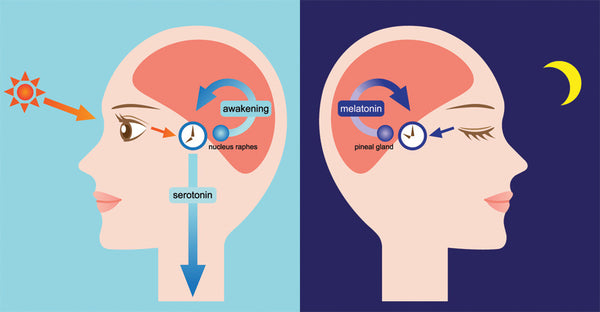 Your circadian rhythm works best when you have regular sleep habits such as those who don't have chronic pain, young children to get up with in the night or do shift work. For example, those who go to bed at night and wake up in the morning around the same time from day to day have the best working circadian rhythm. When external stimuli change your internal clock such as daylight savings, a late night movie or dreaded jet lag, you can disrupt your circadian rhythm, which makes you feel tired, grumpy, and perhaps have difficulty paying attention or just plain out of sorts.
So the question is, can Earthing really help regulate your circadian rhythm and lessen the effects of jet lag? For some people the condition of jet lag can last several days until your system is fully adjusted to the new time zone. However when being in direct contact with the Earth, the effects and adjustment period to your new local time zone can be significantly reduced. Why is this so?
 Grounding leads us to believe that it's much more than the light/dark cycle that effects our diverse bodily circadian rhythm, but a much greater physiological stability that has to do with the natural rhythms of the environment that are easily influenced by taking some time to touch the Earth. The Earth's energy coordinates our biological clock which regulates hormone flow in our bodies. When in contact with the Ground, the slow and gentle rhythm of the Earth's field of energy is essential for maintaining our circadian rhythm. The day/night or wake/sleep cortisol levels are normalized when touching the Earth. The Earth's energy potential fluctuates according to the position of the sun and moon so at any point on its surface, the circadian cycle will be different. The best way to normalize yourself to the area and time zone you are in, is to practice Earthing as soon as you arrive at your new destination or even if it's arriving back home after a trip. By immediately practicing Grounding you can get your biological cycle in sync with the new place you are in, reset yourself to local time and reduce or eliminate the various symptoms many experience from jet lag.
At The Earthing Store our easiest advice to practice Earthing once you arrive at your destination is to wear Earthing shoes while traveling. All you need is a quick 20 minutes to touch the Earth while wearing a pair of Grounding footwear and you can do this without any extra effort on your part. Find some grass or a sidewalk to walk to your parked car or to catch a bus as both will help reset your circadian rhythm even if only for a few minutes. If you are traveling in the night and plan to immediately go to your hotel you can always opt to sleep Grounded. Pack along a travel Earthing sleep aid such as a pillow case, recovery bag or throw. All of which will help you sleep better and reset your biological clock without taking up to much room in your suitcase.
JET LAG ALGORITHM -- EAST TO WEST
1. Tune the Thought Field -- that is, intentionally think about the jet lag that produces such upset in your life. If you are performing this algorithm while in flight, and thus not yet experiencing jet lag symptoms, simply turn your attention to the rapid travel you're doing.
2. Using the Subjective Units of Distress (SUD) scale, rate your distress level at this moment . On this scale, 10 is the worst you could possibly feel, and 1 indicates absolutely no trace of upset. Write down the SUD rating before you continue to the next step.
3. Tap solidly five times under the arm, about four inches directly below the armpit, using rigid fingers. In men, this spot is under the arm about even with the nipple. Women can locate this spot by tapping at about the center of the bra under the arm.

4. Tap the "collarbone point." To locate it, take two fingers of either hand and run them down the center of the throat to the top of the center collarbone notch. This is approximately even with the spot where a man would knot his tie. From there, move straight down an additional inch. Then move to the right one inch. Tap this point five times.
5. Take a second SUD rating and write it down. If the SUD has decreased 2 or more points (which will be the case for most people), then continue with step 6 below. If there was no change, however, or if the change in the SUD was only 1 point, perform the correction for a psychological reversal, using the technique described in this post (CLICK HERE). Then repeat steps 1 through 5.
6. Perform the nine-gamut treatments. Locate the gamut spot on the back of the hand, about an inch below the raised knuckles of the ring finger and little finger when making a fist. Begin tapping the gamut spot with two fingers of the opposite hand, about three to five times per second, and continue tapping while performing all nine steps below ( tap five or six times for each of the nine-gamut positions). It is very important to tap the gamut spot throughout all nine of these gamut treatments:
G1~ Open the eyes.
G2~ Close the eyes.
G3~ Open the eyes and point eyeball down and to the left.
G4~ Point the eyeballs down and to the right.
 G5~ Whirl the eyeballs around in a circle in one direction (clockwise).
G6~ Whirl the eyeballs around in the opposite direction (counter clockwise).
G7~ Hum a few bars of any tune aloud (more than a single note;
G5~ Whirl the eyeballs around in a circle in one direction (clockwise).
G6~ Whirl the eyeballs around in the opposite direction (counter clockwise).
G7~ Hum a few bars of any tune aloud (more than a single note;
rest the eyes).
G8~ Count aloud from one to five.
G9~ Hum the tune again.
7. Tap under the arm five times again.
8. Tap the collarbone point five times again.
9. Take still another SUD rating and write it down. If it has declined to 1 (which will happen with most people), move to step 10 below. But if it has decreased significantly yet is still not a 1, perform the MINI PR correction as described below, and then repeat the treatment steps above.
10. To ensure that the improvements you've made are complete, perform the floor-to-ceiling eye roll (when the SUD is 2 or lower): Hold the head level and move your eyes down. Then begin tapping the gamut point as you move your eyes upward.
MINI PR
A related procedure, called a mini psychological reversal correction, can be used when you decrease your SUD to a 3 or 4 but can't seem to get it any lower. In other words, you've achieved substantial improvement, but you can't get to the finish line. A block exists that is keeping you from reducing the SUD any further
In the algorithm for your particular emotional problem, you'll be instructed on whether and when to use this technique. here is the procedure to follow:
~ Find the PR spot mentioned above, located on the outside edge of the hand, between the wrist and the base of the little finger.
~ Tap about fifteen (15) times with two fingers of the opposite hand.

Image for tapping PR spot
As long as a psychological reversal persists, TFT ( or any other treatment) won't be able to get the SUD to a 1. The PR or mini PR correction will open the door that allows TFT to eradicate your problem.
JET LAG
Whether YOU'RE TRAVELING ACROSS TIME ZONES FOR BUSINESS OR VACATION, jet lag can leave you feeling fatigued and run-down. when your biological clock is disrupted, friends might suggest all kinds of stopgap measures to ease the symptoms, ranging from changes in diet to shifting your sleep/ wake cycle several days before departure. But rarely do these eliminate the problem.
Most experts believe that jet lag is caused by changes in the traveler's eating and sleeping schedules. I can confirm the difficulty I once had constantly changing eating and sleeping patterns when I was a student and also worked on the graveyard shift at an automobile plant in Detroit. But I think there's more to jet lag than radical disruptions of the circadian rhythms. The earth's electro-magnetic environment affects all living things, and I believe that the primary cause of jet lag is the rapid crossing of the north-south electromagnetic lines of force surrounding the earth as we travel in an easterly or westerly direction.
Traveling in an eastward direction had always been particularly difficult for me ( others find westward travel more difficulty). In the past, I would need several days --- sometimes as much as a full week --- of adjustment when jetting to Europe, no matter what strategies I tried. But since I've been using the Thought Field Therapy algorithm above, I have been able to eliminate all traces of jet lag in minutes. As you'll see, there are separate algorithms for traveling from west to east, and from east to west.
Four important points: TAKE NOTE:
1. PERFORM THE ALGORITHM EVERY WAKING HOUR DURING YOUR FLIGHT. IF YOU PLAN TO NAP ON THE PLANE, do the treatment before going to sleep and after awakening. if you've slept during most or all of the flight, perform the algorithm after your arrival to minimize jet lag ; you can also repeat the "recipe" again and again at your destination if you should ever feel symptoms.
2. If you're performing the algorithm on the flight itself, you won't be feeling any symptoms of jet lag yet, so you won't be able to determine an SUD rating at that time. However, when you're using the algorithms at your destination , and you're feeling symptoms associated with the travel, then you can arrive at SUD ratings during the algorithms to evaluate how well the treatments are working.
3. Although the algorithms are effective for the vast majority of people, if they don't work for you, reverse them -- that is, perform the east to west algorithm when traveling west to east, and vice versa.
4. If you're particular susceptible to jet lag problems, avoid consuming alcohol during the flight. Airline cabins are pressurized at an altitude comparable to about 8,000 feet, which can complicate adaptation problems for some people who drink alcoholic products.
JET LAG ALGORITHM -- WEST TO EAST
1. Tune the Thought Field -- that is, intentionally think about the jet lag that produces such upset in your life. If you are performing this algorithm while in flight, and thus not yet experiencing jet lag symptoms, simply turn your attention to the rapid travel you're doing.
2. Using the Subjective Units of Distress (SUD) scale, rate the your distress level at this moment . On this scale, 10 is the worst you could possibly feel, and 1 indicates absolutely no trace of upset. Write down the SUD rating before you continue to the next step.
3. Tap five times under the eye, about an inch below the bottom of the eyeball, at the bottom of the center of the bony orbit, high on the cheek. Tap firmly, but not hard enough to cause pain.
 4. Tap the "collarbone point." To locate it, take two fingers of either hand and run them down the center of the throat to the top of the center collarbone notch. This is approximately even with the spot where a man would knot his tie. From there, move straight down an additional inch. Then move to the right one inch. Tap this point five times.
5. Take a second SUD rating and write it down. If the SUD has decreased 2 or more points (which will be the case for most people), then continue with step 6 below. If there was no change, however, or if the change in the SUD was only 1 point, perform the correction for a psychological reversal, using the technique described in this post (CLICK HERE). Then repeat steps 1 through 5.
6. Perform the nine-gamut treatments. Locate the gamut spot on the back of the hand, about an inch below the raised knuckles of the ring finger and little finger when making a fist. Begin tapping the gamut spot with two fingers of the opposite hand, about three to five times per second, and continue tapping while performing all nine steps below ( tap five or six times for each of the nine-gamut positions). It is very important to tap the gamut spot throughout all nine of these gamut treatments:
G1~ Open the eyes.
G2~ Close the eyes.
G3~ Open the eyes and point eyeball down and to the left.
G4~ Point the eyeballs down and to the right.
Image for nine-gamut treatments

G5~ Whirl the eyeballs around in a circle in one direction (clockwise).
G6~ Whirl the eyeballs around in the opposite direction (counter clockwise).
G7~ Hum a few bars of any tune aloud (more than a single note;
rest the eyes).
G8~ Count aloud from one to five.
G9~ Hum the tune again.
7. Tap under the eye five times again.
8. Tap the collarbone point five times again.
9. Take still another SUD rating and write it down. If it has declined to 1 (which will happen with most people), move to step 10 below. But if it has decreased significantly yet is still not a 1, perform the MINI PR correction as described below, and then repeat the treatment steps above.
10. To ensure that the improvements you've made are complete, perform the floor-to-ceiling eye roll (when the SUD is 2 or lower): Hold the head level and move your eyes down. Then begin tapping the gamut point as you move your eyes upward.
MINI PR
A related procedure, called a mini psychological reversal correction, can be used when you decrease your SUD to a 3 or 4 but can't seem to get it any lower. In other words, you've achieved substantial improvement, but you can't get to the finish line. A block exists that is keeping you from reducing the SUD any further
In the algorithm for your particular emotional problem, you'll be instructed on whether and when to use this technique. here is the procedure to follow:
~ Find the PR spot mentioned above, located on the outside edge of the hand, between the wrist and the base of the little finger.
~ Tap about fifteen (15) times with two fingers of the opposite hand.
Image for tapping PR spot
As long as a psychological reversal persists, TFT ( or any other treatment) won't be able to get the SUD to a 1. The PR or mini PR correction will open the door that allows TFT to eradicate your problem.


