Showing posts with label tap. Show all posts

Wednesday, May 10, 2017

TFT Algorithm For Shame / Embarrassment

SHAME ALGORITHM

1. Tune the Thought Field -- that is, intentionally think about the shame that you'd like to resolve.

2. Using the Subjective Units of Distress (SUD) scale, rate the degree of shame you feel at this moment when thinking of the incident associated with it. On this scale, 10 is the worst you could possibly feel, and 1 indicates absolutely no trace of shame. Write down the SUD rating before you continue to the next step.

3. Tap a treatment point on the center of the chin, just under the lip. Tap this point five times.

Image result for tapping center of the chin spot

4.  Take still another SUD rating and write it down. If it has declined all the way to 1 (which will happen with most people), move to step 5 below. But if it has decreased significantly yet is still not a 1, perform the MINI PR correction as described below, and then repeat the treatment steps above.

5. To ensure that the improvements you've made are complete, perform the floor-to-ceiling eye roll (when the SUD is 2 or lower): Hold the head level and move your eyes down. Then begin tapping the gamut point as you move your eyes upward.

MINI PR

 A related procedure, called a mini psychological reversal correction, can be used when you decrease your SUD to a 3 or 4 but can't seem to get it any lower.  In other words, you've achieved substantial improvement, but you can't get to the finish line.  A block exists that is keeping you from reducing the SUD any further
  
In the algorithm for your particular emotional problem, you'll be instructed on whether and when to use this technique. here is the  procedure to follow:
~ Find the PR spot mentioned above,  located on the outside edge of the  hand, between the wrist and the  base of the little finger.

 ~ Tap about fifteen (15) times with two fingers of the opposite hand.

Image result for tapping PR spot

Image for tapping PR spot

As long as a psychological reversal persists, TFT ( or any other treatment) won't be able to get the SUD to a 1.  The PR or mini PR correction will open the door that allows TFT to eradicate your problem.

SHAME / EMBARRASSMENT

If you feel shame or embarrassment over events in your past or present, and if it is making it difficult for you to function in your day-to-day activities without emotional distress, then you should use the appropriate Thought Field Therapy (TFT) algorithm. Within minutes, it can put feelings such as these behind you so you can lead your life without the disruption of unproductive emotions. 

  There are separate algorithms for shame (see above) and embarrassment(see below). They are brief and can be carried out in just seconds.

EMBARRASSMENT ALGORITHM

1. Tune the Thought Field -- that is, intentionally think about the embarrassment that you'd like to resolve.

2. Using the Subjective Units of Distress (SUD) scale, rate the degree of embarrassment you feel at this moment when thinking about the incident associated with it. On this scale, 10 is the worst you could possibly feel, and 1 indicates absolutely no trace of embarrassment. Write down the SUD rating before you continue to the next step.


3. Tap a treatment point on the upper lip below the nose. Tap this point five times.

Image for tapping  the upper lip below the nose spot
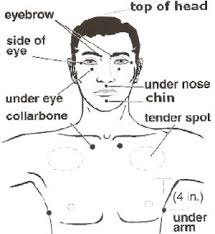
Image result for tapping center of the chin spot

4.  Take still another SUD rating and write it down. If it has declined all the way to 1 (which will happen with most people), move to step 5 below. But if it has decreased significantly yet is still not a 1, perform the MINI PR correction as described below, and then repeat the treatment steps above.

5. To ensure that the improvements you've made are complete, perform the floor-to-ceiling eye roll (when the SUD is 2 or lower): Hold the head level and move your eyes down. Then begin tapping the gamut point as you move your eyes upward.

MINI PR

 A related procedure, called a mini psychological reversal correction, can be used when you decrease your SUD to a 3 or 4 but can't seem to get it any lower.  In other words, you've achieved substantial improvement, but you can't get to the finish line.  A block exists that is keeping you from reducing the SUD any further
  
In the algorithm for your particular emotional problem, you'll be instructed on whether and when to use this technique. here is the  procedure to follow:
~ Find the PR spot mentioned above,  located on the outside edge of the  hand, between the wrist and the  base of the little finger.

 ~ Tap about fifteen (15) times with two fingers of the opposite hand.


Image result for tapping PR spot
Image for tapping PR spot

As long as a psychological reversal persists, TFT ( or any other treatment) won't be able to get the SUD to a 1.  The PR or mini PR correction will open the door that allows TFT to eradicate your problem.


TFT Algorithm For Guilt

GUILT ALGORITHM

1. Tune the Thought Field -- that is, intentionally think about the guilt that produces such emotional distress in your life.

2.  Rate the intensity of your guilt at this moment, using the Subjective Units of Distress (SUD) scale. On this scale, 10 is the worst you could possibly feel, and 1 indicates absolutely no trace of guilt. Write down the SUD rating before you continue to the next step.

3. Tap the "index finger spot" five times. It is located on the tip of the index (pointing) finger, on the side of that finger next to the thumb.
Image result for tapping index finger spot

4. Tap the "collarbone point." To locate it, take two fingers of either hand and run them down the center of the throat to the top of the center collarbone notch. This is approximately even with the spot where a man would knot his tie. From there, move straight down an additional inch. Then move to the right one inch. Tap this point five times. 

5. Take a second SUD rating and write it down. If the SUD has decreased 2 or more points (which will be the case for most people), then continue with step 6 below. If there was no change, however, or if the change in the SUD was only 1 point, perform the correction for a psychological reversal, using the technique described in this post (CLICK HERE). Then repeat steps 1 through 5.

6. Perform the nine-gamut treatments. Locate the gamut spot on the back of the hand, about an inch below the raised knuckles of the ring finger and little finger when making a fist. Begin tapping the gamut spot with two fingers of the opposite hand, about three to five times per second, and continue tapping while performing all nine steps below ( tap five or six times for each of the nine-gamut positions). It is very important to tap the gamut spot throughout all nine of these gamut treatments:

G1~ Open the eyes.

G2~ Close the eyes.

G3~ Open the eyes and point eyeball down and to the left.

G4~ Point the eyeballs down and to the right.

 Image for nine-gamut treatments
Image result for nine-gamut treatments

G5~ Whirl the eyeballs around in a circle in one direction (clockwise).

G6~ Whirl the eyeballs around in the opposite direction (counter clockwise).

G7~ Hum a few bars of any tune aloud (more than a single note; 
rest the eyes).

G8~ Count aloud from one to five.

G9~ Hum the tune again.

7. Tap the index finger spot five times again.

8. Tap the collarbone point five times again.

9. Take still another SUD rating and write it down. If it has declined to 1 (which will happen with most people), move to step 12 below. But if it has decreased significantly yet is still not a 1, perform the MINI PR correction as described below, and then repeat the treatment steps above.

10. To ensure that the improvements you've made are complete, perform the floor-to-ceiling eye roll (when the SUD is 2 or lower): Hold the head level and move your eyes down. Then begin tapping the gamut point as you move your eyes upward.

MINI PR

 A related procedure, called a mini psychological reversal correction, can be used when you decrease your SUD to a 3 or 4 but can't seem to get it any lower.  In other words, you've achieved substantial improvement, but you can't get to the finish line.  A block exists that is keeping you from reducing the SUD any further
  
In the algorithm for your particular emotional problem, you'll be instructed on whether and when to use this technique. here is the  procedure to follow:
~ Find the PR spot mentioned above,  located on the outside edge of the  hand, between the wrist and the  base of the little finger.

 ~ Tap about fifteen (15) times with two fingers of the opposite hand.


Image result for tapping PR spot
   Image for tapping PR spot


As long as a psychological reversal persists, TFT ( or any other treatment) won't be able to get the SUD to a 1.  The PR or mini PR correction will open the door that allows TFT to eradicate your problem.

GUILT
Many people have difficulty letting go of guilt. They may feel guilty about past behaviour or violations of personal commitments. Or their guilt may be related to the shirking of responsibilities or to extramarital affairs. Perhaps you can make a list of your own past regrets over which you still carry some heavy emotional baggage. 

  Guilt can be a disabling emotion, often related to events from decades earlier that can't be changed. But guilt can be eliminated with the above algorithm. 

Alternative 2: Algorithm For Obsession (OCD)

OBSESSION (OCD) ALGORITHM -- ALTERNATIVE 2

1. Tune the Thought Field -- that is, intentionally think about the obsession that you are treating.

2. Using the Subjective Units of Distress (SUD) scale, rate the intensity of your urge to engage in the obsessive at this moment . On this scale, 10 is the most intense it could possibly be, and 1 indicates absolutely no trace of it. Write down the SUD rating before you continue to the next step.

3. Tap five times under the eye, about an inch below the bottom of the center of the bony orbit, high on the cheek. Tap firmly, but not hard enough to cause pain.

4. Tap solidly five times under the arm, about four inches directly below the armpit, using rigid fingers. In men, this spot is under the arm about even with the nipple. Women can locate this spot by tapping at about the center of the bra under the arm.

5. Tap the "collarbone point." To locate it, take two fingers of either hand and run them down the center of the throat to the top of the center collarbone notch. This is approximately even with the spot where a man would knot his tie. From there, move straight down an additional inch. Then move to the right one inch. Tap this point five times. 

6. Take a second SUD rating and write it down. If the SUD has decreased 2 or more points (which will be the case for most people), then continue with step 7 below. If there was no change, however, or if the change in the SUD was only 1 point, perform the correction for a psychological reversal, using the technique described in this post (CLICK HERE). Then repeat steps 1 through 6.

7. Perform the nine-gamut treatments. Locate the gamut spot on the back of the hand, about an inch below the raised knuckles of the ring finger and little finger when making a fist. Begin tapping the gamut spot with two fingers of the opposite hand, about three to five times per second, and continue tapping while performing all nine steps below ( tap five or six times for each of the nine-gamut positions). It is very important to tap the gamut spot throughout all nine of these gamut treatments:

G1~ Open the eyes.

G2~ Close the eyes.

G3~ Open the eyes and point eyeball down and to the left.

G4~ Point the eyeballs down and to the right.

 Image for nine-gamut treatments
Image result for nine-gamut treatments

G5~ Whirl the eyeballs around in a circle in one direction (clockwise).

G6~ Whirl the eyeballs around in the opposite direction (counter clockwise).

G7~ Hum a few bars of any tune aloud (more than a single note; 
rest the eyes).

G8~ Count aloud from one to five.

G9~ Hum the tune again.

8. Tap under the eye five times again.

9. Tap solidly five times under the arm again.

10. Tap the collarbone point five times again.

11. Take still another SUD rating and write it down. If it has declined to 1 (which will happen with most people), move to step 12 below. But if it has decreased significantly yet is still not a 1, perform the MINI PR correction as described below, and then repeat the treatment steps above.

12. To ensure that the improvements you've made are complete, perform the floor-to-ceiling eye roll (when the SUD is 2 or lower): Hold the head level and move your eyes down. Then begin tapping the gamut point as you move your eyes upward.

MINI PR

 A related procedure, called a mini psychological reversal correction, can be used when you decrease your SUD to a 3 or 4 but can't seem to get it any lower.  In other words, you've achieved substantial improvement, but you can't get to the finish line.  A block exists that is keeping you from reducing the SUD any further
  
In the algorithm for your particular emotional problem, you'll be instructed on whether and when to use this technique. here is the  procedure to follow:
~ Find the PR spot mentioned above,  located on the outside edge of the  hand, between the wrist and the  base of the little finger.

 ~ Tap about fifteen (15) times with two fingers of the opposite hand.

Image result for tapping PR spot
   Image for tapping PR spot

As long as a psychological reversal persists, TFT ( or any other treatment) won't be able to get the SUD to a 1.  The PR or mini PR correction will open the door that allows TFT to eradicate your problem.

Friday, May 5, 2017

TFT ALGORITHM FOR COMPLEX TRAUMA WITH GUILT

COMPLEX TRAUMA WITH GUILT ALGORITHM

1. Tune the Thought Field -- that is, intentionally think about the traumatic event that produces such emotional distress in your life. 

2. Rate you distress level at this moment, using the Subjective Units of Distress (SUD) scale. On this scale, 10 is the worst you could possibly feel, and 1 indicates absolutely no trace of upset. Write down the SUD rating before you continue to the next step.

3. Using two fingers of one hand, tap a spot at the beginning of the eyebrow, just above the bridge of the nose. tap five times, firmly and gently, not nearly hard enough to bruise or hurt, but solidly enough to stimulate the energy flow in the system. 

4. Tap five times under the eye, about an inch below the bottom of the eyeball,  at the bottom of the center of the bony obit, high on the cheek. Tap firmly, but not hard enough to cause pain. 

5. Tap solidly five times under the arm, about four inches directly below the armpit, using rigid fingers. In men, this spot is under the arm about even with the nipple. Women can locate this spot by tapping at about the center of the bra under the arm.

6. Tap the "collarbone point." To locate it, take two fingers of either hand and run them down the center of the throat to the top of the center collarbone notch. This is approximately even with the spot where a man would knot his tie. From there, move straight down an additional inch. Then move to the right one inch. Tap this point five times. 

7. Tap the "little finger spot" five times. It is located on the inside tip of the finger, adjacent to the nail, and on the side of the finger next to the ring finger.

8. Tap the collarbone point five times again.

9. Take a second SUD rating and write it down. if the SUD has decreased 2 or more points (which will be the case for most people), then continue with step 6 below. If there was no change, however, or if the change in the SUD was only 1 point, perform the correction for a psychological reversal, using the technique described in this post(CLICK HERE). Then repeat steps 1 through 9.

10. Perform the nine-gamut treatments. Locate the gamut spot on the back of the hand, about an inch below the raised knuckles of the ring finger and little finger when making a fist. Begin tapping the gamut spot with two fingers of the opposite hand, about three to five times per second, and continue tapping while performing all nine steps below ( tap five or six times for each of the nine-gamut positions). It is very important to tap the gamut spot throughout all nine of these gamut treatments:

G1~ Open the eyes.
G2~ Close the eyes.
G3~ Open the eyes and point eyeball down and to the left.
G4~ Point the eyeballs down and to the right.
G5~ Whirl the eyeballs around in a circle in one direction (clockwise).
G6~ Whirl the eyeballs around in the opposite direction (counter clockwise).
G7~ Hum a few bars of any tune aloud (more than a single note; rest the eyes).
G8~ Count aloud from one to five.
G9~ Hum the tune again.

11. Tap the spot at the beginning of the eyebrow again. Tap five times, firmly and gently.

12. Tap under the eye five times again.

13. Tap solidly five times under the arm again.

14. Tap the collarbone point five times again.

15. Tap the index finger spot five times again.

16. Tap the collarbone point free times again.

17. Take still another SUD rating and write it down. If it has declined to 1 (which will happen with most people), move to step 18 below. But if it has decreased significantly yet is still not a 1, perform the MINI PR correction as described below, and then repeat the treatment steps above.

18. To ensure that the improvements you've made are complete, perform the floor-to-ceiling eye roll (when the SUD is 2 or lower): Hold the head level and move your eyes down. Then begin tapping the gamut point as you move your eyes upward.

MINI PR

 A related procedure, called a mini psychological reversal correction, can be used when you decrease your SUD to a 3 or 4 but can't seem to get it any lower.  In other words, you've achieved substantial improvement, but you can't get to the finish line.  A block exists that is keeping you from reducing the SUD any further
  In the algorithm for your particular emotional problem, you'll be instructed on whether and when to use this technique. here is the  procedure to follow:
~ Find the PR spot mentioned above,  located on the outside edge of the  hand, between the wrist and the  base of the little finger.

~ Tap about fifteen (15) times with two fingers of the opposite hand. 

 [Image result for tapping PR spot]


  As long as a psychological reversal persists, TFT ( or any other treatment) won't be able to get the SUD to a 1.  The PR or mini PR correction will open the door that allows TFT to eradicate your problem.

Sunday, April 30, 2017

THE THOUGHT FIELD

Einstein demonstrated that everything is energy (E= mc2) ; Though Field Therapy is based on the premise that even thought is energy. Perhaps not surprisingly, the energy produced within the brain can be detected and measured with sophisticated tools such as electroencephalography (EEG)

Image result for electroencephalography machine

Image result for electroencephalography (eeg)

Image result for electroencephalography (eeg)

Image result for electroencephalography (eeg)

Now , for a moment , picture this thought energy as being bound in a field -- no more directly observable, but just as real, as a magnetic or gravitational field. Even though you can't see a magnetic or gravitational field, you can experience its effects; the same is true with Thought Fields. 

  The dictionary defines field this way: "a complex of forces serve as causative agents in human behavior." The Thought Field is the most fundamental concept in TFT. This intabgible "structure" or "scaffold" can contain large amounts of information, but in treating psychological distress, we'll concentrate on the information that is generating the negative emotions you are experiencing. When you are terrified of snakes, devastated by a marital breakup, or death of someone you care and love, or depressed over the loss of a job, valuable items, the cause of this disturbance is contained in a Thought Field. Because what you think about during the treatment itself is crucial for the success of this program, I coined the term Thought Field to describe where this critical information is found. 

  Remember, there is no direct way to observe a Thought Field -- or, for the matter, the grief, trauma, or fear you might be feeling. But that does not make it any less real. In the past, physicists couldn't see an electron, but they acknowledged the indirect evidence of its existence. 

  Some scientists have approached psychological distress in a much different way than I have. They have argued that the fundamental information causing negative emotions is hardwired into the brain, and that the amygdala of the brain in the center of these emotions and cannot be changed. As this theory goes, painful life experiences are permanently embedded in the brain, at best, we can direct attention away from them, or use medications to mask the pain they cause. But there's no way to get rid of them short of some future surgical procedure or some future drug. 

  My own research -- supported by the results of treatment with TFT -- seriously undermines this "hardwiring" theory. if hardwiring were true, emotional upsets could not be so rapidly eradicated by TFT. As British biologist Rupert Sheldrake has written," The memory is no more in the brain than the picture coming from a television studio is in  the television receiver. " I believe the evidence now shows that we aren't dealing with "hardwire" when we're talking about negative emotions; we're dealing with software instead. And this software can be changed very rapidly since it has little inertial mass. 

Image result for amygdala

Image result for amygdala

Image result for amygdala

Image result for amygdala
The amygdala (Latin, corpus amygdaloideum) is an almond-shape set of neurons located deep in the brain's medial temporal lobe. ... In humans and other animals, this subcortical brain structure is linked to both fear responses and pleasure. ... Conditions such as anxiety, autism, depression ...