http://www.wealthbuildingcourse.com/download/products/Silver-Fortune-Report.pdf
Whenever governments start to dilute their money investors transfer their money into gold and silver. Although gold is a great way to preserve your wealth, it’s silver you could actually make a fortune with!
Saturday, November 12, 2011


Friday, November 11, 2011
I don’t read, I ZOX !
Click Here!
Imagine the worker that sees their “IN” box overflowing, and their “OUT” box empty … every day.
How would it change, if the worker has:
$261.04 SGDPayPal Conversion Rate as of 11 Nov 2011: 1 Singapore Dollar = 0.754676 US Dollar
Imagine the worker that sees their “IN” box overflowing, and their “OUT” box empty … every day.
How would it change, if the worker has:
- A Photographic Memory
- A memory like a bear trap – never letting go of important information
- The ability to know everything about their favorite topic, or their job
- Control of their own life
$261.04 SGDPayPal Conversion Rate as of 11 Nov 2011: 1 Singapore Dollar = 0.754676 US Dollar
Thursday, November 10, 2011
The Most Powerful Force in Human Behaviour: Homeostasis
Homeostatic imbalance
Many diseases are a result of disturbance of homeostasis, a condition known as homeostatic imbalance. As it ages, every organism will lose efficiency in its control systems. The inefficiencies gradually result in an unstable internal environment that increases the risk for illness. In addition, homeostatic imbalance is also responsible for the physical changes associated with aging. Even more serious than illness and other characteristics of aging is death. Heart failure has been seen where nominal negative feedback mechanisms become overwhelmed, and destructive positive feedback mechanisms then take over.[10]Diseases that result from a homeostatic imbalance include diabetes, dehydration, hypoglycemia, hyperglycemia, gout, and any disease caused by a toxin present in the bloodstream. All of these conditions result from the presence of an increased amount of a particular substance. In ideal circumstances, homeostatic control mechanisms should prevent this imbalance from occurring, but, in some people, the mechanisms do not work efficiently enough or the quantity of the substance exceeds the levels at which it can be managed. In these cases, medical intervention is necessary to restore the balance, or permanent damage to the organs may result.
According to the following quote, every illness has aspects to it that are a result of lost homeostasis:
- "Just as we live in a constantly changing world, so do the cells and tissues survive in a constantly changing microenvironment. The 'normal' or 'physiologic' state then is achieved by adaptive responses to the ebb and flow of various stimuli permitting the cells and tissues to adapt and to live in harmony within their microenvironment. Thus, homeostasis is preserved. It is only when the stimuli become more severe, or the response of the organism breaks down, that disease results - a generalization as true for the whole organism as it is for the individual cell." (Pathologic Basis of Disease, third edition, S.L. Robbins MD, R.S. Cotran MD, V.K. Kumar MD. 1984, W.P. Saunders Company) http://www.hypnosis.edu/webtv/
Tuesday, November 8, 2011
Endurance, Optimization,Creativity,Simplicity, Innovation : Steve Jobs have jobs for you too ....Live on !!!
If you are not familiar with recently deceased inventor and technology pioneer Steven Jobs, then you have lived under a rock for the last ten years and more. There are not many areas of the modern technological world you live in today that this heroic genius of a man did not touch in some meaningful way.
Even his arch rival and long time nemesis Microsoft founder Bill Gates said about the late founder of Apple that the world will feel the impact of the late legend Steve Jobs for generations to come.
Steve Jobs did more than simply change your world. He used his creativity and brilliance to generate enormous financial wealth for himself, many of his employees, and his shareholders for four decades. In the paragraphs below, you will learn the five principles that he used to accomplish this.
In under a decade, Apple Computers owned a major manufacturing facility, captured a coveted share of the personal computer market, and made millionaires out of numerous shareholders who had shown the foresight to trust Steve Jobs with their investment capital.
These achievements alone would have made an important place in personal computer history for Steve Jobs and his beloved Apple Corporation. The tireless inventor and innovator did not rest on his past glories after he left Apple. He developed and built up an incredible new form of animation known to the world as CGI Animated Feature Films with Pixar Animation Studios in the early 1990′s.
This company became so successful in its distribution partnerships with Disney Studios through such international hit releases as Toy Story 1, 2, and 3, Monsters Inc., Finding Nemo, The Incredibles, and Cars that Disney bought it from him in 2006 for $7.4 billion in cash and Disney stock, twenty years after he had acquired the fledgling venture and 26 Academy Awards wins later. This made Jobs the largest shareholder in the Walt Disney Company and earned him a seat on the revered company’s board of directors.
You probably most remember Steve Jobs like countless millions of others for his triumphant return to Apple in the late 1990′s. When Apple bought out another venture of his called Next, he came back as interim CEO in 1997/1998 and re-gained his old post permanently in 2000. During those eventful next over ten years, you saw Jobs innovate such incredible products that literally changed modern society.
These started with the iPod that allowed you to listen to thousands of songs that you kept on a small cigarette lighter sized device, continued with the iPhone the world’s first smart phone, and culminated in the few last years with the iPad that made even sleek laptops seem like dinosaurs by comparison.
Innovation refers to the capability to take ingenious ideas and turn them into marketable products. Steve did this time and again with everything from the affordable and powerful personal computer, to the disc man portable CD deck replacement the iPod.
The idea that you could have a small desk top sized personal computer in your home or office was a great theoretical concept, but only through true innovation could you take this brainstorm from the drawing board successfully to the store shelves. Steve Jobs demonstrated this uncanny ability again with the iPod, when he looked back at the old cassette tape walkman and the portable CD discman and decided that computer technology allowed for a better way to store infinitely more music.
2. Simplicity
Simplicity is the ability for you to take technology and make it less impersonal and more pleasurable. The cell phone was not a new idea when Jobs approached the technology. It had already existed on a widespread scale for over a decade. But cell phones were cold and fairly limited up to that point. Steve Jobs looked at cell phones and said we can make them simpler and more powerful to use.
He made cell phones fun with his iPhones. The proof of his success is obvious in the many companies that have since attempted to copy Apple’s Smart Phone idea. Again, Steve Jobs did not create the cell phone, but with his iPhones, he made it so much more fun to use them.
3. Creativity
Creativity is your ability to think outside of the box, or the normal way of doing things. Steve Jobs approached the iPad this way. Laptops had always required the use of a mouse button or mouse pad to move a cursor or pointer around the screen.
No one bothered to re-design this well worn and proven concept until Steve Jobs asked, what if you could touch the screen directly and move around the Internet simply with the point of your finger, or manipulate pictures, documents, and data without a mouse pad or button at all. This kind of creative thinking made him a huge success on practically every product launch, and it made both he and his shareholders at Apple and Pixar Animation Studios fantastically wealthy several times over.
4. Optimization
When you hear optimization, this has to do with the belief that everything on earth can be made better. In the last year of his life, Steve Jobs walked into a Sony store in a mall and picked up a new model of digital video camera that Sony had recently designed and released.
After he worked with and manipulated it for a few minutes, Jobs said to the person with him that we could do this better. It did not matter to him that Apple did not design digital video cameras. Jobs always saw the potential to take a product that someone else had pioneered and radically improve on it himself.
5. Endurance
You have endurance in life if you can stick with projects, dreams, and goals no matter how they appear to fail or suffer setbacks at first. It is all too easy to look back on Steve Jobs’ life with rose colored sunglasses and only see one brilliant success after another. The truth is far less simple. Consider that Steve Jobs had his cutting edged new operating system stolen from him by a contractor who worked for him at the time.
Bill Gates took Apple’s brilliant ideas, called them Windows, rushed them secretly to market ahead of Apple, then sealed Microsoft’s fate and Apple’s for many years when he signed an exclusive and universal deal with IBM to use this Windows system on all of their platforms and computers in the future. Microsoft’s star rose while Apple’s failed as a result. Finally after years of disappointment and people management problems, Jobs found himself forced out of the computer company that he had personally created in his garage.
He did not let this stop him, but proved his endurance when he co-founded Pixar Animation Studios. Apple’s fortunes waxed and waned after Steve’s departure, and he finally returned to the company in triumph over a decade later to pick up the failing pieces of Apple. He then proceeded to rebuild Apple into the largest and most successful consumer technology company on earth.
How can you argue with the principles that Steve Jobs used to make billions of dollars over and over again?
Even his arch rival and long time nemesis Microsoft founder Bill Gates said about the late founder of Apple that the world will feel the impact of the late legend Steve Jobs for generations to come.
Steve Jobs did more than simply change your world. He used his creativity and brilliance to generate enormous financial wealth for himself, many of his employees, and his shareholders for four decades. In the paragraphs below, you will learn the five principles that he used to accomplish this.
What Are Steve Jobs’ Accomplishments and Inventions?
Steve Jobs’ greatest claim to fame is of course that he started Apple Computers out of his garage basement back in the early 1970′s. These Macintosh computers that he and early partner Steve Wozniak began to build proved to be smaller, sleeker, more attractive, more affordable, and more fun than anything that the eight hundred pound gorilla IBM had built up to that point.In under a decade, Apple Computers owned a major manufacturing facility, captured a coveted share of the personal computer market, and made millionaires out of numerous shareholders who had shown the foresight to trust Steve Jobs with their investment capital.
These achievements alone would have made an important place in personal computer history for Steve Jobs and his beloved Apple Corporation. The tireless inventor and innovator did not rest on his past glories after he left Apple. He developed and built up an incredible new form of animation known to the world as CGI Animated Feature Films with Pixar Animation Studios in the early 1990′s.
This company became so successful in its distribution partnerships with Disney Studios through such international hit releases as Toy Story 1, 2, and 3, Monsters Inc., Finding Nemo, The Incredibles, and Cars that Disney bought it from him in 2006 for $7.4 billion in cash and Disney stock, twenty years after he had acquired the fledgling venture and 26 Academy Awards wins later. This made Jobs the largest shareholder in the Walt Disney Company and earned him a seat on the revered company’s board of directors.
You probably most remember Steve Jobs like countless millions of others for his triumphant return to Apple in the late 1990′s. When Apple bought out another venture of his called Next, he came back as interim CEO in 1997/1998 and re-gained his old post permanently in 2000. During those eventful next over ten years, you saw Jobs innovate such incredible products that literally changed modern society.
These started with the iPod that allowed you to listen to thousands of songs that you kept on a small cigarette lighter sized device, continued with the iPhone the world’s first smart phone, and culminated in the few last years with the iPad that made even sleek laptops seem like dinosaurs by comparison.
The Five Principles that Steve Jobs Employed When He Created Wealth
1. InnovationInnovation refers to the capability to take ingenious ideas and turn them into marketable products. Steve did this time and again with everything from the affordable and powerful personal computer, to the disc man portable CD deck replacement the iPod.
The idea that you could have a small desk top sized personal computer in your home or office was a great theoretical concept, but only through true innovation could you take this brainstorm from the drawing board successfully to the store shelves. Steve Jobs demonstrated this uncanny ability again with the iPod, when he looked back at the old cassette tape walkman and the portable CD discman and decided that computer technology allowed for a better way to store infinitely more music.
2. Simplicity
Simplicity is the ability for you to take technology and make it less impersonal and more pleasurable. The cell phone was not a new idea when Jobs approached the technology. It had already existed on a widespread scale for over a decade. But cell phones were cold and fairly limited up to that point. Steve Jobs looked at cell phones and said we can make them simpler and more powerful to use.
He made cell phones fun with his iPhones. The proof of his success is obvious in the many companies that have since attempted to copy Apple’s Smart Phone idea. Again, Steve Jobs did not create the cell phone, but with his iPhones, he made it so much more fun to use them.
3. Creativity
Creativity is your ability to think outside of the box, or the normal way of doing things. Steve Jobs approached the iPad this way. Laptops had always required the use of a mouse button or mouse pad to move a cursor or pointer around the screen.
No one bothered to re-design this well worn and proven concept until Steve Jobs asked, what if you could touch the screen directly and move around the Internet simply with the point of your finger, or manipulate pictures, documents, and data without a mouse pad or button at all. This kind of creative thinking made him a huge success on practically every product launch, and it made both he and his shareholders at Apple and Pixar Animation Studios fantastically wealthy several times over.
4. Optimization
When you hear optimization, this has to do with the belief that everything on earth can be made better. In the last year of his life, Steve Jobs walked into a Sony store in a mall and picked up a new model of digital video camera that Sony had recently designed and released.
After he worked with and manipulated it for a few minutes, Jobs said to the person with him that we could do this better. It did not matter to him that Apple did not design digital video cameras. Jobs always saw the potential to take a product that someone else had pioneered and radically improve on it himself.
5. Endurance
You have endurance in life if you can stick with projects, dreams, and goals no matter how they appear to fail or suffer setbacks at first. It is all too easy to look back on Steve Jobs’ life with rose colored sunglasses and only see one brilliant success after another. The truth is far less simple. Consider that Steve Jobs had his cutting edged new operating system stolen from him by a contractor who worked for him at the time.
Bill Gates took Apple’s brilliant ideas, called them Windows, rushed them secretly to market ahead of Apple, then sealed Microsoft’s fate and Apple’s for many years when he signed an exclusive and universal deal with IBM to use this Windows system on all of their platforms and computers in the future. Microsoft’s star rose while Apple’s failed as a result. Finally after years of disappointment and people management problems, Jobs found himself forced out of the computer company that he had personally created in his garage.
He did not let this stop him, but proved his endurance when he co-founded Pixar Animation Studios. Apple’s fortunes waxed and waned after Steve’s departure, and he finally returned to the company in triumph over a decade later to pick up the failing pieces of Apple. He then proceeded to rebuild Apple into the largest and most successful consumer technology company on earth.
How can you argue with the principles that Steve Jobs used to make billions of dollars over and over again?
Thursday, November 3, 2011
Rules of Money
Week 1 – The New Rules of Money
The new rules of money became established during the 70s after Nixon had canceled the gold standard. No longer would the dollar be worthwhile, as its value would continue to drop over the years. Even now, the dollar’s value is lower than that of many foreign currencies.
Consequently, prices rise while your income remains the same. This causes many problems as you end up spending all your money just to survive. You will continue this pattern until you learn the new rules of money. Once this becomes engraved in your mind, you will have the power to become rich.
Such a concept is maybe difficult to believe. You maybe think that in order to become rich, you must be super-intelligent. In reality, intelligence has very little to do with being rich. What really matters is how you handle your money. This is a skill that rich people always had, though in the olden days the concept was applied differently.
To get a better understanding, take a look at the section below as it will discuss the old rules behind making money.
In the olden days, school was the ultimate answer to financial success. After graduating, you would get a job that you would stay with for most of your adult life. Then, when it came time to retire, the job would provide a pension. Today, not only is it hard to find a job, but getting a pension is usually out of the question. Most are lucky if they even get health insurance.
Outsourcing has not made the problem any better. With a click of a button, a company can hire a foreign person for significantly less money. This leaves Americans with very few alternatives. Some even turn to outsourcing for themselves, especially as freelancing sites become more popular. However, when this happens, they typically work for the same wages as their foreign counterparts. So, either way, they are not making the money they need.
If you are working a traditional job you do not have things any easier. Unlike your parents and grandparents, who stayed with one job forever, nowadays you will work several different jobs throughout your lifetime. Indeed, with today’s work force, you cannot expect one company to provide financial security. Instead, expect to work more than three jobs in your lifetime.
2. Work Your Way Up
In today’s time, you get taxed more as your income rises. As a result, it is possible that you end up paying more taxes than your company’s CEO, (who may have more deductions available).
Warren Buffet is an example. Even though he is a billionaire, his secretary is actually taxed more than him. She is getting penalized for being an employee, something that happens maybe to you too as you use hard work to increase your salary.
3. Put Your Money Away
This strategy worked well in the past, when the US dollar was actually worth something. It can still be useful, but only to a point. If hyperinflation happens, your savings do not mean anything. The $10,000 you were able to save today may only be worth $5,000 ten years down the road.
4. Eliminate Debt
In the past you had to work harder to get loans. This is because credit was not readily available. If you wanted to buy a house, you needed to have little debt and at least 10 percent down. Today, you need credit to build your financial portfolio. You just have to make sure you have a handle on your debt. Otherwise, it will become a stumbling block.
5. Use Your 401K to Diversify Mutual Funds Investments
The problem with this approach is that the mutual fund company takes most of the money. This is while you assume all of the risk. It is just not worth it considering the small percentage you will receive in the end. Plus, if you use your 401K for the funds, you are essentially spending away your retirement money.
Before, you could do this because stocks were just that profitable. They would earn tens of thousands even after the mutual fund company took their cut. Now stocks are not profitable enough to make such a return, especially as the economy continues to get worse.
There you have it‚ the old ways of making money. These are the rules that gave you in the past very happy lives. If they are applied now, you will earn a little bit of money, but you will limit your potential in the process. To become rich in the present day, you must learn the new rules of money.
In between your regular job, consider starting a business from home. In addition to being a lot of fun, at-home businesses tend to offer many tax benefits. This is because you are allowed to make more deductions. In some cases, you do not even have to buy anything. Your mortgage and utility bills by themselves could result in a generous deductible.
Do not become too enamored with your business, though. If you do not make enough to cover your household expenses, you need to do whatever you can to keep your day job. At most, you can consider getting your spouse to work a job while you do your business at home.
2. Be Entrepreneurial
To be entrepreneurial, you must think outside of the box. School alone will not teach you this skill. It is obtained through your creative mind. Use it to make money on your talents. For instance, if you love writing, you can make money self-publishing books. If you like to draw, you could freelance as an illustrator or sell T-shirts with catchy slogans. Handymen can help repair problems in people’s houses. The list of possibilities is endless.
3. Invest in Commodities
You should never keep your funds in dollar form. Instead, consider investing in gold, silver and other commodities. These tend to rise in value over time. So, when you go to sell them, you will end up doubling or tripling your original investment.
Going back to Warren Buffet, he was able to make millions with this very method. He invested much of his money in silver, during a time when that type of thing was not popular. Other investors laughed at him. They were not laughing when he sold his silver. Now other investors are earning thousands doing the exact same thing.
4. Make Debt an Advantage
Good debt not only makes you more attractive to lenders, but it can also earn you more money. For example, a business loan of $100K is indeed a big debt. However, if your business can make a decent return, it is a debt that is worth having. Debt can be an excellent leverage!
Your mortgage is another example. If it is paid off in its entirety, you have to pay property taxes out of your own pocket. In some jurisdictions, this could be tens of thousands‚ almost a mortgage in itself. To avoid this problem, consider renting out your property. With the money that the renter provides, you will be able to make a decent return while still letting the mortgage company handle your property taxes.
5. Do not Listen to Salespeople
The get-rich-quick schemes you see on television usually make suggestions based off of the old ways of making money. They sound good on the surface, but in the end only one person makes money; the individual who created the program.
Instead, consider reading materials created by people who do not have an agenda. Entrepreneurial magazines, blogs and similar resources can be used to gather more ideas on the new rules of money. Just remember to find information written by people who do as they say. Anything else is just a ploy designed to sell an over-priced product.
In conclusion, the new rules of money must be learned if you want to get out of a financial rut. The old rules of yesterday just do not apply anymore, even if they seem to make sense. As the dollar continues to inflate, and job security weakens, it is important to keep an open mind towards money-making. Doing so could make you a wealthier person.
Consequently, prices rise while your income remains the same. This causes many problems as you end up spending all your money just to survive. You will continue this pattern until you learn the new rules of money. Once this becomes engraved in your mind, you will have the power to become rich.
Such a concept is maybe difficult to believe. You maybe think that in order to become rich, you must be super-intelligent. In reality, intelligence has very little to do with being rich. What really matters is how you handle your money. This is a skill that rich people always had, though in the olden days the concept was applied differently.
To get a better understanding, take a look at the section below as it will discuss the old rules behind making money.
The Old Rules of Money
1.Get an EducationIn the olden days, school was the ultimate answer to financial success. After graduating, you would get a job that you would stay with for most of your adult life. Then, when it came time to retire, the job would provide a pension. Today, not only is it hard to find a job, but getting a pension is usually out of the question. Most are lucky if they even get health insurance.
Outsourcing has not made the problem any better. With a click of a button, a company can hire a foreign person for significantly less money. This leaves Americans with very few alternatives. Some even turn to outsourcing for themselves, especially as freelancing sites become more popular. However, when this happens, they typically work for the same wages as their foreign counterparts. So, either way, they are not making the money they need.
If you are working a traditional job you do not have things any easier. Unlike your parents and grandparents, who stayed with one job forever, nowadays you will work several different jobs throughout your lifetime. Indeed, with today’s work force, you cannot expect one company to provide financial security. Instead, expect to work more than three jobs in your lifetime.
2. Work Your Way Up
In today’s time, you get taxed more as your income rises. As a result, it is possible that you end up paying more taxes than your company’s CEO, (who may have more deductions available).
Warren Buffet is an example. Even though he is a billionaire, his secretary is actually taxed more than him. She is getting penalized for being an employee, something that happens maybe to you too as you use hard work to increase your salary.
3. Put Your Money Away
This strategy worked well in the past, when the US dollar was actually worth something. It can still be useful, but only to a point. If hyperinflation happens, your savings do not mean anything. The $10,000 you were able to save today may only be worth $5,000 ten years down the road.
4. Eliminate Debt
In the past you had to work harder to get loans. This is because credit was not readily available. If you wanted to buy a house, you needed to have little debt and at least 10 percent down. Today, you need credit to build your financial portfolio. You just have to make sure you have a handle on your debt. Otherwise, it will become a stumbling block.
5. Use Your 401K to Diversify Mutual Funds Investments
The problem with this approach is that the mutual fund company takes most of the money. This is while you assume all of the risk. It is just not worth it considering the small percentage you will receive in the end. Plus, if you use your 401K for the funds, you are essentially spending away your retirement money.
Before, you could do this because stocks were just that profitable. They would earn tens of thousands even after the mutual fund company took their cut. Now stocks are not profitable enough to make such a return, especially as the economy continues to get worse.
There you have it‚ the old ways of making money. These are the rules that gave you in the past very happy lives. If they are applied now, you will earn a little bit of money, but you will limit your potential in the process. To become rich in the present day, you must learn the new rules of money.
The New Rules of Money
1.Start a Business at HomeIn between your regular job, consider starting a business from home. In addition to being a lot of fun, at-home businesses tend to offer many tax benefits. This is because you are allowed to make more deductions. In some cases, you do not even have to buy anything. Your mortgage and utility bills by themselves could result in a generous deductible.
Do not become too enamored with your business, though. If you do not make enough to cover your household expenses, you need to do whatever you can to keep your day job. At most, you can consider getting your spouse to work a job while you do your business at home.
2. Be Entrepreneurial
To be entrepreneurial, you must think outside of the box. School alone will not teach you this skill. It is obtained through your creative mind. Use it to make money on your talents. For instance, if you love writing, you can make money self-publishing books. If you like to draw, you could freelance as an illustrator or sell T-shirts with catchy slogans. Handymen can help repair problems in people’s houses. The list of possibilities is endless.
3. Invest in Commodities
You should never keep your funds in dollar form. Instead, consider investing in gold, silver and other commodities. These tend to rise in value over time. So, when you go to sell them, you will end up doubling or tripling your original investment.
Going back to Warren Buffet, he was able to make millions with this very method. He invested much of his money in silver, during a time when that type of thing was not popular. Other investors laughed at him. They were not laughing when he sold his silver. Now other investors are earning thousands doing the exact same thing.
4. Make Debt an Advantage
Good debt not only makes you more attractive to lenders, but it can also earn you more money. For example, a business loan of $100K is indeed a big debt. However, if your business can make a decent return, it is a debt that is worth having. Debt can be an excellent leverage!
Your mortgage is another example. If it is paid off in its entirety, you have to pay property taxes out of your own pocket. In some jurisdictions, this could be tens of thousands‚ almost a mortgage in itself. To avoid this problem, consider renting out your property. With the money that the renter provides, you will be able to make a decent return while still letting the mortgage company handle your property taxes.
5. Do not Listen to Salespeople
The get-rich-quick schemes you see on television usually make suggestions based off of the old ways of making money. They sound good on the surface, but in the end only one person makes money; the individual who created the program.
Instead, consider reading materials created by people who do not have an agenda. Entrepreneurial magazines, blogs and similar resources can be used to gather more ideas on the new rules of money. Just remember to find information written by people who do as they say. Anything else is just a ploy designed to sell an over-priced product.
In conclusion, the new rules of money must be learned if you want to get out of a financial rut. The old rules of yesterday just do not apply anymore, even if they seem to make sense. As the dollar continues to inflate, and job security weakens, it is important to keep an open mind towards money-making. Doing so could make you a wealthier person.
Tuesday, November 1, 2011
Forewarned is forearmed. Informed decision about vaccines
Story at-a-glance
- Thirteen percent of parents are now using an alternative vaccination schedule, and two percent refuse all vaccines for their children. Still, 28 percent of parents following the childhood vaccination schedule think it would be safer to delay the use of vaccines.
- In German children, 11 percent of those vaccinated reported having ear infections, compared to less than 0.5 percent of unvaccinated children. Similarly, sinusitis was reported in over 32 percent of vaccinated children, while the prevalence in unvaccinated children was less than one percent.
- There are important, basic differences between naturally-acquired immunity and temporary vaccine-induced antibody production. As a parent, you need to educate yourself on each individual disease and corresponding vaccine in order to make an informed decision about the risks and benefits of the choices you make.
- An important vaccine safety review was issued by the Institute of Medicine (IOM) in August. According to this review of over 1,000 independent studies on vaccines, they were unable to determine whether or not vaccines are a causative factor in over 100 serious adverse health outcomes. In short: the research available is insufficient and cannot be used to confirm nor deny causation for many poor health outcomes and vaccinations.
LATEST VACCINE SAFETY REVIEW
By Dr. Mercola
In the first video above, Barbara Loe Fisher, co-founder and president of the National Vaccine Information Center (NVIC) summarizes one of the most important scientific reviews on vaccines that was just published in August.
Barbara has been a pioneer for the last 30 years in vaccine safety and informed consent, and this discussion is of grave importance to everyone, including pediatricians and doctors.
What You Must Know about the Latest Vaccine Safety Review by IOM
The report was released by the Institute of Medicine (IOM), which is part of the National Academy of Sciences.
They've been around for over 100 years. The institute analyzes health policies and issues advice to the US government.
They're funded not just by the government but also by pharmaceutical companies and independent philanthropic organizations and individuals.
They are considered a very prestigious scientific body in the world.
In the last three decades, the IOM has reviewed vaccine safety several times.Dr. Mercola Recommends...Every "Like" Helps Support This Cause
Their first reports came out in 1991 and 1994.
However, the latest report on this issue, released in August 2011 is very significant, and many still do not understand its true importance.
Over a period of three years, they reviewed over 1,000 studies on vaccines. Interestingly, they excluded studies funded by the pharmaceutical industry, although some of the studies were funded by government agencies independently.
The review focused on eight vaccines:
| Hepatitis A-hepatitis B | Measles, mumps and rubella vaccine | Meningococcal vaccine | Pneumococcal vaccine |
| Diphtheria, tetanus and acellular pertussis, also known as DTaP or Tdap | Varicella zoster (chickenpox) | HPV vaccine | Influenza vaccine |
Perhaps the most important thing IOM did in this review is that they looked at two categories of science:
- Epidemiological research (large studies comparing different groups of people against each other)
- Bench science (research into the biological mechanisms at work within cells and molecules)
"This is very important because a lot of the studies that the CDC relies on as evidence that vaccines don't cause any problems are epidemiological studies. This report is important because they looked at both kinds of science," Barbara explains. "The most shocking conclusion of this report is that for more than a hundred bad health outcomes that have been reported after these eight vaccines have been given to people, they could not come to a conclusion as to whether or not those vaccines did or did not cause those adverse events!"Some of those serious health problems included:
| Multiple sclerosis | Lupus | Encephalitis (brain inflammation) |
| Rheumatoid arthritis | Autism | Encephalopathy, involving permanent brain damage |
Why Couldn't IOM Conclude Whether Vaccines are Causative Factors?
Why is it that the IOM was unable to determine whether there was a direct causative link between vaccines and the many serious health outcomes indicated in these studies? Barbara suggests four potential explanations:
Says Barbara:
- The studies were not available in the published literature
- There were too few studies showing the same link
- The available studies were methodologically unsound
- The available studies were conflicting (i.e. there was evidence both for and against)
"What I call this category is the 'We Don't Know' category. When you think about it, these vaccines are mandated for children, and yet in most instances the scientific evidence [of safety] is so poor, they don't know! When the report came out there were a lot of organizations like the American Academy of Pediatrics that came forth and said, "They didn't find causation… So vaccines are safe." That's NOT what that report said at all. I think people need to understand the significance of it… [T]he category of 'We Don't Know' is a very important category…"
Individual Susceptibility was Discussed as a Co-Factor
The IOM report also discussed individual susceptibility; the fact that some people are more susceptible for biological reasons, including genetic reasons, to having an adverse event after a vaccination. According to the report, both epidemiologic and mechanistic research suggests that most individuals who experience an adverse reaction to vaccines have a preexisting susceptibility. However, the report also states that in most cases they don't know what those individual susceptibilities are.
"They have taken a look and listed some that they believe are important," Barbara saysPotential predispositions suggested in the report include:
- Genetic variation
- Age
- Coinciding illness
- Environmental factors
"Every physician who gives a vaccine should read this 600-page report," Barbara says. "That it is their responsibility because this is the latest report on the science of vaccination; of what's in the published literature.
They really need to take it seriously because if a patient that they vaccinate, whether it's an adult or a child, has a deterioration in health after a vaccination… [the doctor] needs to not blow that off and say that's just a coincidence. They need to take it seriously and make a report to the Vaccine Adverse Event Reporting System (VAERS), not to the manufacturer (who we know doesn't give the CDC and FDA the proper information for them to follow up). You need to report to the government.
And you need to not give that person another vaccination, unless you know for sure that that health problem was not caused by the vaccine. And guess what? Science says in all these categories they don't know. So the precautionary principle of "first do no harm," that has got to be responsibility of every physician giving a vaccine."
Many Parents Now Buck the System
About 13 percent of parents are now using an "alternative" vaccination schedule for their young children, according to a recent survey. And two percent of parents are refusing vaccines altogether for their children.
According to Reuters:
"The Internet survey included 748 parents of kids between the ages of six months and six years. Of those, 13 percent said they used some type of vaccination schedule that differed from the CDC recommendations. That included refusing some vaccines or delaying vaccines until kids were older -- mostly because parents thought that 'seemed safer.'"Among the parents who do follow the recommended childhood vaccination schedule, 28 percent still stated they think it would indeed be safer to delay the use of vaccines, and that the current vaccination schedule is far from ideal.
The Centers for Disease Control and Prevention's (CDC) vaccination schedule for children aged six and younger includes vaccines for measles, mumps, rubella, whooping cough, chicken pox, hepatitis, seasonal flu, and others. All in all, U.S. children are expected to get 48 doses of 14 vaccines by the time they're six years old. By age 18, federal public health officials say they should have gotten a total of 69 doses of 16 vaccines.
Is this safe and beneficial in the short- and/or long-term? No one really knows, primarily because large studies comparing the health outcomes of vaccinated versus unvaccinated children have not been a priority for vaccine researchers. Most vaccine studies are about developing more vaccines for children and adults to use.
Some claim studies comparing the health of highly vaccinated and unvaccinated children cannot be done because it would be "unethical" to leave children participating in the study unvaccinated in order to do the comparison.
But since there are numbers of American parents, who are already delaying or avoiding vaccinating their children altogether, this hardly seems like a reasonable excuse. It seems more likely that comparing the health of vaccinated and unvaccinated children in appropriately designed studies are avoided because the results might upset the proverbial apple cart.
Vaccinated vs. Unvaccinated: Survey Reveals Who's Healthier
However, that doesn't mean there is a total absence of evidence about the health of vaccinated versus unvaccinated children to give us an indication of whether or not the use of many more vaccines by children is contributing to their being chronically ill. In December 2010, a survey was initiated by VaccineInjury.info to compare the health of vaccinated children with unvaccinated children. To date over 7,850 surveys have been submitted, and the study is ongoing, so if you have an unvaccinated child (or are unvaccinated yourself) and would like to submit your child's health data, you can do so here.
Though this is obviously not a double-blind controlled study, and depends on the individuals submitting the data to give accurate information, it is still revealing. So far, the results show:
| Health Condition | Prevalence in Vaccinated Children | Prevalence in Unvaccinated Children |
| Allergies | 40% report at least one allergy | Less than 10% |
| Asthma | 6% | 2.5% |
| Hayfever | 10.7% of German children | 2.5% |
| Neurodermatitis (an autoimmune disorder) | 13% of German children | 7% |
| ADHD | 8% of German children, and another nearly 6% with borderline cases | 1-2% |
| Middle ear infections | 11% of German children | Less than 0.5% |
| Sinusitis | Over 32% of German children | Less than 1% |
| Autism | Approximately 1 in 100 | Only 4 cases out of 7,800+ surveys (one child tested very high for metals, and another's mother tested very high for mercury) |
Are the Risks All in Your Head?
CNN sounds like an advertisement for Big Pharma in this featured article, using a combination of scare-tactics and guilt-tripping trigger points, such as "parents have no knowledge of the diseases their children are being inoculated against," and "not only do unvaccinated children run the risk of becoming ill or worse, but they also endanger others who don't have the option to vaccinate."
Personally, I don't believe either of those statements reflect what's really happening. I believe the parents, who are taking a stand against their children being given too many vaccines, are the ones, who have taken the time to become informed and have carefully analyzed and evaluated the risks and benefits for their children.
As just discussed above, the only conclusion the IOM could reach after reviewing the available (independent) research is that we don't know if all of these vaccines, individually or together, are in fact safe.
The media would have you believe that those who refuse vaccines are ignorant but when you examine the facts, mothers with college educations and higher incomes are actually LESS likely to vaccinate their children than those with less education.
Besides, I don't think any parent, who is coming up against doctors throwing them out of their offices for refusing to use every recommended vaccine or wanting to use an individualized vaccination schedule, in this age of Big Pharma brainwashing, would even consider bucking the system without having good solid reason for doing so. After all, the price of nonconformity runs the gamut from being vilified by other parents and health professionals to being resolutely kicked out of some pediatricians' offices!
The fact is that delaying and/or opting out of some vaccines can indeed be a safer alternative to maintaining good health. Whether or not it's the most appropriate course of action for a particular child or adult can only be determined on a case-by-case basis. Each person is different, and it is these individual biological and environmental exposure differences that make a mass-vaccination policy so hazardous.
For example, the health of a child's gut flora can significantly influence the risk of suffering vaccine complications and chronic health problems. For more information about this, please see my interview with Dr. Natasha Campbell-McBride.
Total Video Length: 1:13:21
Download Interview TranscriptCNN then goes on to discuss measles as if it were the ebola virus, completely ignoring the fact that many middle-aged and elderly parents in America today actually HAD the measles during childhood, and while uncomfortable, it was not considered a particularly dangerous disease for most healthy children. When I was young, having measles, mumps, rubella and chickenpox was just a routine part of childhood.See Dr. Natasha Campbell-
McBride and Me Speak
in November
We are both scheduled to speak at the Weston Price Foundation Conference Nov 11-13th.
Please click here for more details.
Parents back then hoped that every child in the family and neighborhood would get those common childhood diseases and develop natural community immunity that lasted a lifetime. As a result, in generations past our population experienced those diseases in childhood and ended up with a qualitatively superior, longer lasting natural immunity and there were far fewer children suffering with chronic disease.
What You Need to Know about "Herd Immunity"
Typically, vaccine promoters will stress the importance of compliance with the vaccine schedule that requires multiple doses of a vaccine in order to create and maintain vaccine induced "herd immunity," because a vaccine is never 100 percent effective. However, they never quite seem to be able to explain why the majority of outbreaks occur in areas that are thought to HAVE herd immunity status, i.e. where the majority of people are vaccinated and "should" therefore never get the disease.
The problem is that there is in fact such a thing as natural herd immunity. But what's they've done is they've taken this natural phenomenon and assume that vaccines will work the same way. However, they do not, and the science clearly shows that there's a big difference between naturally arising herd immunity and vaccine-induced herd immunity.
To learn more, I urge you to listen to the second video above, in which Barbara discusses the concept of herd immunity.
"The original concept of herd immunity is that when a population experiences the natural disease… natural immunity would be achieved – a robust, qualitatively superior natural herd immunity within the population, which would then protect other people from getting the disease in other age groups. It's the way infectious diseases work…" Barbara explains. "But the vaccinologists have adopted this idea of vaccine induced herd immunity.Vaccine professionals would like you to believe they are the same, but they're qualitatively two entirely different types of immune responses.
The problem with it is that all vaccines only confer temporary protection… Pertussis vaccine is one the best examples… Pertussis vaccines have been used for about 50 to 60 years, and the organism has started to evolve to become vaccine resistant. I think this is not something that's really understood generally by the public: Vaccines do not confer the same type of immunity that natural exposure to the disease does."
"In most cases natural exposure to disease would give you a longer lasting, more robust, qualitatively superior immunity because it gives you both cell mediated immunity and humoral immunity," Barbara explains. "Humoral is the antibody production. The way you measure vaccine-induced immunity is by how high the antibody titers are. (How many antibodies you have, basically.)
But the problem is, the cell mediated immunity is very important as well. Most vaccines evade cell mediated immunity and go straight for the antibodies, which is only one part of immunity. That's been the big problem with the production of vaccines."
Vaccines May Promote Viral Adaptation, Creating Vaccine-Resistant Diseases
Making matters worse, there's evidence indicating that certain viruses are adapting and becoming vaccine-resistant. For example, one study cited by Barbara in the second video above showed that progressive gene loss occurred in B. pertussis strains. This confirmed that B. pertussis is dynamic and continuously evolving, suggesting the bacteria may use gene loss as one strategy to adapt to highly immunized populations.
Survival is a universal principle, and viruses and bacteria are no exception.
"When you put pressure on a virus or bacteria that is circulating with the use of a vaccine that contains a lab altered form of that virus or bacteria, it doesn't seem illogical that the organism is going to find a way to adapt in order to survive."There are many examples of such vaccine-resistance cropping up in the real world. Take last year's outbreak of mumps, for example. In the United States, children typically receive their mumps vaccination as part of the Measles, Mumps, and Rubella (MMR) vaccine. The U.S. Centers for Disease Control and Prevention (CDC) advises children to receive their first dose between 12 and 18 months, and their second between the ages of 4 and 6.
The MMR vaccine is supposed to make you immune to measles, mumps and rubella … yet 77 percent of the 1,000+ who were sickened with mumps last year were vaccinated. This was NOT reported in the conventional media. They conveniently leave out this important fact.
Similarly, in 2006, when mumps infected more than 6,500 people in the United States, cases occurred primarily among college students who had received the recommended two doses of MMR vaccine. At that time, just about the only people who were truly immune to mumps were older Americans who had recovered from mumps as children, and therefore had received natural, lifelong immunity.
The Problem with Artificial Immunity (Vaccination)
It's important to understand that vaccines are never 100 percent protective because they usually provide only temporary, inferior immunity compared to that your body obtains from naturally experiencing, and recovering from, a disease. Vaccines are designed to trick your body's immune system into producing the antibodies needed to resist any future infection. However, your body is smarter than that. The artificial stimulation of your immune system produced by an attenuated or dead virus simply is not the same as your body engaging with and overcoming the real live virus.
According to Barbara Loe Fisher:
"The fact that manmade vaccines cannot replicate the body's natural experience with the disease is one of the key points of contention between those who insist that mankind cannot live without mass use of multiple vaccines and those who believe that mankind's biological integrity will be severely compromised by their continued use.
... [I]s it better to protect children against infectious disease early in life through temporary immunity from a vaccine, or are they better off contracting certain contagious infections in childhood and attaining permanent immunity?
Do vaccine complications ultimately cause more chronic illness and death than infectious diseases do? These questions essentially pit trust in human intervention against trust in nature and the natural order, which existed long before vaccines were created by man."
To Vaccinate or Not: It's a Serious Decision
There are basic differences between naturally acquired immunity and temporary vaccine-induced antibody production. But few are willing to look at this issue -- least of all conventional medicine, which is so dominated by pharmaceutical companies seeking bigger markets and more profits from the investment they make in developing new vaccines..
Unfortunately, if we continue down the road they're paving for us, and they turn out to be wrong about the effictiveness, safety, and overall long-term side effects of vaccines, then we're on an extremely dangerous slippery slope. This is why I believe we really need an open and fearless conversation about vaccines; one that addresses the glaring questions about vaccine effectiveness (or lack thereof) and vaccine side effects, and leaves room for real, honest answers, and alternatives to our society's use of vaccination as the primary disease prevention tool.
Until that happens, however, it is imperative to continue to educate yourself and your family on the issues surrounding vaccinations of all kinds.
To help you locate all the latest vaccine information on my site, I've created a dedicated Vaccine News page. Bookmark it and return often. I also recommend you familiarize yourself with the National Vaccine Information Center (NVIC) web site. As a leader for vaccine safety, the NVIC offers information on everything from vaccine laws to late-breaking vaccine news and how you can get involved to protect vaccine choices in your state.
What You Can Do to Make a Difference
While it seems "old-fashioned," the only truly effective actions you can take to protect the right to informed consent to vaccination and expand vaccine exemptions, is to get personally involved with your state legislators and the leaders in your community.
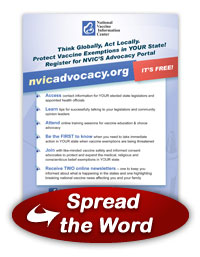
THINK GLOBALLY, ACT LOCALLY.
Mass vaccination policies are made at the federal level but vaccine laws are made at the state level, and it is at the state level where your action to protect your vaccine choice rights can have the greatest impact.
Signing up for NVIC's free Advocacy Portal at www.NVICAdvocacy.org not only gives you access to practical, useful information to help you become an effective vaccine choice advocate in your own community, but when national vaccine issues come up, you will have the up-to-date information and call to action items you need at your fingertips to make sure your voice is heard.
So please, as your first step, sign up for the NVIC Advocacy Portal.
Contact Your Elected Officials
Write or email your elected state representatives and share your concerns. Call them, or better yet, make an appointment to visit them in person in their office. Don't let them forget you!
It is so important for you to reach out and make sure your concerns get on the radar screen of the leaders and opinion makers in your community, especially the politicians you elect and are directly involved in making vaccine laws in your state. These are your elected representatives, so you have a right and a responsibility to let them know what's really happening in your life and the lives of people you know when it comes to vaccine mandates. Be sure to share the "real life" experiences that you or people you know have had with vaccination.
Share Your Story with the Media and People You Know
If you or a family member has suffered a serious vaccine reaction, injury or death, please talk about it. If we don't share information and experiences with each other, everybody feels alone and afraid to speak up. Write a letter to the editor if you have a different perspective on a vaccine story that appears in your local newspaper. Make a call in to a radio talk show that is only presenting one side of the vaccine story.
I must be frank with you; you have to be brave because you might be strongly criticized for daring to talk about the "other side" of the vaccine story. Be prepared for it and have the courage to not back down. Only by sharing our perspective and what we know to be true about vaccination will the public conversation about vaccination open up so people are not afraid to talk about it.
We cannot allow the drug companies and medical trade associations funded by drug companies to dominate the conversation about vaccination. The vaccine injured cannot be swept under the carpet and treated like nothing more than "statistically acceptable collateral damage" of national one-size-fits-all mass vaccination policies that put way too many people at risk for injury and death. We shouldn't be treating people like guinea pigs instead of human beings.
Internet Resources Where You Can Learn More
I encourage you to visit the following web pages on the National Vaccine Information Center (NVIC) website at www.NVIC.org:
- NVIC Memorial for Vaccine Victims: View descriptions and photos of children and adults, who have suffered vaccine reactions, injuries and deaths. If you or your child experiences an adverse vaccine event, please consider posting and sharing your story here.
- If You Vaccinate, Ask 8 Questions: Learn how to recognize vaccine reaction symptoms and prevent vaccine injuries.
- Vaccine Freedom Wall: View or post descriptions of harassment by doctors or government officials for making independent vaccine choices.
Connect with Your Doctor or Find a New One that Will Listen and Care
If your pediatrician or doctor refuses to provide medical care to you or your child unless you agree to get vaccines you don't want, I strongly encourage you to have the courage to find another doctor. Harassment, intimidation, and refusal of medical care is becoming the modus operandi of the medical establishment in an effort to stop the change in attitude of many parents about vaccinations after they become truly educated about health and vaccination.
However, there is hope.
At least 15 percent of young doctors recently polled admit that they're starting to adopt a more individualized approach to vaccinations in direct response to the vaccine safety concerns of parents. It is good news that there is a growing number of smart young doctors, who prefer to work as partners with parents in making personalized vaccine decisions for children, including delaying vaccinations or giving children fewer vaccines on the same day or continuing to provide medical care for those families, who decline use of one or more vaccines.
So take the time to locate a doctor, who treats you with compassion and respect and is willing to work with you to do what is right for your child.
See new "The Greater Good" Documentary for Free This Week
"The Greater Good" movie is a groundbreaking documentary about the vaccine safety and informed consent debate that is a "must see" for everyone who wants to learn more about the different scientific, health policy, economic, legal, ethical and political issues involved in the vaccination controversy. This film will help you educate others about how important it is to do your own research and learn more before you make a vaccination decision for yourself or your child.
You can see this eye-opening movie for free on Mercola.com this week only and also get the DVD of the film for $10 until supplies run out. Click here.
Source: Reuters October 3, 2011
Source: CNN October 3, 2011
Source: Video Transcript 1
Source: Video Transcript 2
Subscribe to:
Posts (Atom)
