Sunday, July 16, 2023

Discerning The Call

 Knowing when to Get out of the boat and take a risk does not only demand a courage; it also demands the wisdom to ask the right questions,  the discernment to recognize the voice of the Master, and the patience to wait for His command. Lord Jesus Christ is not looking for impulse-ridden Type Ts. He is looking the desire for what might be called the Type W, or water-walking personality. This involves the desire for adventure with God — the God-gene — and we all have one. It is part of our spiritual DNA. It requires both courage to take risks and wisdom to know which risks to take.


So how do I discern the difference between an authentic call from God to get out of the boat from my own rash impulse? 

How do I become a Type W follower? 

To probe this question further, let us   consider the biblical notion of calling.


Calling: A Reflection of God's Image


We begin with a theological question: What does God do all day! 

If you had to answer that question in a single word, what would you say? 

For most of us, if we are on an extended vacation or for some reason have a large block of unfilled time, What will I do today? is a major question. I'm bored is the primary complaint of both childhood and retirement. We are talking about the need to "kill some time such situations. God has all eternity. What does He do with all that time? Think He mostly sits around watching stuff ?

The biblical writers tell us what God Almighty does in a single phrase : He works. 

The opening lines in the Bible , of Genesis 1 are filled with God's work —He separates light from darkness,  He makes the sky and heavenly bodies, He gathers the waters, He forms first human beings from dust . The universe is run by God. 

O LORD, how manifold are YOUR works !

知道何时下船去冒险不仅需要勇气,还需要勇气。 它还需要提出正确问题的智慧,识别大师声音的洞察力,以及等待他命令的耐心。 主耶稣基督并不是在寻找冲动的 T 型人。 他正在寻找对所谓W型人格或水上行走人格的渴望。 这涉及到与上帝一起冒险的渴望——上帝基因——我们都有一个。 它是我们精神 DNA 的一部分。 承担风险既需要勇气,也需要智慧来知道要承担哪些风险。


 那么,我如何辨别上帝真实的呼召让我下船与我自己鲁莽的冲动之间的区别呢?

 我如何成为 W 型追随者?

 为了进一步探讨这个问题,让我们考虑一下圣经中呼召的概念。


 呼召:上帝形象的反映


 我们从一个神学问题开始:上帝整天都在做什么!

 如果你必须用一个词来回答这个问题,你会说什么?

 对于我们大多数人来说,如果我们正在休假或由于某种原因有大量空闲时间,我今天会做什么? 是一个主要问题。 我很无聊是童年和退休时的主要抱怨。 我们谈论的是需要“在这种情况下消磨一些时间。上帝拥有一切永恒。他用这些时间做什么?认为他大部分时间都坐在周围看东西?

 圣经作者用一句话告诉我们全能的上帝所做的事情:他工作。

 圣经创世记第一章的开头几行充满了上帝的工作——他将光明与黑暗分开,他创造了天空和天体,他聚集了水,他从尘土中创造了第一个人类。 宇宙是由上帝运行的。

 耶和华啊,你的作为何其多!

GOD IS 

CALLING YOU 

EQUIPPING YOU 

PREPARING YOU 

ACCORDING TO HIS PURPOSE

上帝在 Shàngdì zài

 呼召你、hū zhào nǐ,

装备你、zhuāngbèi nǐ,

让你按照他的目的做好准备

ràng nǐ ànzhào tā de mùdì zuò hǎo zhǔnbèi

Restore Qi in Traditional Chinese Medicine

中医补气 Zhōngyī bǔ qì Restore Qi in Traditional Chinese Medicine 

Though the main ideas and techniques of traditional Chinese medicine (TCM) are thousands of years old, these medical practices are still commonly employed in China, and are even being adopted around the world.


In China, you'll find a confusing mixture of modern and traditional medical practices. You may be confused, amused and even frightened by the traditional practices that you see and by the medical advice that you'll receive.


Read on for a better understanding of TCM...


Qi and the Yin-Yang Balance — TCM Theory

The core belief of traditional Chinese medicine (中医, zhōng yī, / jong ee/ ) is about the yin-yang (阴阳, yīnyáng) or qi balance in the body and its organs. There is no scientific evidence for the existence of qi. Yet the treatments result is profoundly obvious and mysteriously observable. 


What Is "Qi" Believed to Be?

It is believed that qi is life energy, and its flow in the body depends on the environment and what happens to the body. The balance of qi in the parts of the body depends on the flow of various kinds of qi and fluids. Injury, physical suffering, and lack of proper food causes a qi deficiency 气虚 (qìxū).


Yin Qi and Yang Qi

Most Chinese medicine practitioners think that there are many kinds of qi 气 (), and the most basic kinds are yin qi 阴气 and yang qi 阳气.


Everything is a balance of yin and yang. Yin 阴 is female, dark and formless. Yang 阳 is male, light, and form. Females have more yin qi, and males have more yang qi, and as people age, they lose qi.


Achieving a Yin-Yang Balance

It is theorized that each person and part of the body has an ideal point of balance of yin and yang for optimal health. Some techniques are more appropriate for increasing yang qi, and some are appropriate for decreasing yang qi, and likewise for yin qi.


The core idea of Chinese medicine is that people can increase or decrease the various qis in the body, and its parts, by various medical techniques, to create a healthful yin-yang balance.


How TCM Balances Qi for Better Health

Through use of Chinese herbs and medicines.

It is believed that qi deficiencies (i.e. poor health) in a person or a body part can be corrected by eating proper food, taking herbs and medicines, using physical manipulation such as cupping, moxibustion, acupuncture and massage, or doing meditation and physical exercise such as qigong.


How to Replace Qi

For example, if a woman is sick or weak from a lack of yin qi, she can eat foods high in yin qi such as melons or goji berries or various high yin herbs.


Older men may want to take herbal and food remedies, such as drinking ginseng tea or eating seahorse dishes, because they are high in yang content, or get a moxibustion treatment that adds Yang to the body.


How to Improve Qi Circulation

If, due to injury or stress, the qi circulation gets blocked or stagnated, all the above medical techniques can be used to unblock the qi channels called meridians, or increase or decrease the qi in various locations. However, a medical practitioner should help you decide which procedure will best help to cure your condition.


Qigong and tai chi practitioners think that special exercises and meditation helps the qi in the body to circulate. They think that by practicing, they can learn to control the motion of qi, and use the qi to heal injured body parts, cure diseases, get healthier, defend themselves, and live longer.


The Most Common TCM Techniques


Acupuncture: This strange and famous medical technique involves inserting needles at precise meridian points.


Fire cupping:This ancient practice isn't just a Chinese tradition, it has been practiced for hundreds and thousands of years across Eurasia and North Africa. The Chinese style uses the acupuncture meridians. It is used to remove yang from the body, and it is appropriate for conditions such as bronchitis, heat stroke, and hot weather-related conditions.


Traditional herbology and medicines:In many ways, Chinese herbal medicine is similar to Western herbal medicine, though the emphasis is on promoting the yin-yang balance.


Massage: It seems like there are massage parlors everywhere, and there are various styles that are all thought to be good for the health, some of which are more appreciated by Chinese than foreigners.


Medicinal cuisine: The emphasis in this traditional method of meal preparation, special recipes, and way of eating is to promote the yin-yang balance. 药用美食 Yào yòng měishí


Moxibustion 艾灸 Ài jiǔ: This is another surprising technique and is used to add Yang to the body. It is appropriate for women with birthing problems, older men, and cold weather-related health issues. The mugwort smoke is thought to have medicinal properties.


Qigong: Meditation and special exercise, such as qigong and tai chi also manipulates the qi balance and the body fluids in the body.


Physical Exercise click here

Click here for more 

Saturday, July 15, 2023

Write a Love Letter to Yourself

💌

Write a Love Letter to Yourself


Writing a letter to yourself can help you establish a dialogue with yourself and gain self-awareness about how you're thinking and feeling. 

This, in turn, will help you make choices and take the next steps in your life.


Dear Self,

We've been together since the beginning, and it's thanks to you that I get to experience this life. You are closer to me than anyone, the only one who knows all that I've seen and done. The only one who has witnessed the world through my eyes. Who knows my deepest thoughts. My darkest fears. And my biggest dreams.

We've been through a lot together—everything, in fact. The highest highs, and the lowest lows. You're with me in my greatest moments and the ones I'd like to do over. And no matter what, you've always stuck by me. We are true partners—you are the only one About whom I can say without a doubt that we will always be together.

But in spite of your loyalty, and your caving, I've sometimes ignored you. I haven't always listened when you told me what's best for me or nudged me in the direction I should go. Instead of looking to you, I looked outward, at what others were doing or saying. I distracted myself, so I couldn't hear your voice. Instead of caring for you, I sometimes pushed too hard. And yet you’ve never abandoned me. You’ve always forgiven me. And you’ve always welcomed me home, without judgment or criticism.

For all of that, I thank you. Thank you for being gentle with me. For being strony. For always being willing to learn and grow with me through my mistakes, and my triumphs. And for over and over reflecting back to me the best of what is inside me. Thank you for showing me what unconditional love truly means.

Love, 

Me

(64 of 286)


Meditation for Solitude


This meditation is focused on self-love. 

When we practice love and gratitude for ourselves, we nourish the soil in which love is rooted, and from which love in its many forms will grow and blossom.

This meditation is best practiced in bed, before you go to sleep at night and when you wake up in the morning.


1. Find a comfortable position.

2. Close your eyes, if that feels good to you. If not, simply soften your focus.

3. Whether your eyes are open or closed, gently lower your gaze.

4. Take a deep breath in. And breathe out.

5. If you find that your mind is wandering, that’s okay. Gently bring it back to a space of calm, balance, and stillness.


Self-Gratitude Meditation


1. Breathe normally and naturally. Take a moment to notice the pattern of your breathing.


2. Allow your focus to shift to your body. Notice where it touches the bed, and   where it does not. If there’s a sheet or blanket on you, notice the sensation   where it touches your skin.


3. Now, bring your attention to the soles 🦶🏽  of your feet 🦵 🦵. Notice how they feel.

Express gratitude to your feet 🦶🏽  🦶🏽 for what they allow you to do. “I am grateful for your support. I am grateful for how you ground and connect me to the earth. I thank my Creator for you, I love you my dear feet” Use whatever language feels natural and welcome to you.


4. Allow your attention to move upward to your lower legs, your knees, and your thighs. Notice how they feel. Express gratitude to them. “Thank you for your steadiness. Thank you for helping me move around in the world.” (66 of 286)


5. Bring your focus to your arms 💪🏽 💪🏽 . Notice your upper arms, elbows, forearms, and hands  🙌. Give thanks. “Thank you for all you do to help me interact with the world around me, enabling me to care for and express myself.”


6. Allow your attention to shift to your face 👨🏻 . Notice the nose 👃 that lets you smell, the mouth 👄 that enables you to eat, the eyes 👀 that let you see, and the ears 👂 👂 that let you hear. Express your gratitude. “I’m grateful for the richness you bring to my life, allowing me to enjoy nourishing food, to hear music, to smell flowers, and to take in the beauty of nature and the world around me.” 


7. Now, take a moment to go inside, beneath the skin. Scan slowly downward, starting with your brain 🧠 . Express gratitude to your brain for all the important functions it is able to perform. “Thank you for all you do to coordinate and monitor this miraculous organism that is me. For enabling me to process information, to think, to joke, to appreciate, to feel compassion, and to take action.”


8. Lower your focus to your heart 🫀❤️ . Notice its rhythm as it beats inside your chest. Express your gratitude. “Thank you for working all day and all night, whether I appreciate you or not. Whether I acknowledge you or not.”


9. Shift your attention to your lungs 🫁 . Notice how your rib cage softly expands   and collapses with each breath. Give thanks. “Thank you for filling me with life.”


10. Allow your attention to drop to your stomach. Notice how it feels. Thank your stomach. “I am grateful for how you digest food to create the energy I need for each day.”


11. Slowly, shift your focus back out to your whole body. Take a moment to express gratitude to your body, or to your mind, for whatever stands out to you in this moment.

(67 of 286)


Friday, July 14, 2023

First Loves (Rules of Love)

First Loves

Our ideas of love are also shaped by our early romances. 

In 2015, the artist Rora Blue invited people to anonymously post messages to their first loves. 

Over a million people responded with notes like, “You ruined me, but I still write you love notes on paper plates and napkins” and “You'll always be etched into my bones” and “I loved losing myself in you, but it’s been forever and I still can’t find myself” and “If I keep my eyes closed he looks just like you.” 

There’s a biological reason first loves create samskaras

A key area of our brain—the prefrontal cortex—doesn’t develop fully until we’re about twenty-five years old. 

As brain expert Daniel Amen describes it, the prefrontal cortex helps us to think before we speak and act, and to learn from our mistakes. 

Young people “think” with their feelings. 

Without a fully developed prefrontal cortex filter, much of our mental life runs through our amygdala—a brain center associated with emotional processes like fear and anxiety. 

As we age, our passion is tempered by reason and self-control, and we don’t feel with the same wild abandon. 

Those of us who felt the passion of young love may remember it as more intense than anything in adult life, even if it wasn’t ideal or even healthy.


The first time you enter a relationship out of pure infatuation, the person might break your heart. 

If you don’t accept the lesson and enter your next relationship again out of infatuation, then the second time, you might find yourself bored and acting out of character. 

The third time, the person might steal your money. 

Karma will bring you the same lesson through a different person again and again until you change. 

And sometimes it will bring you the same lessons with your partner over and over again. 

Vedic teachings say that there are three levels of intelligence. 

In the first level, when someone tells you the fire will burn you, you listen and learn and never touch fire. 

In the second level, you experience it for yourself. 

You touch fire, it burns you, and you learn not to touch fire again. 

In the third level, you keep burning yourself, but you never learn. 

If we don’t heed our karma, we’re stuck in the third level of intelligence, and we bear the scars. 

We forget that what we experienced in the past holds information about how we'll feel if we do it again. 

Often, when we believe that we have bad luck in relationships, the real problem is that we keep ignoring the data and refusing the karmic lesson. 

In other words—if you don’t learn anything, you repeat the same mistake. 

Karma encourages you to reflect on the choice, the reason you made it, and what you should do differently next time.

(50 of 286)

Let’s look deeply at some of the “types” we date and what karmic lessons they have to offer.

The Rebel. In the movie I Know What You Did Last Summer, Julie says to Ray, “I hate this, I really hate this. You’re gonna go and you’re gonna fall for some head-shaven, black-wearin’, tattoo-covered, body-piercing philosophy student.”

Ray answers, “That sounds attractive.”

This character is found over and over again in literature and movies—from Rochester in Jane Eyre and Heathcliff in Wuthering Heights to Edward in Twilight.


Being attracted to someone who bucks the system isn’t necessarily a mistake.

 But if you keep hoping adventure and mystery will give way to loyalty and responsibility, it’s time to learn from your choices. 

Why are you attracted to this person? 

Are they offering you the relationship you want? 

If you’re ready to move into a deeper commitment, then you'll need to choose someone based on the qualities they have to offer instead of just their rebellious allure.


FIVE TYPES WE FALL FOR

◇ Rebel 🎲 

◇ Chase 🎈 

◇ Project  🔧 ⚒️🛠️

F- boy 💌💟💞

◇ Opulent One 💰💲 🤑 


The Chase. Sometimes we're drawn to someone who is emotionally, even physically unavailable. 

They keep moving, but sometimes pause just long enough to keep us hoping. (51 of 286)

We are enchanted by them, so we convince ourselves that they will stop in their tracks and suddenly give us their time and attention. 

We’re sure that once they finally focus on us, they'll fall in love with us. 

So we commit ourselves to tracking them. 

Where are they? 

How are they spending their time when they could be with us? 

When will they call? 

How can we make ourselves visible and available without seeming desperate? 

When we are caught up in the chase, we are not getting to know a person, discovering compatibilities, learning about each other, and growing together. 

All of our romantic energy is invested, but there is no return.


In her book Why Him? Why Her? anthropologist Helen Fisher, the chief scientific advisor for Match.com, explains that playing hard to get creates a phenomenon she calls “frustration attraction.” 

She writes, “Barriers intensify feelings of romantic love... probably because the brain pathways associated with pleasure, energy, focus and motivation keep working when a reward is delayed.” 

However, she adds that researchers have looked at the eventual result of playing hard to get and found no evidence that it helps establish a long-term relationship. 

No matter which side of hard-to-get you’re on, if you are not spending time together, you’re not building a relationship.


If you’re drawn to the thrill of the chase, be aware of what you’re choosing. 

If you start a relationship with a musician who is constantly on the road, then you can’t expect them to give up their career and spend all their time with you. 

When someone is unavailable, they will generally stay that way. 

Are you drawn to them because you are looking for someone who is as busy as you are? 

Or did you grow up with an unavailable parent, so that is the only level of love you think you deserve? 

To use your karma well, you must be conscious of who you're choosing, why, and whether they fit what you want in your life, as you began to explore in Rule 1.


The Project. 

Sometimes a partner needs saving. 

You are compelled to take care of them, giving them attention, help, and stability. 

This may play to your nurturing side. In the short term it makes you feel competent and in control. 

They need you, and you feel like you can help them live a better life. 

But in the long term if they aren’t transforming, you feel drained and resentful because you've become that person’s caregiver. (51 of 286)

You’re not equals. 

And you're investing far more in the relationship than they are.


Dominating a relationship bolsters our ego and makes us feel important. 

It doesn’t require us to question ourselves or to follow our partner’s suggestions. 

But ultimately it interferes with the long-term connection we’re trying to form. We're attracted to the dynamic rather than the person. 

If you love the role of  guiding, leading, and giving advice, you can find that elsewhere in your life.

==========

TRY THIS:

RELATIONSHIP ROLES

Here are some questions to help you examine what role you played in your most recent relationship or expect to have in a new relationship. 

Is it what you want? 

You'll play all the roles I describe below, but you want to move toward being supporters of each other while consciously allowing for moments of being fixers and dependent.


TYPE 1: FIXER

Did you find yourself constantly trying to solve, nurture, help, or make the other person better? 

Were you trying to carry them, trying to make their goals happen for them?


TYPE 2: DEPENDENT

Did you feel like you relied on your partner too much? 

Did you go to them with all your issues and expect them to find solutions?


TYPE 3: SUPPORTER

Did you like their personality, respect their values, and want to help them toward their goals?


Did you respect how they spent their time and kept their space, or did you always want them to change it?


The fixer has a parental mentality. 

You feel that it’s your responsibility to take care of the other person, nurture them.

 Their happiness is your priority.

(53 of 286)

This mentality can be useful, but it can also go overboard. 

When you parent your partner, it makes them behave like a child.


The dependent has a childlike mentality.

 You rely on your partner. 

You want them to figure it all out, and you get upset when they can’t solve everything for you. 

Sometimes we settle into this mentality when we have a domineering partner. 

It can feel comforting to have someone else take the lead. 

But we lose out when we don't follow our own path and shape our own lives.


The supporter is their partner’s champion. 

You're not a parent, you're not a child, you’re side by side with your partner. 

You're trying to take responsibility; you’re trying to develop patience; you're trying to help the other person grow, but you're not trying to micromanage. 

This is the Goldilocks “just right” mentality.


For a quiz to help figure out the relationship role that you play, please visit www.RelationshipRoles.com.


Its natural to move in and out of all three of these roles throughout our relationships. 

Sometimes we take the lead. 

Sometimes we're more comfortable following. 

What we're trying to avoid is dating a type with whom we are stuck in the same dynamic all the time.


Being a full-time fixer means your partner isn’t taking their own journey. 

We don't have the right to take it for them. 

It’s not our role to fix something that may not even be broken. 

Being fragile full-time means you lack confidence and seek validation from others. 

You feel broken and want someone to fix you. 

Being with someone who supports this side of you interferes with you taking responsibility for your own growth, joy, and SUCCESS.


The supporter is an ideal to strive for. 

Both partners communicate as equals. 

Your partner is always teaching you, but you are always teaching them. 

And when you both understand that

 you’re both teaching and learning at the same time, that’s when you create a partnership. (More on this in Rule 3.)

==========

The F-boy or F-girl.

 When we date someone who sleeps around, they are clearly communicating that they aren’t interested in an exclusive commitment. 

If that’s what you’re looking for, consider whether it’s worth staying in it for great sex. 

Sex can distract us from making good choices about who to be with and whether to stay with them, and one of the biggest causes of that distraction is the hormone oxytocin. 

According to neuroscientist and psychiatrist Daniel Amen, oxytocin is related to feelings of being in love, and the release of oxytocin can support and even accelerate bonding and trust.

(54 of 286)

Generally, men have lower levels of oxytocin than women, but sex causes men’s oxytocin levels to spike more than 500 percent. 

New York University neuroscientist Robert Froemke says that oxytocin acts like a volume dial, “turning up and amplifying brain activity related to whatever someone is already experiencing.” 

During and after sex, we feel more in love, but it’s not actually love. 

We feel closer chemically even though we’re not closer emotionally. 

Additionally, the hormone actually has a temporary blocking effect on negative memories, so all of those “little things” that were bothering you or that argument you had beforehand—which might have been a major warning sign— could fade after sex.


When I interviewed husband-and-wife relationship experts John and Julie Gottman on my podcast, John said that oxytocin can be the “hormone of bad judgment.” 

He says, “You keep thinking it’s going to be okay because that hormone makes you feel safe and secure and you don’t see the red flags the person is sending saying, ‘I’m not trustworthy.”


If someone makes it clear that they aren’t interested in committing, there can still be a fun connection, but know that you aren’t likely to learn much from them.


The Opulent One. The Bhagavad Gita talks about six opulences: knowledge, fame, money, beauty, strength, and renunciation. 

Sometimes we are attracted to someone who has a single opulence, and this is enough to prematurely convince us were in love. 

In Beyoncé’s song “Halo,” the light surrounding someone convinces her they’re “everything [she] need[s] and more,” yet someone’s “halo” isn’t necessarily an accurate indicator of who they are. 

In psychology, the halo effect is a type of cognitive bias where we form an inaccurate impression of someone or something based on a single trait or characteristic. 

For instance, if someone is attractive, we’re more likely to assign other positive attributes to them, like intelligence, wit, or kindness. 

This particular halo effect is called the attractiveness stereotype. 

One study showed that teachers graded attractive students more favorably when the class was in person, but not when the class was online and the teachers couldn’t see the students. 

Other studies showed that servers deemed to be more attractive made higher tips. 

When we see a good-looking person, we might make unconscious assumptions that they’re wealthier, or more ambitious, or more likable, and so on, and this can influence our attraction to them.(55 of 286)

The Bhagavad Gita says that the six opulences show us the fallibility of desire. 

We want attention but a million likes won’t make us feel loved. 

We want beauty, but we try to make youth (which is not the only kind of beauty) last forever. 

We want money, but it won’t buy happiness. 

Try googling “lottery winners” if you want proof of that. 

If we look for the opulences in a partner, we are being sold a temporary bill of goods. 

The Bhagavad Gita says that divine love of God is to know their greatness but gravitate to their sweetness. 

You may know all of your partner’s accolades and achievements, but that doesn’t define them as an individual. 

Being attracted to our partners for what they have or what they’ve achieved is not a bad place to start, but it’s not a good place to end. 

Abilities and achievements don’t matter so much as qualities and actions. 

We make the mistake of assigning qualities to people based on their abilities. 

We assume that a good communicator will be trustworthy. 

We think a writer must be thoughtful. 

A manager must be organized. 

The only way we can know what qualities a person truly has is by spending time with them and observing them.

Only when we know someone intimately and deeply do we find the sweetness in them.

===========

TRY THIS:

REFLECT AND LEARN FROM A PAST RELATIONSHIP 

We tend to base success in relationships on how long they last, but their actual value lies in how much we learn and grow from them. 

If we understand that, we can examine the choices we've made, assess why we picked a person, figure out what went wrong, and develop a better sense of whom to pick and whether we need to change anything for next time.


1. What energy were you in when you chose to be with your ex?

(56 of 286)

Energy of ignorance

In this energy, you might have picked someone because you were bored, because there was nobody else around, or because you were lonely. 

Choices made in ignorance lead to depression, pain, and stress.


Energy of passion

In this energy, you picked someone because you wanted one of the opulences. 

Decisions made in passion start well but have to deepen into understanding and respect or else they end terribly.


Energy of goodness

In this energy, you chose someone with whom you felt connected and compatible. 

There was mutual respect, and often these relationships end with some feelings of respect still intact.

2. Why did it end? Be as honest with yourself as you can when you assess what went wrong in this relationship.

3. Learn from it. What can you think of that you will try to do differently next time? 

Can you enter your next relationship from an energy of goodness? 

Can you set aside opulences and look for qualities that make good partners?

===========

You Attract What You Use to Impress

The opulences highlight a very practical way of understanding karma. 

If we are attracted to someone for their ambition, that’s what we get—a person whose priority is ambition. 

There’s nothing wrong with ambition... until you realize that you want someone who has lots of time to share with you. 

Sometimes we feel like none of the options before us are people we want to date. 

And then we have to ask ourselves, 

Why are these my options? 

Why are we attracting these people, and how can we attract the ones we want? 

Again, karma has the answer. 

If you put something into the world, you get it back. 

This is karma in its most basic form. 

If I use money to present myself as valuable, 

I'll attract someone who believes that money is what makes me valuable.


When we present ourselves, we are signaling the dynamic we want, how we expect to be treated, what we think we deserve. 

I had one client who was a successful entrepreneur. 

He was upset because every woman he met “only wanted him for his money.” 

But every picture he posted in his online profile showed him in a supercar or him in front of another home he’d bought. 

He said, “I’m not like that in person.” 

But he shouldn’t have been surprised that he was attracting a certain type of person.

(57 of 286)

If you use wealth to impress someone... you are committing to whatever it takes to sustain your wealth. But one day you may want to change how you spend your time. You may want to feel that your partner values you for more than your net worth.


If you use your body to impress someone... you are putting yourself in a position where aging is hard to accept. One day your body will change, and you may want a partner whose love will last for years.


If you use your social status to impress someone... you may find that someone with a higher social status is more attractive to your partner. Or something may change your status and you’ll want a partner who can support you through a hard time.


If you use your intellect to impress someone... you may find that you dont feel an emotional connection.


If you use sex to impress someone... you are setting a standard for physical connection that may be hard for one or both of you to sustain if attraction fades.


When we put ourselves out in the world, whether it’s on a first date, social media, or a dating profile, we are saying, “This is the version of me that I want you to like.” 

It’s important to put out the version of yourself that you want someone to be attracted to, as opposed to the version of yourself that you think someone would be attracted to. 

These are two different things. 

If you attract someone through a persona, then you're either going to have to fake being that promotable person forever, or they’re eventually going to discover the real you.


One study showed that 53 percent of online daters lied in their profiles— women more than men, and more often about looks (doing things like posting an old photo so they looked younger), and men more often about financial status. 

Considering that men tend to rank physical attractiveness as a highly valued characteristic in a potential partner and women tend to rank financial success similarly, you can see how that might play out, at least in heterosexual relationships. 

Even if your self-positioning is more subtle, and you’re willing to play out the role you’ve invented indefinitely, you will always know in your heart that you aren’t loved for who you really are. 

You’ve made them fall in love with a character that you created, not you. 

By pretending to be someone else, you will attract strife into your life. 

Save yourself that time and energy. 

(58 of 286)

It’s natural to want to present the best version of yourself. 

You may be doing this through the opulences, whether by trying to slip where you went to college into conversation or taking your date to an expensive restaurant to demonstrate wealth or uploading your most seductive photos to a dating website. 

We can easily get caught up in judging ourselves by our net worth, or the way we show it in material possessions; our friends or followers; our physical appeal. 

But we all know people who have high “value” using these metrics and still have low selfworth. 

There is a saying that the poor man begs outside the temple while the rich man begs inside it. 

Or, as Russell Brand puts it, “The more that I've detached myself from the things that I thought would make me happy like money and fame and other people’s opinions, the more truth is being revealed.” 

We market ourselves to others using our opulences, but doing that won’t benefit us in the long run. 

We want to show our real personality, values, and goals, so we are loved for what matters most to us.


The converse is also true. 

Be aware if opulences are what attract you to your partner and beware if they’re all that attracts you. 

You don’t want to end up with someone whom you're only attracted to physically, or whose social life captivates you, or whom you only connect with about work, or whose external success compels you. 

These qualities are tied to temporary situations and characteristics. 

They won’t last, and when they are gone, so is the relationship.


When I met Radhi, I had nothing. 

No—that’s not true. 

What’s true is that we've been together ever since all I had to offer her was myself, and that seemed to be enough.

============

TRY THIS:

WHAT YOU SHOWCASE

When there's a disparity between what attracts your partner and what you love about yourself, you may struggle to live up to their vision. 

First, make a list of what you love about yourself. 

Think about the qualities you are most proud of and try to steer clear of the opulences. 

Are you kind, caring, hardworking, honest, creative, grateful, flexible, reliable? (59 of 286)

Now, for each of your long-term or defining relationships, make a list of the qualities you think that person saw and appreciated in you. 

We want to build relationships where we are loved for what we love in ourselves.


What You Want from Someone Else First Give to Yourself

Once we have a better sense of the samskaras we’ve gathered over the years, we can look at how they’ve influenced our choices and see if we like the results. 

We don’t want to make the same mistakes over and over again. 

We want to carry the gifts from our pasts into the present, but we can’t assume our partner will receive them exactly as we expect. 

We don’t want to bring gaps to our relationships, expecting our partner to fill them. 

We want to fill our own gaps.


As you observe your partner or potential partner, consider what draws you to them.

 Is your judgment influenced by outdated criteria from your past? 

If your parents gave you all their attention, are you expecting that from a partner? 

Do the movies you saw in your youth have you expecting to be swept off your feet? 

Was your first love remote and unavailable, so you’re stuck in a pattern of repeating that dynamic? 

One of my clients was getting really angry at his wife when she didn’t come home from work on time. 

I asked him why he was having such a strong reaction, and in the course of our work he realized that his own mother never came home on time, and it had bothered his father. 

He had “inherited” his father’s anxiety. 

I asked him what his wife’s lateness signified for him. 

After some thought, he said, “It’s like she doesn’t care about me and doesn’t want to spend time with me.” 

I suggested that he ask his wife about it, and we talked about how instead of saying, “So how come you're always late?” in an accusatory tone, he could ask, “What have you been working on? 

Is it exciting or stressful?” 

It turned out that his wife was stressed about a project, and that she thought in three months’ time she’d be able to start coming home earlier. 

She didn’t realize that it would have eased his mind to know about this project and when it might end, but even more important was his realization that the reason for her lateness differed from his interpretation. 

It wasn’t a perfect happily ever after, but he was able to come to terms with the situation instead of enduring his inherited anxiety. (59 of 286)

He asked for time with her over the weekend, and they figured out how to address both of their needs.


Our relationships aren’t supposed to be responses to what our parents did and didn’t give us or balms for the insecurities of our youth. 

If we look to our partners to fill an emotional gap, this puts undue pressure on our partner. 

We are asking them to take responsibility for our happiness. 

That’s like saying, “I won’t drive my car until my partner puts gas in it.” 

Why wait for someone else to make you feel good? 

And that’s why it’s so deeply important that we heal ourselves, taking charge of that process instead of shifting blame and responsibility to a partner. 

If we’re trying to fill an old void, we'll choose the wrong partner. 

A partner can’t fill every gap. 

They can’t unpack our emotional baggage for us. 

Once we fulfill our own needs, we’re in a better place to see what a relationship can give us.


Meanwhile, and always, you can give yourself what you want to receive. 

If you want to treat yourself, you could make plans to go someplace you’ve never been before, or arrange a birthday celebration for yourself, or dress beautifully for an upcoming event. 

If you want to feel respected at work, you could decide that you’re going to make a list for your own benefit of everything you contributed to a project. 

We think of feeling appreciated, respected, and loved as core needs in a relationship, but when we attend to these needs for ourselves in small ways every day, then we don’t have to wait for our partner to deliver them through a grand gesture.

===========(61 of 286)

TRY THIS:

GIVE YOURSELF WHAT YOU WANT TO RECEIVE 

Fill your own gaps by looking for ways to treat yourself the way you're looking for others to treat you.

I never felt appreciated by my parents.

If you want to be appreciated... 

What do you want to be appreciated for? 

What can you do every day that makes you feel appreciated?


I never felt like my parents thought I was special.

If you want to feel special...

What do you want to feel special for?

What can you do every day to make yourself feel special?


My parents didn’t respect my feelings or opinions.

 If you want to feel respected...

What do you want to be respected for?

What can you do every day to respect yourself?


These are hard questions, so take your time with them. 

Answers may not come quickly. 

Ponder them for a day.

 A week. 

You may gradually start to identify recurring negative thoughts that you've carried from your past. 

If you keep telling yourself, l'm nobody until someone tells me I’m someone, it will make you more prone to insecurity, stress, and pressure. 

It's not what others say or don't say about you, it is what you say about yourself that matters.  

If you often tell yourself that you’re not good enough, you become not good enough. 

We need to disrupt those negative patterns by developing new thought patterns. 

It may feel forced or fake, but when you practice these new, positive thought patterns, you start living up to them.

=============

Check In With Yourself

Set aside three minutes before you start your day and three minutes at the end of your day to make sure you're filling your own gaps. 

Attaching new habits to the beginning or end of things is natural to us and the best way to bring the behaviors and beliefs we need into our lives.


In the three minutes you’ve set aside in the morning, sit by yourself and pick one thing you can do for yourself today to improve your day. 

It might be deciding to make a lunch date with a friend you haven’t seen in a while. 

It might be showing up at a yoga class or taking no phone calls for the first hour of the morning. 

To wake up and hope the day will be great is outsourcing the day. Instead, pick just one act you can perform yourself that might change your day for the better.

(62 of 286)

In the last three minutes of the day, assess how you felt about the one thing you picked. 

Did it help your day? 

Should you try it again tomorrow or choose something else?


Expanding Our Love


Our preparation for love began with two rules guiding us to solitude and selfexamination. 

We began practices to transform loneliness to productive time in solitude. 

We unpacked our pasts and began to unlock our samskaras so that we can learn from our karma. 

Whether you’re in a relationship, looking for one, or leaving one, these rules help you build and maintain the skills you need for love. 

By now, you're already better prepared for love than most people! 

And that opens the door for you to share your love with another person. 

One of the translators of the Bhagavad Gita, Eknath Easwaran, said, “Love grows by practice, there’s no other way.” 

Now, as we move into the practice of love, we will build our ability to recognize love, define it, develop it, trust it, and, if and when we are ready, to embrace love.

(63 of 286)


Click here to read on .... Write a Love 💌 Letter to Yourself 


Sunday, July 9, 2023

Australian woman's toes amputated after fish spa pedicure on holiday

 Australian woman's toes amputated after fish spa pedicure on holiday.

Yahoo News Australia (and agencies).

14 September 2018.

澳大利亚女子度假时做鱼疗足疗后脚趾被截肢。

 澳大利亚雅虎新闻(和机构)。

 2018 年 9 月 14 日。

WARNING, GRAPHIC CONTENT: An Australian woman was left devastated after an indulgent Thai holiday fish spa turned into a living nightmare when an infected fish tank led to all five toes on her right foot being amputated.

警告,图片内容:一名澳大利亚妇女在享受泰国假日鱼疗后变成了一场活生生的噩梦,因为受感染的鱼缸导致她右脚的五个脚趾全部被截肢。

Property manager Victoria Curthoys, 29 from Perth contracted an infection in her big toe after stepping on glass, resulting in doctors amputating half of her toe.

来自珀斯的 29 岁物业经理维多利亚·柯托伊斯 (Victoria Curthoys) 在踩到玻璃后大脚趾感染,导致医生截掉了她的半个脚趾。

Four years later, while on holiday in Thailand in 2010, Victoria used one of the ever-popular fish spas whereby small freshwater fish feed off and remove the foot’s dead skin.

四年后,2010 年,维多利亚在泰国度假时,使用了一种非常受欢迎的鱼疗中心,小淡水鱼以小淡水鱼为食,并去除脚上的死皮。

The fish spa treatment, which has soared in popularity over the past decade, involves placing one's feet in a tank containing hundreds of Garra rufa, a small species of cyprinid fish native to rivers, ponds, streams and lakes in West Asia and Anatolia.

鱼疗在过去十年中迅速流行,其中包括将脚放入装有数百条 Garra rufa 的水箱中,Garra rufa 是一种小型鲤鱼,原产于西亚和安纳托利亚的河流、池塘、溪流和湖泊。

Once human's feet enter the water, the fish immediately congregate around patches of dead skin to feed, eventually leaving them silky smooth. Fish pedicures are also believed to alleviate the symptoms of eczema and psoriasis.

一旦人类的脚进入水中,鱼立即聚集在死皮周围进食,最终使它们变得丝滑光滑。 鱼足疗也被认为可以缓解湿疹和牛皮癣的症状。

The fish spa treatment gave Victoria another infection, this time to the bone of her big toe, from a waterborne bug only found in Thailand, which had seeped through the wounds from her earlier surgery.

鱼疗给维多利亚带来了另一次感染,这次是她的大脚趾骨,这是一种仅在泰国发现的水生细菌,这种细菌是从她之前手术的伤口中渗入的。

Upon returning to Perth, Victoria was forced to see doctors after the infection left her with fevers and sickness.

返回珀斯后,维多利亚因感染导致发烧和生病,被迫去看医生。

After a year of tests, a doctor eventually diagnosed her with osteomyelitis, a rare and serious condition involving infection of the bone.

经过一年的检查,医生最终诊断她患有骨髓炎,这是一种涉及骨骼感染的罕见而严重的疾病。

Despite her declining state of health, it took doctors over a year to diagnose the disease as Schwelmenella, an infection which eats away at the bone, eventually forcing doctors to amputate the entire big toe in December 2012.

尽管她的健康状况每况愈下,医生还是花了一年多的时间才诊断出她的疾病为舒韦尔门氏菌(Schwelmenella),这是一种侵蚀骨头的感染,最终迫使医生在 2012 年 12 月截掉了整个大脚趾。

Two years later, Curthoy's big toe on her right foot had to be amputated to contain the disease. However, it didn't get rid of the infection fully. The doctors then told Curthoys she had no choice but to remove all the remaining toes on her right foot—a procedure that took five years to complete.

两年后,柯索伊的右脚大脚趾不得不被截肢以控制病情。 然而,它并没有完全消除感染。 医生随后告诉柯索伊斯,她别无选择,只能切除右脚所有剩余的脚趾——这个手术花了五年时间才完成。

After the initial infection was removed through amputation, the pressure of walking on her smaller toes left Victoria with rough calluses and further infections, eventually leading to Victoria’s other four toes being removed over the course of the next five years.

在通过截肢去除最初的感染后,用小脚趾行走的压力使维多利亚长满了粗糙的老茧和进一步的感染,最终导致维多利亚的其他四个脚趾在接下来的五年内被切除。

“When I was 17 years old I received a cut on the bottom of my big toe after cutting it on some glass,” said Victoria.

“当我 17 岁的时候,我的大脚趾底部被玻璃割伤了,”维多利亚说。

“I didn’t notice it was cut as it was on the bottom of the toe and not causing me any pain.

“我没有注意到它被割伤了,因为它位于脚趾底部,没有给我带来任何疼痛。

“It took me a while to realise it was there so by that time I already had an infection in the bone, so the doctors amputated half of the big toe.

“我花了一段时间才意识到它在那里,所以那时我的骨头已经感染了,所以医生切除了一半的大脚趾。

“Then when I was in Thailand I decided to use a fish spa. I thought nothing of it as I’d watched the owner set up the system and it looked very clean, but how wrong I was.

“然后,当我在泰国时,我决定使用鱼疗。 我没有多想,因为我看到业主设置了系统,看起来很干净,但我错了。

“I ended up getting another bone infection in my big toe and it took doctors over a year to figure out what type of bug I had. By the time they’d realised what it was, my entire toe bone had been eaten away and I’d been suffering from sickness the whole time.

“我的大脚趾最终再次出现骨感染,医生花了一年多的时间才弄清楚我感染的是哪种细菌。 当他们意识到那是什么时,我的整个脚趾骨都被吃掉了,而且我一直在生病。

“They eventually decided to take the big toe off completely. I felt relieved that I could go back to my life without being sick all the time and I was determined to get better, so I could show the doctors I had been right the whole time.

“他们最终决定完全去掉大脚趾。 我感到很欣慰,因为我可以回到原来的生活,不再一直生病,而且我决心变得更好,这样我就可以向医生证明我一直都是对的。

“A year of walking without a big toe caused ulcers on the second toe from the pressure placed on it. It had a rough callus over the top, but I was unaware that underneath that there was another raging infection.

“一年没有大脚趾行走导致第二个脚趾因压力而溃疡。 它的顶部有一个粗糙的愈伤组织,但我没有意识到下面还有另一种严重的感染。

“This time, the doctors took the second toe and left me with three toes.

“这一次,医生拿走了第二个脚趾,只剩下三个脚趾。

“I was healthy for another two years, I thought I was very lucky to still have my foot and carried on with my life. But then I started to get sick again.

“我又健康了两年,我认为我很幸运,我的脚还活着,并继续我的生活。 但后来我又开始生病了。

“Every morning I would be vomiting and constantly had a fever, but X-rays weren’t showing any signs of infections, so the doctors fobbed it off for a long time and they told me it was all in my head.

“每天早上我都会呕吐,并且不断发烧,但X光检查没有显示任何感染迹象,所以医生很长一段时间都隐瞒了我的情况,他们告诉我这都是我的想法。

“It wasn’t until my podiatrist ordered blood samples that they realised that I did in fact have another bone infection and I had a very high white blood cell count. This was why I was feeling so terrible.

“直到我的足病医生订购了血液样本,他们才意识到我实际上确实患有另一种骨骼感染,而且我的白细胞计数非常高。 这就是为什么我感觉如此糟糕。

“In November 2016 my doctors took the third and fourth toes, but for some reason they left the small toe.

“2016 年 11 月,我的医生取走了第三和第四个脚趾,但由于某种原因,他们留下了小脚趾。

“Because the little toe was the only one left, I kept knocking it and when I walked, and all the pressure would go onto the little toe.

“因为只剩下小脚趾了,所以我一直敲它,走路的时候所有的压力都会转移到小脚趾上。

“Last year I noticed my small toe wasn’t looking very happy and there was some liquid on my sock, but I couldn’t see any cuts.

“去年,我注意到我的小脚趾看起来不太高兴,袜子上有一些液体,但我看不到任何伤口。

“After a few blood samples and more X-rays, they discovered another bone infection, so they finally took the last toe in November 2017.”

“在采集了一些血样和更多的 X 光检查后,他们发现了另一种骨头感染,所以他们终于在 2017 年 11 月取走了最后一个脚趾。”

Despite losing all of her toes, Victoria is glad to no longer suffer from infectious diseases and she wants to warn others against using the fish spas which caused her so much devastation.

尽管失去了所有的脚趾,维多利亚很高兴不再患有传染病,她想警告其他人不要使用鱼疗,因为鱼疗给她带来了如此多的伤害。

“I can honestly say that my foot has never been as healthy as it is now. Now I can put pressure on my foot,” said Victoria.

“我可以诚实地说,我的脚从来没有像现在这样健康。 现在我可以对脚施加压力了,”维多利亚说。

“Now and again I tend to trip because of the lack of feeling and having to get used to not having any toes, but I’ve been very lucky to be able to just get back up and walk.

“有时我会因为缺乏感觉而绊倒,并且不得不习惯没有脚趾,但我很幸运能够重新站起来行走。

“My parents are proud of me and my friends think I’m awesome because I’ve been through a lot, but at the end of the day I’ve seen people with far worse injuries and life-altering illnesses, so I consider myself lucky.

“我的父母为我感到骄傲,我的朋友们认为我很棒,因为我经历了很多事情,但归根结底,我看到人们受到更严重的伤害和改变生活的疾病,所以我认为自己 幸运的。


Saturday, July 8, 2023

What Does the Chinese Character 家 Mean?

 家 

家 (jiā) means family, home, or house in Chinese. Read on to learn about its counterintuitive character development and other Chinese vocabulary words that include the character 家.

 Jia is the chinese symbol for either house or family. 


Radicals

The Chinese character 家 (jiā) consists of two radicals. One is 豕(shǐ) and the other is 宀 (miān). 豕 can stand on its own as a character, and in fact, means hog (猪)or wine (酒) . On the other hand, 宀 is not a character and can only act as a radical. It is also called the roof radical. 


Character Evolution

The first Chinese symbol for home was a pictograph of a pig 🐖 inside a house 🏠 . Although much more stylized, the modern character today still represents the character for hog underneath the roof radical. 


There are a few speculations as to why the character for home (家) in Chinese depicts a pig in a house rather than a person. 

● One explanation is the practice of animal husbandry. Because pigs were domesticated and lived inside the house, a house with a pig in it inevitably meant that it was a home for people too.

● Another possible reason is that pigs were commonly used as animal sacrifices made to family ancestors, especially during Chinese New Years. Therefore, the pig somehow symbolizes respect (尊, Zūn) for the family (家 , jiā). 


Pronunciation

家 (jiā) is pronounced in the first tone, which is flat and steady. Characters in the first tone are also typically pronounced at a relatively high pitch. 


Mandarin Vocabulary with 家 Jiā

Because 家 means home or family on its own, pairing 家 with other characters creates words or phrases that relate to the house or family. 

Here are a few examples: 


家具 (jiā jù) - furniture


家庭 (jiā tíng) - household


国家 (guó jiā) - country


家乡 (jiā xiāng) - hometown 


家人 (jiā rén) - family member 

家属 (jiāshǔ) - family members


大家 (dàjiā) - everybody; everyone 


大家庭 (dà jiātíng) - big family


出家 (chūjiā) - become a monk / nun


家家 ( jiā jiā) - every family


However, that is not always the case. There are many Chinese words containing 家 but not relating to family or home. Often, 家 refers to a person who specializes in a school of thought. For example, 科学 (kēxué) means "science." And 科学家 means " scientist." Here are a few more examples:

人家 (rénjiā) - other people

艺术 (yì shù) - art / 艺术家 (yì shù jiā) - artist


物理 ( wù lǐ) -physics / 物理学家 ( wù lǐ xué jiā) - physicist 


哲学 ( zhé xué) - philosophy / 哲学家 ( zhé xué jiā) - philosopher


专家 (zhuānjiā) - expert


行家 (hángjiā) - connoisseur


 房子可以用棍棒和泥土或大雪块建造。


 房子可以有二十层楼高


 或者在下面的地面上。


 家可以在山上


 或者毗邻大海。


 一个家上面可以有一个磨坊


 或者在它的一侧有一个烟囱。


 家可以是您安全无忧的地方,也可以是与家人、朋友等在一起的地方。


 家可以是你拥有你的心和你所热爱的一切的地方。


Home


A home can be made of sticks and mud Or great big blocks of snow.


A home can be twenty stories tall


Or in the ground below.


A home can be way up on a hill


Or next to the ocean wide.


A home can have a mill above


Or a chimney on its side.


A home can be where you're safe and sound Or with family, friends and more.


A home can be where you have your heart And all that you adore.

Friday, July 7, 2023

Tuna FISHING IN FRANCE 🇫🇷 & 9 Recipes

 🫰🏼 fish 🐟 tuna🐟 👍🏼 On Saturday 8th July 2023 early morning, ten professional anglers from FwP set out to open ocean to catch wild tuna and they empty their house refrigerators  in order to keep their catch.  Bon fishing tuna guys 👦🐟 😋 😀 👌 

TUNA FISHING IN FRANCE 🇫🇷 

Come and 'fight' the most powerful fish of our French coasts: bluefin tuna. Tuna fishing in France, in the Mediterranean or Atlantic, offers unique sensations that any fisherman, novice or expert, should one day experiment. It is true that the fight of this fish is just uncommon and makes us addict ! Very popular in our country, tuna fishing in France is still difficult and highly regulated. It can be useful, even mandatory, to get closer to a tuna fishing guide to make your sea fishing trip a success.

In the company of a tuna fishing guide in France, you will discover different techniques of tuna fishing that will allow you to measure yourself against this giant of the seas, while better understanding his behavior and ways to protect it. Whether on casting, fly fishing, trolling or even broumé, come discover the many facets of tuna fishing in France in the company of professionals for whom this fish has no secrets. Thanks to Rodmaps, it is now very easy to find a tuna fishing guide near you or at your holiday destination. More than just a hobby, tuna fishing is a sport that will not leave you indifferent. 

Warning : this game is highly addictive

Our tuna is 100% fresh and hand-selected each day by our expert fishmongers and delivered to your door. The succulent, firm meat and rich, distinctive flavor of fresh ahi tuna makes it a favorite among seafood lovers.


TYPES OF TUNA

Tuna comes in many different types, including Ahi, Albacore, Skipjack and Bluefin Tuna.


AHI TUNA

Ahi tuna is one of the most widely consumed fresh tuna in the world. “Ahi” is a Hawaiian term that refers to both Yellowfin tuna and Bigeye tuna. Its distinctive flavor and fresh taste, rich texture, and firm but tender consistency make it a top choice for fresh fish enthusiasts worldwide.


ALBACORE TUNA

Albacore has a light flavor that's less pronounced than other types of fresh tuna. It also has an impressive density that helps make albacore an excellent choice for quality canned tuna products like tuna melts, salads, and sandwiches.


SLIPJACK TUNA

Skipjack tuna is the most abundant fresh tuna found in the world's oceans today. It is also one of the best for fresh consumption due to its high oil and moisture content, which gives it an enjoyable fresh flavor.


BLUEFIN TUNA

With a higher fat content than other fresh tuna, Bluefin offers a rich taste that lends itself well to sushi dishes, as well as many other gourmet recipes calling for fresh tuna.


HEALTH BENEFITS OF TUNA

Similar to salmon, ahi tuna is a tasty source of omega-3 fatty acids - it's also low in fat, making it a low-calorie option for any diet, including Weight Watchers (WW), keto, paleo, and Whole30. Protein-packed and rich in amino acids, tuna is an excellent choice when you're working out. With its high concentration of B vitamins, tuna can improve your energy levels and bone strength.


HOW TO COOK & ENJOY EATING TUNA

There are endless ways to cook tuna. Try quickly searing tuna on both sides and serve it rare with your favorite vegetables for a quick and healthy meal. Dice and enjoy it as a brightly-flavored tuna tartare that's ready in minutes. Or grill tuna with lemon and herbs and serve with rice, potatoes or salad. Browse our collection of tuna recipes (9 unique fashioned) here and get inspired.


1. TUNA TARTARE ASIAN INSPIRED RECIPE

Rated 2.5  stars 🌟 🌟 🌟

(See image click here)

PREP TIME 15 minutes

COOK TIME 0 minutes

This Tuna Tartare recipe is perfect as an appetizer or main dish. This recipe is simple, easy, and goes from prep to plate in 15 minutes. Enjoy this delicious Tuna Tartare Asian Inspired recipe that will leave you wanting more.

INGREDIENTS

• 1½ Tablespoons sesame oil

• 2 teaspoons ginger, finely diced

• 1 Tablespoon scallions, chopped

• 1 Tablespoon shallots, finely diced

• 1 avocado, sliced

• 1 teaspoon salt

• ½ teaspoon coarsely ground black pepper

• 1 pound tuna loin

DIRECTIONS

1. Using a sharp knife, cut the tuna into ¼ cubes.

2. Place the tuna into a large bowl, and gently combine with sesame oil, ginger, scallion, salt and pepper.

3. Place a round mold in the center of your plate, fill with the tuna mixture, and lightly press. Lift the mold, and repeat.

4. Garnish with avocado slices and serve cold.


2. TUNA NOODLE CASSEROLE RECIPE

Rated 3.8 stars 🌟 🌟 🌟 🌟

( see image click here )

SERVINGS 4 adults 

PREP TIME 10 minutes

COOK TIME 45 minutes

Some foods just scream comfort and takes you straight back to your childhood. Our easy Tuna Noodle Casserole recipe gives the classic a major upgrade with our fresh Ahi tuna steaks. Creamy, hearty, and delicious this bubbly baked gem will quickly become a family favorite, again!


INGREDIENTS

• 1 Tablespoon butter, melted

• 4 cups dry egg noodles

• 2 x 10.5-ounce cans condensed cream of chicken soup

• 1 cup milk

• 1½ cups frozen peas

• 2 large carrots, peeled and diced

• 1 pound fresh ahi tuna loin, cubed

• kosher salt

• freshly ground black pepper

DIRECTIONS

1. Preheat the oven to 375°F. Grease a 2 quart ovenproof dish or Dutch oven with melted butter.

2. Cook the egg noodles in a large saucepan of salted boiling water until 'al dente,' 6-8 minutes. When ready, drain well.

3. In a large mixing bowl, combine the cooked noodles, condensed soup, milk, peas, carrots, tuna, 1 teaspoon salt, and ½ teaspoon black pepper; thoroughly stir to combine.

4. Spoon the mixture into the prepared dish. Bake until the tuna is cooked through and the casserole is piping hot, 20-25 minutes.

5. Remove from the oven and let stand for 5 minutes before serving.


3. TUNA CAKES RECIPE

Rated 3.6 stars 🌟 🌟 🌟 🌟

(See image click here)

SERVINGS 4 adults 

PREP TIME 10 minutes

COOK TIME 10 minutes

One taste of our fresh tuna cakes recipe and you’ll never go back to using canned tuna! Tuna cakes, or tuna patties, are a childhood favorite but are usually dry and tasteless when they're made with canned tuna and lots of filler like breadcrumbs or mashed potatoes. We've updated the classic tuna cakes recipe using our fresh ahi tuna which keeps the tuna cakes light, moist and juicy. Master our easy tuna patties recipe and enjoy them a myriad of ways - serve them over salad for a healthy lunch, stuff them into buns or pita for tuna burgers, or serve smaller tuna cakes as an easy appetizer idea. Another update we've made to the traditional tuna patties recipe is going light on the panko or crackers so our luscious tuna really shines. All you need is our fresh #2+ ahi tuna, plus eggs, some crackers and herbs for a quick and easy meal. Then you can adapt our tuna cakes recipes with your family's favorite herbs or spices: try adding a shake of Old Bay seasoning, a spoonful or two of hot sauce or lemon or lime zest to the mix before shaping.


INGREDIENTS

•2 x 8-ounce Ahi Tuna Steaks, finely diced into ¼ inch pieces

•1 cup panko or plain unsalted crackers, crushed in a food processor

•2 eggs, beaten, plus 1 extra egg, beaten, for breading

•2 Tablespoons parsley, finely chopped (can also use cilantro or dill)

•salt and pepper, to taste

•squeeze of fresh lemon juice

•½ cup flour

•1 cup fine breadcrumbs or crushed panko

•vegetable oil


DIRECTIONS

1. In a medium bowl, add the diced tuna, crushed panko or crackers, 2 beaten eggs, parsley, salt and pepper to taste, and lemon juice. Mix gently and set aside for 10 minutes.

2. Set up your dredging station with one shallow tray containing the flour, another with the 1 beaten egg, and a third with the fine breadcrumbs or crushed panko.

3. Shape the tuna mixture into patty shapes and flatting the top. Carefully dip the cakes into the flour, shaking off any excess, then into the egg, then into the crumbs, pressing them into the cakes. Set aside on a wire rack while you finish shaping and dredging the rest.

4. Heat the vegetable oil over medium heat in a skillet to come ¼ inch up the side of the pan. When hot, carefully add the tuna cakes, being careful not to overcrowd the pan. Cook for 3 minutes on one side, then flip and cook another 2-3 minutes. Brown the sides for 1 minute. Set aside on a wire rack while you finish cooking the rest. Enjoy!


4. TUNA & CAULIFLOWER CASSEROLE RECIPE

Rated 4.7 stars 🌟 🌟 🌟 🌟 

SERVINGS 6-8 adults 

PREP TIME 10 minutes

COOK TIME 40 minutes


This classic casserole recipe gets a significant upgrade with our fresh Ahi tuna loin and is baked with cauliflower florets, peas, and parmesan cheese. This easy tuna and cauliflower casserole is perfect for a weekend in or freeze to enjoy at a later day.

Click here to see Image of Tuna & Cauliflower Casserole Recipe)


INGREDIENTS

• 1 Tablespoon butter, softened

• 1 loaf sourdough bread, cubed, divided

• ½ red onion, finely diced

• 1 pound fresh ahi tuna loin, roughly chopped

• 2 cups cauliflower florets

• 1½ cups frozen peas, thawed

• 2 X 10.5-ounce cans condensed mushroom soup

• ¾ cup whole milk

• ½ cup fresh flat-leaf parsley, chopped, divided

• 1 cup shredded Parmesan

• kosher salt

• freshly ground black pepper

DIRECTIONS

1. Preheat the oven to 400°F. Grease a 9-inch by 13-inch baking dish with butter.

2. In a large mixing bowl, combine two-thirds of the cubed bread with the red onion, tuna, cauliflower, peas, mushroom soup, milk, half the parsley, 1 teaspoon salt, and ½ teaspoon black pepper; thoroughly stir to combine.

3. Transfer the mixture to the baking dish; top with the remaining cubed bread and sprinkle with the Parmesan.

4. Bake until the casserole is golden brown on top and bubbling at the edges, 25-30 minutes.

5. Remove from the oven and let stand briefly before serving with a garnish of the remaining parsley.


5. STEAKHOUSE TUNA STEAK WITH ASPARAGUS RECIPE

Rated 3.3 stars 🌟 🌟 🌟 

(See Image of Steakhouse Tuna Steak with Asparagus Recipe, click here )

SERVINGS 4 adults 

PREP TIME 5 minutes

COOK TIME 10 minutes


Delicious Steakhouse Tuna Steak with Asparagus recipe comes together in under 30 minutes and is only 6 ingredients. The Fulton Fish Market Signature Seasoning blend enhances the naturally mild, meaty flavor of Ahi tuna. This recipe is a fantastic substitute for a traditional steak when you’re looking for all the satisfaction, with fewer calories and fat.

INGREDIENTS

•4 Finest Wild Ahi Tuna Steaks 

•1 Tablespoon Fulton Fish Market Signature Seasoning 

•grapeseed oil 

•salt and pepper 

•1 bunch asparagus, trimmed

•2 large lemons, zest and wedges

DIRECTIONS

1.Pat the tuna dry and sprinkle liberally with the seafood seasoning on both sides.

2. Heat oil in a medium skillet over medium high heat. Add the tuna steaks and cook 1-2 minutes per sides, or until golden brown, but still pink inside.

3. Remove the tuna from the skillet and while the pan is still hot add the asparagus. Season with salt and pepper and add a drizzle of oil, if needed. Cook until just tender, about 3-5 minutes.

4. Slice tuna against the grain into 1-inch slices. Top tuna and asparagus with lemon zest, and serve immediately with lemon wedges.


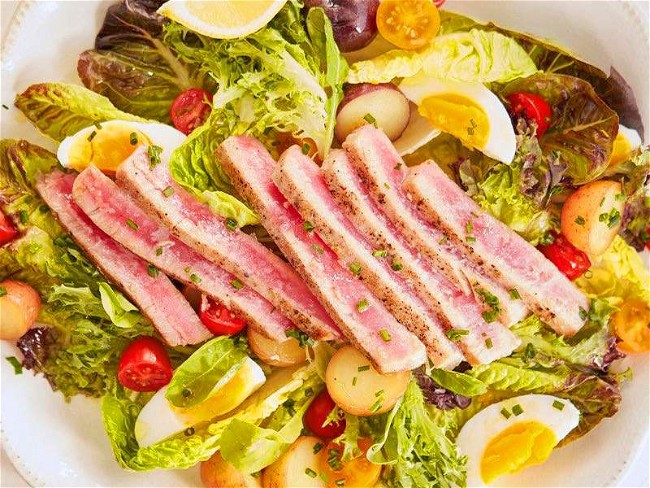
6.  SEARED TUNA NICOISE SALAD RECIPE Rated 2.3 stars 🌟 🌟 🌟 

SERVINGS 

4 adults 

PREP TIME

10minutes

COOK TIME

15 minutes

This colorful salad is usually made with canned tuna, but searing our fresh wild tuna makes for a melt-in-the-mouth upgrade. One taste of our seared tuna nicoise salad recipe will transport you to the south of France without leaving home.

Image of Seared Tuna Nicoise Salad Recipe

INGREDIENTS

    DRESSING

  • 1 garlic clove, minced
  • ½ teaspoon Dijon mustard
  • 1 ½ Tablespoons red wine vinegar
  • ¼ cup extra virgin olive oil
  • SALAD

  • ½ pound baby potatoes, scrubbed and halved
  • ¼ pound French beans, trimmed and cut into thirds
  • 2 x 8-ounce ahi tuna steaks

  • salt and pepper
  • extra virgin olive oil
  • mixed salad leaves
  • 4 hard boiled eggs, cut into quarters
  • 8 anchovies, in oil, drained
  • 16 grape tomatoes, halved
  • ½ red onion, finely sliced
  • 12 pitted black olives
  • chives, finely chopped
  1. DIRECTIONS 1. Make the dressing: In a small bowl, whisk garlic, mustard, vinegar, and salt and pepper to taste. Slowly drizzle the olive oil, whisking until the dressing thickens. Store in the refrigerator until ready to use. You can also place all the ingredients in a Mason jar and shake vigorously for 1-2 minutes until well combined and thickened.
  2. 2. In a medium-large pot, boil the potatoes in salted water until just tender (be sure to stop cooking them before they become fall-apart soft), about 8 minutes. 2 minutes before they’re ready, add the beans. Drain.
  3. 3. Season the tuna on both sides with salt and pepper. Heat a skillet over medium-high heat, add a little olive oil and sear the tuna, 1 minute on each side. The outside will be lightly brown and inside rare. Remove from the heat, then slice against the grain in half-inch slices.
  4. 4. Arrange the salad, starting with salad leaves, and layering the rest of the ingredients. Scatter chives over the top and drizzle with the dressing.


7. SEARED ASIAN TUNA RECIPE

Rated 2.7 stars 🌟 🌟 🌟 


SERVINGS 4 adults 

PREP TIME 5 minutes

COOK TIME 10 minutes

Pan searing tuna has never been easier with this seared Asian tuna recipe.

[Click here to see Image of Seared Asian Tuna Recipe]


INGREDIENTS

• 4 x 8-ounce tuna steaks, approximately 1 inch thick

• ¼ teaspoon salt

• 1 Tablespoon coarsely cracked black pepper

• 2 Tablespoons vegetable oil

• 2 Tablespoons sesame oil

• ¼ teaspoon fresh ginger, grated

• 1 teaspoon garlic, minced

• 2 Tablespoons scallions, chopped

• 3 Tablespoons soy sauce

• ½ cup orange juice

DIRECTIONS

1. Sprinkle the tuna on both sides with the salt. Then sprinkle with the black pepper, pressing to adhere.

2. Heat the vegetable oil in a large frying pan over moderate heat. Add the tuna and sear for 2 minutes on both sides for medium rare. Remove from the pan and set aside.

3. Reduce the heat and add the sesame oil, ginger, garlic and scallions. Cook, stirring for 1 minute. In a small bowl, combine the soy sauce and orange juice.

4. Add the orange juice mixture and simmer for about 2 minutes. Plate the tuna and serve with the sauce.


8. FRESH TUNA BURGER RECIPE

Rated 3.4 stars 🌟 🌟 🌟 

SERVINGS 4 adults 

PREP TIME 5 minutes

COOK TIME 5 minutes

Our family-favorite fresh tuna burger recipe lets the fresh taste of our #1 ahi tuna shine, and is ready in under 10 minutes!

(See Image of Fresh Tuna Burger click here)

INGREDIENTS

• 2 x Finest ahi tuna steaks, sliced in half lengthways to ¾ to 1 inch thick

• ½ cup mayonnaise

• 2 Tablespoons miso

• 1 teaspoon grated ginger

• 1 teaspoon honey

• 1 large tomato, sliced

• butter lettuce leaves, for topping

• 4 burger buns

DIRECTIONS

1. Heat a pan over medium-high heat. Drizzle tuna with olive oil on both sides, and season with salt and pepper.

2. Sear the tuna for 2 minutes on each side. Remove and rest.

3..Make the mayo: mix the mayonnaise, miso, ginger and honey in a bowl.

4. Toast the burger buns, then spread with the mayo, add a slice of tomato and a lettuce leaf, then the tuna, then top with more lettuce. Enjoy!


9. AHI TUNA STEAK RECIPE

Rated 3.6 stars 🌟 🌟 🌟 🌟 

(See image here)

SERVINGS 4 adults

PREP TIME 10 minutes

COOK TIME 4 minutes

Ahi tuna steaks are a breeze to cook when you have the world's best tuna. While our #1 Finest ahi tuna is best served rare in poke or in our tuna tartare recipe, our #2+ tuna is both meaty and melt-in-the-mouth and is the best tuna to use in our ahi tuna steak recipe. We prefer serving ahi tuna steak rare, but follow along if you prefer it more well done.

Our ahi tuna steaks recipe is delicious served with seasonal vegetables and rice or soba noodles, but tuna steaks are super versatile so serve with your favorite side dishes. Drizzle with a little soy sauce and sesame oil, or balsamic vinegar and fresh herbs, and this will become your new favorite week night 🌙 fish dish.

INGREDIENTS

• 2 x 8-ounce Ahi Tuna Steaks, patted dry

• olive oil

• salt and pepper

• sesame seeds, optional

DIRECTIONS

1. Brush the tuna steaks with olive oil, then season with salt and pepper. Sprinkle with sesame seeds if using and press them lightly into the tuna.

2. Heat a skillet, cast iron pan or grill pan over medium-high heat. Once hot, cook the tuna for 2 minutes on one side, then flip and cook for another 2 minutes for rare. If you’d like it cooked more, cook for 3 minutes on each side. It should still be a little pink inside to avoid overcooking.

3. Remove from the pan and allow to rest for 5 minutes. Serve whole or sliced against the grain in 1-inch thick slices.

4. If grilling, cook over medium heat and cook for the same amount of time as above for your preferred level of doneness.


Relax 😌 😌 😌 

Explore Freely click below items :

1. Surprise me here 

2. Harvest Tonnes of Giant Tuna at Vast Ocean  https://m.youtube.com/watch?v=Cvduq18nQtA

3. Indonesia Tuna Fishing here 

4. See the sardines come to you here

5. The exact number of fish species worldwide is unknown, as it is believed that some species have not yet been discovered. However, scientists estimate that the total number of fish species in the world is approximately 33,600. 

6. Different species of fish exist around the globe and have adapted to living in diverse aquatic environments, such as rocky shores, kelp forests, deep-sea waters, rivers, streams, and ponds.

7. Species Of Fish :

● The majority of the world's fish species (approximately 70%) live in the Pacific Ocean, which is the largest ocean and has the highest number of coral reefs. 

■ In fact, the Pacific Ocean has about twice as many coral species as the Atlantic Ocean, which is the world's second largest ocean as well as the saltiest. 

♠︎ Approximately 20% of the world's fish come from the Atlantic Ocean, which ranks second, while 8% comes from the Indian Ocean, which is the warmest ocean and therefore has low   concentrations of oxygen. 

◆ China is the world's leader in terms of fish production, harvesting approximately 58.68 metric tons of fish each year.

♣︎  In addition to being the largest producer, China is also the leading consumer of fish.

8. Leading Countries In Fishing And Aquaculture Output

RankCountryTotal Annual Fisheries Harvest Volume
1China76.15 billion kilograms
2Indonesia20.88 billion kilograms
3India9.60 billion kilograms
4Vietnam6.33 billion kilograms
5United States5.41 billion kilograms
6Myanmar5.05 billion kilograms
7Japan4.77 billion kilograms
8Philippines4.69 billion kilograms
9Russia4.40 billion kilograms
10Chile3.82 billion kilograms