Gallstone Flush & Liver Detox – Recipe & Cleanse Info
[You Are Encouraged To Watch This Youtube (CLICK HERE)And Self Educate Yourself Here. Did you know that cancer cannot hold into your body when your liver is working well? Lets find out how to look after your liver and health; the only organ in your body that has the capability to regrowth itself.]


Have you tried the latest health cleanse? It’s SO great. It’ll help you feel better about your body inside and out, and jump-start your healthy choices so you’ll have the motivation to be active and feel A-MA-ZING. THIS cleanse is brand new. None of the celebrity health gurus or fitspiration icons have tried this, and you’ll NEVER hear about it from an actress in US Weekly. You don’t have to drink cayenne pepper juice OR forego solid foods for days and you’ll STILL remove countless toxins from your body. But this time, the toxins are in your mind and they’re just as harmful to your health.
Those mental toxins have built up from years of taking in distorted, profit-driven messages about what it means to have a healthy and fit female body. Whether it’s health and fitness magazines featuring airbrushed celebrities in bikinis with the latest strategies to get “sleek and sexy” in 3 days without ever moving an inch, or fitspiration models with exposed buttocks, breasts and oiled-up abs all over Instagram and Facebook — you’ve likely got a pretty specific image in your mind of what it means to be a “fit” and “healthy” woman. (We’re not even going to show you an example here, because you already have it in your mind.) This is a trending beauty ideal that is parading as a fitness ideal — made to look attainable for any woman willing to put in enough effort, willpower and sacrifice.
But what about the vast majority of women who will never, ever have six-pack abs, jutting hip bones, cellulite-free thighs that don’t touch, and every other appearance ideal that is held up as a sure indicator of fitness — regardless of how many squats they do, how “clean” they eat, how many marathons they run, etc.? This image of what it looks like to be a fit woman is so ingrained in our cultural wallpaper that we are completely desensitized to it. It is so common and unquestioned that it has become natural and invisible. THIS cleanse will start to rid you of that numbness.
It’s called the media fast. Rather than cutting out food, you cut out media. You cleanse your mind in order to cleanse your body. Choose a time period — 3 days, a week, a month, or more — and avoid media as much as humanly possible. All of it. No Twitter/Instagram/Facebook, TV, Netflix, movies, blogs, radio, any advertising you can avoid. Without this never-ending stream of biased, $-driven, idealized, Photoshopped, self-promoting messages and images (even well-meaning ones from friends and family and people trying to encourage their version/depiction of health), you give your mind the opportunity to become more sensitive to the messages that don’t look like or feel like the truths you experience in real life, face to face, with real fit people and your own health choices. Without those messages, you can see how your life is different and how your feelings toward your own body are affected. When you return to viewing and reading popular media, you will be more sensitive to the messages that hurt you, that hurt your self-perception and those that are unrealistic for you. Then you can make personalized, critical, well-informed media choices for yourself and your household that will uplift and inspire, and promote health rather than objectification and unattainable appearance ideals that may shame you into poor health choices.
The following is a personal story of a Beauty Redefined supporter and health blogger named Kate, who shared her health and fitness journey with a large community of fans at This is Not a Diet — It’s My Life. She has written about her experience with a media fast, and provides some fantastic insight into what makes this type of cleanse crucial for anyone genuinely seeking health and fitness — not just the appearance of health and fitness. Here is her story:
I’ve been a larger person for the great majority of my life. I’ve never experienced being someone who has teeny little invisible-to-others flaws they pick apart in the mirror. In fact, for most of my adult life I thought it would just be fantastic to wear a size 14 so I could shop somewhere that sold clothes I liked. I never coveted a “thigh gap” or a stomach with so little fat you could see my abdominal muscles. I thought it would be great if my thighs didn’t chafe when I walked from all the rubbing.
The closest I ever got to the nit-picking your body phase was at the end of my weight-loss and the year that followed. I flew past original goals, to wear that size 14 and be able to walk anywhere I wanted to without getting out of breath or chafing my thighs. I was wearing size 8, even 6 in some things. My thighs didn’t chafe. In fact, they didn’t touch at all. In clothes, my stomach looked flat. I lost most of my breast tissue and went from a DD-cup to a small C or even a large B.
While I was deep in the process of obsessively losing weight, I became a consumer of a type of media I previously never knew existed: fitness and health. I started looking at pictures of fitness models. I started following them and reading about their workout routines and diets. I worked out at least 6 times a week, for 1-2 hours each time. It was all very intense. No walks in the park for me! I weighed myself every morning and I adjusted my diet accordingly. I was the thinnest I had ever been in my life and I kept it that way with constant vigilance. But I still didn’t look like the fitness models. There was a time when I thought I should, and could, look like them if I just tried a little harder. Why not? I lost 125 pounds. I could do anything. All it takes is enough “will-power” right? If I didn’t get the six-pack, I must be full of lazy-excuses. That’s what those fitness model types said, and look at them! It must be true…
mediafastExcept that it’s not true at all. My body is my body. The reason I do not, and never will, look like one of those headless ab posters actually doesn’t have anything to do with laziness or excuses. It’s just not the way my body is going to look due to my genetics and personal history. It took me a long time to recognize and be able to accept that, especially with all the messaging telling you that if you just Tried a Little Harder, you could make all your perfect body dreams come true.
The fitness and health world is not at all what it seems to be. My outlook on myself was far healthier before I ever started reading about health and fitness. Isn’t that just backwards? Shouldn’t the health industry be promoting actual health and fitness, not obsessive body re-composition?
I had long ago stopped looking at fashion magazines and models. I knew they were underweight and that it was crazy to think I would ever look like them. But the fitness look seemed so “healthy” and that’s how it was promoted. Anybody can do this, they tell you. You just have to want it bad enough. Just eat a “clean” diet, lift weights, and wake up one day looking like Jamie Eason!
Fast forward to now. My outlook is totally different. I’m never going to look like Jamie Eason. I’m me. I look like me. Kate. Hi! Nice to meet you. My thighs touch and my belly is not flat. I am strong and healthy. The 2013 picture was taken a few months ago. I’m wearing the same outfit today, so I must be a similar size. I don’t weigh myself anymore though, so I can’t say for sure.
I went on a new type of diet, you see. I went on a Media Diet. I already didn’t watch much TV or read magazines, but I do spend a lot of time online. Throughout my changing lifestyle I had managed to build up quite the repertoire of places to consume other people’s tight, toned, surgically and digitally enhanced bodies online and read about their endless nit-picking of their imperceptible flaws, Facebook being the most gluttonous.
magazinesThe most important tool of the Media Diet for me is the Facebook UNLIKE button. Does the page post fitspo? Unlike. Does it go on about counting carbs after 3 pm to get the flattest belly? Unlike. Does it tell me I’m not good enough the way I am? Unlike. Does it send me the message that if I don’t look like the model in the picture, I’m a lazy, full of excuses waste of space? UNLIKE at the speed of light!
If it does not lift me up and support actual health and actual fitness, I don’t need to consume it.
We are bombarded with messages about not being good enough every single day. You cannot completely escape this. I can’t stop going to the grocery store and seeing the headlines about which celebrities are too fat and which are too thin. But I can take an active role in many parts of my life. I can choose.
You do not have to buy those magazines or follow those pages to be healthy. If you’re like me, you might be a lot saner and healthier without them. My New Year’s Resolution this year was to stop reading weight/health/nutrition books. I am proud to say that in 2013 I have only read fiction and art books. Come to think of it, ever since I went on my Media Diet, I am doing a lot of things I enjoy that are important to me that I wasn’t doing before. I’m not working out 6 days a week anymore. I am walking in the park. I am hiking. I am practicing yoga. I only go to the gym 1 time a week, for BodyPump, which is just plain FUN. I have drawn in my sketchbook almost every day this year, something I kept telling myself I would do that I never did. I guess I needed to free up the mental space for it. When I get sick or am too exhausted, I do a crazy thing: I REST. I do not worry about what it might do to my weight the next day.
I don’t track anything anymore, except my menstrual cycle. When I exercise, I do it for myself, for my mental and physical health, and because I want to, not for calories burned. I don’t do it to earn my dinner. I’m going to eat dinner either way. And sometimes it’s going to be pizza. I have allowed myself time and space to think about what is really important to me, how I really feel about my body, and to stop comparing myself to anyone else. Comparing yourself to other people is stupid. A person with my body and my history is never going to look like someone who has always been thin. That’s a great big “DUH.” right? But I think a lot of people still don’t get it.
Many people would look at my body and find things to dislike about it, but I am not them, so it’s okay. My hips? They are glorious. My stomach and thighs that touch once more (but don’t chafe) — so nice, so comforting, so warm and soft. Fat is not an enemy, it is part of my body. It gives me my hourglass shape. It gives me my fabulous D-cups. I gives me warmth. I am no longer constantly cold. I don’t feel dizzy. I have a lot more energy. I am more comfortable sleeping. I feel more attractive and less self-conscious.
Contrary to what I thought, being the thinnest ever didn’t make me happier. It didn’t make me better. It just made me look different. I remember how I felt when I took the middle picture you see above, and I kept staring at it thinking “Wow, I am actually thin.” It was strange and intriguing. It was an out of body experience for sure. When I look at the picture of me now, I see me. It’s not weird, it just is. Living the life I want to live naturally returned me to the body I was meant to have. The funny thing is, this is the body I probably would have had if I had never dieted at all. If I had just let my body mature as it was meant to. But everything told me I wasn’t okay the way I was, and I believed it. I don’t believe it now. And anyway, it’s not for anyone else to say.
You shouldn’t consume things that make you feel like crap. That includes food and media. Are there people in real life or online in your life who treat you like crap? Do they talk down to you? Do they act like they know you better than you know yourself? Do they make you doubt yourself? Cut them out. You deserve better. And make sure you’re not one of them.
Thanks to Kate for sharing her work with us! Her original post appeared here. For more information on how Beauty Redefined seeks to turn the conversation from focusing on looking healthy to actually being healthy, see our two-part Healthy Redefined series on how health is traditionally defined and how we’re redefining it. See also our popular piece on how to tell if the fitspiration images/messages you’re viewing are helping or harming your health goals. For in-depth help to reframe your health perceptions and improve your body image, check out our 8-Week Body Image Resilience Program!

A Brand New Nutrient for PCOS Treatment: N-Acetyl-L-Cysteine
Improves Insulin Sensitivity and Fertility while Reducing NDLF and NASH
Hormone-Balance-Specific-Nutrient-N-Acetyl-l-Cysteine
Watch an Expert Talk About PCOS
NAC Proves a Powerful Tool in The Fight Against Hormonal Imbalance
NAC is a stable derivative of the amino acid L-cysteine. It’s main importance in the body can be categorized into two main areas. The first comes from its necessity for the production of glutathione, one of the body’s most powerful antioxidants. Both NAC and glutathione are both strong antioxidants that are vital for protecting your cells from oxidative damage. Women suffering from PCOS tend to need greater amounts of antioxidants as they are under greater oxidant stress.
The second is due to it being one of only two amino acids that contain sulphur, an element plays a major role in metabolism and liver function (Both of which are important for PCOS). Unfortunately, NAC can’t be obtained from your diet and is solely available through nutritional supplementation.
Improves Insulin Sensitivity
Take a Look at What Insulin Resistance can Do to Your Body and Mind
"NAC may be a new treatment for the improvement of circulating insulin levels and insulin sensitivity in hyperinsulinemic patients with polycystic ovary syndrome." (Abu 2010)
Heightened insulin sensitivity is a known symptom of PCOS and a major one!
A 2002 study conducted an experiment to test the impact of NAC on insulin secretion in women with PCOS (Fulghesu 2002). The results of the study showed a clear link between NAC and normal insulin levels. Subjects who had exaggerated insulin levels prior to the trials showed a significant reduction of said levels. The NAC treatment also resulted in a significant decline in testosterone levels. Stabilizing hormone levels treats the PCOS itself and can often lessen or even reduce completely the associated symptoms.
Increases Fertility
"N-Acetyl Cysteine is proved effective in inducing or augmenting ovulation in polycystic ovary patients." (Badawy 2007)
NAC also has the effect of improving fertility in women with PCOS. In one study, the ovulation rates of 573 women with PCOS, taking Clomid, a widely used fertility drug, were monitored. NAC significantly improved ovulation rates by almost 200% from 18% (without NAC) to 52% (with NAC).
Similarly, a study of Clomid-resistant women concluded that NAC makes Clomid more effective. 150 Clomid-resistant women with PCOS were observed. Within those given NAC, 49.3% ovulated and 1.3% became pregnant. In contrast, within those not given NAC, only 21% ovulated and there were no pregnancies. (Rizk 2005)
NAC is Not Only Helpful for PCOS But for Fertility Issues as well
Reduced NFLD and NASH (Non-Alcoholic Fatty Liver Disease)
"NAC...appears to ameliorate several aspects of NASH, including fibrosis."
A shocking 55% of women with PCOS also suffer from a fatty liver degeneration disease called Nonalcoholic Fatty Liver Disease (NFLD). This disease can also worsen to become a more serious medical condition called "nonalcoholic steatohepatitis"(NASH), a form of liver inflammation to which there is no treatment.
Learn about NAFLD as a Progressing Condition
Conclusion
The main causes of both NAFLD and NASH appear to be oxidative stress and insulin resistance, both conditions that women suffering from PCOS also tend to have. A recent study from the University of São Paulo School of Medicine in Brazil has shown that NAC may be effective in treating NASH. After 12 months of a regular daily dose of NAC, both liver fat deposits and liver fibrosis were reduced.
The bottom line is that NAC has been shown to be helpful in treating a lot of PCOS symptoms including weight issues, increased hair growth, irregular menstrual cycle, infertility and more.


[You Are Encouraged To Watch This Youtube (CLICK HERE)And Self Educate Yourself Here. Did you know that cancer cannot hold into your body when your liver is working well? Lets find out how to look after your liver and health; the only organ in your body that has the capability to regrowth itself.]
With the exception of the skin, the liver is the largest organ in the body and performs over 500 functions, far more than any other organ in the body. We cannot be healthy or recover from illness without a strong, clean well-functioning liver. If the liver is unable to carry out its full function, not only does it become congested and weak; all other organs will be more challenged as a result.
Imagine how much happier you liver feels after releasing these!
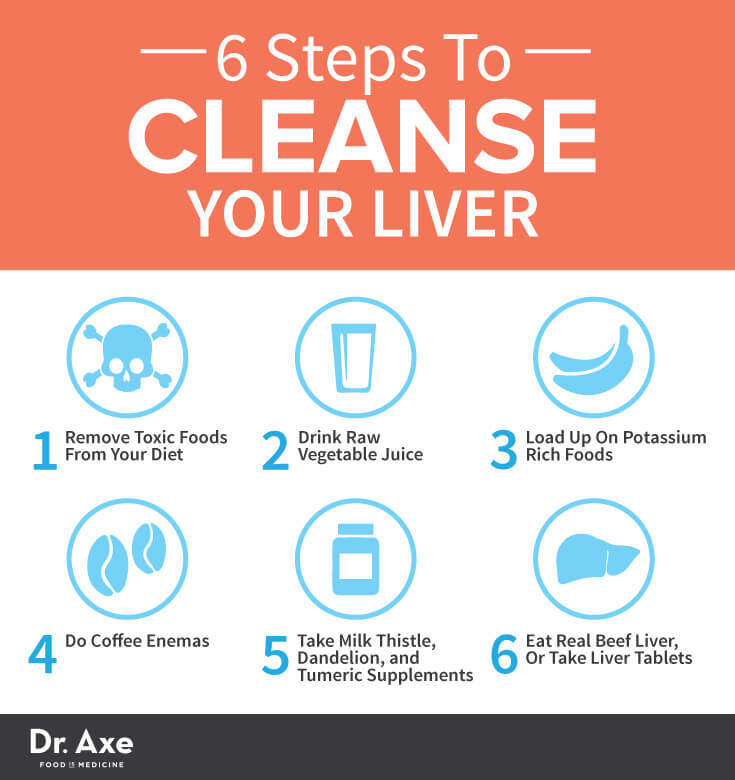
If you want to do more specific liver cleansing, you can try a Liver/Gallstone Flush at home. This flush can be done in just 24 hours, so it is easy to fit into a busy schedule. It is recommended that you have done a full 7-day cleanse prior to this flush, mainly to take the toxic pressure off your organs and to be sure that your body is alkaline.
In the days before the cleanse, it is important to avoid fried and fatty foods so your liver is not over-worked or stressed. Avoid avocado, cheese, nuts and fatty meats for at least 3 to 5 days before this cleanse. If you work a normal Monday – Friday work week, it is best to plan to do this cleanse on Friday night, that way you have the entire weekend to rest, relax and recover.
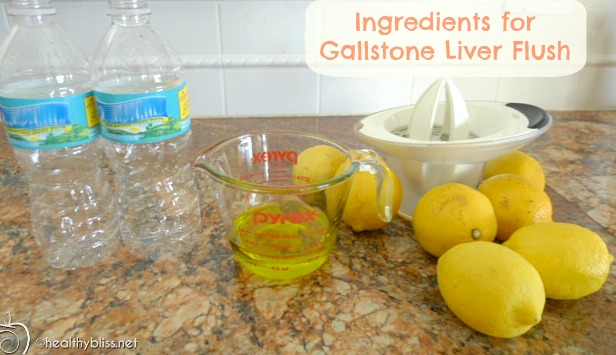
Mix Olive Oil and Fresh Lemon Juice in a bottle
The most common recipe to use for this cleanse comes from Dr. Hulda Clark’s book A Cure for All Diseases. If this is the first time you are trying this cleanse, I recommend that you use this formula, outlined below. If you release more than 200 stones in the first flush, it is recommended that you repeat the cleanse every 6-8 weeks until you have less than 20 stones come out. It is believed that you may have to release up to 2,000 stones to rid yourself of allergies linked to liver congestion. On my first Gallstone/Liver Flush, I released 600 stones – no joke!
Please note that with Dr. Clark’s recipe, she recommends using ornithine to help you sleep and she also recommends to do a parasite cleanse before you do the Gallstone Flush. If you want to do those things, that’s ok; personally I have never used ornithine and I’ve done this cleanse 13 times in the past 10 years. I did not do a parasite cleanse initially, although I have done them since…in my opinion you do not have to do a parasite cleanse prior to this flush, but admittedly you may get better results if you do so.
Preparation
Eat a diet high in alkaline-forming foods and low in fats for at least 3-5 days before the cleanse.
Help to gently prepare the liver by having a glass of fresh apple juice every day for 1 week prior to the cleanse. Apple juice helps to dissolve the stones.
Gallstone Live Flush Ingredients
- Epsom salts (Magnesium Sulfate): 4 tablespoons. (You can usually buy this at your local pharmacy.)
- Olive oil: 1/2 cup or 125 ml (light olive oil is easier to get down).
- Fresh pink grapefruit: 1 large or 2 small, enough to squeeze 1/2 cup (125 ml) juice. (Or use 7-8 fresh lemons/limes: squeezed into 1/2 cup juice.)
- 1 liter jar with lid.
Gallstone Liver Flush Instructions
Choose a day like Friday or Saturday for the cleanse, since you will be able to rest the next day. Take no medicines, vitamins or pills that you can do without; they could prevent success. Stop the parasite program too, the day before. Eat a no-fat breakfast and lunch such as cooked cereal, fruit, fruit juice, bread and preserves or honey (no butter or milk). This allows the bile to build up and develop pressure in the liver. Higher pressure pushes out more stones.
Mix Epsom Salts and Water, marking the bottles with a black marker to know how much to drink each time
2:00 PM. Do not eat or drink after 2 o’clock. If you break this rule you could feel quite ill later. Get your Epsom salts ready. Mix 4 Tbsp. in 3 cups (750 ml) water and pour this into a container or jar. This makes four servings, ¾ cup (185 ml) each. Set the jar in the refrigerator to get cold (this is for convenience and taste only). Note: I also make the 9:45pm drink described below at 2pm and I put it in the fridge, ready to drink later. Making all the drinks at my last meal makes me feel more committed to do the cleanse, and I can prepare everything while not feeling hungry. I highly recommend that you do this too, and do not allow any re-negotiation to skip the cleanse for another day just because you feel slightly hungry at 6pm.
6:00 PM. Drink one serving (¾ cup) of the Epsom salts and water drink. If you did not prepare this ahead of time, mix 1 tbs. in ¾ cup water now. You may add 1/8 tsp. vitamin C powder or 1/4 fresh lemon squeezed to improve the taste. You may also drink a few mouthfuls of water afterwards or rinse your mouth.
8:00 PM. Repeat by drinking another ¾ cup (185 ml) of Epsom salts and water drink. Get your bedtime chores done. The timing is critical for success.
9:45 PM. Pour ½ cup (measured) olive oil into the pint jar. Squeeze the citrus fruit (fresh grapefruit, lime or lemon) by hand into the measuring cup. Remove pulp with fork. You should have at least ½ cup. Add this to the olive oil. Close the jar tightly with the lid and shake hard until watery. Do not drink it yet!
Now visit the bathroom one or more time, even if it makes you late for your ten o’clock drink. Don’t be more than 15 minutes late. You will get fewer stones.
10:00 PM. Drink the potion you have mixed. Take it all to your bedside if you want, but drink it standing up. Get it down within 5 minutes (fifteen minutes for very elderly or weak persons).
Lie down immediately. You might fail to get stones out if you don’t. The sooner you lie down the more stones you will get out. Be ready for bed ahead of time. Don’t clean up the kitchen. As soon as the drink is down walk to your bed and lie down on your right side with your knees pulled up close to your chest. Try to think about what is happening in the liver. Try to keep perfectly still for at least 20 minutes. You may feel a train of stones traveling along the bile ducts like marbles. There is no pain because the bile duct valves are open (thank you Epsom salts!). Go to sleep, you may fail to get stones out if you don’t. Try to sleep in this position.
Next morning. Upon awakening (6:00 am) take your third dose of the Epsom salts and water drink. If you have indigestion or nausea wait until it is gone before drinking the Epsom salts. You may go back to bed. Don’t take this potion before 6:00 am.
8:00 am (2 Hours Later.) Take your fourth (the last) dose of the Epsom salts and water. You may go back to bed again.
After 2 More Hours you may eat. Start with fruit juice (see note below). Half an hour later eat fruit (see note below). One hour later you may eat regular food but keep it light. By supper you should feel recovered.
*NOTE – Fresh apple juice is the best juice to break the fast. At 10:00am, make fresh apple juice using 5-6 large apples in a juicer and drink it. The apple juice helps dissolve gallstones and is a nice transition for the liver from the detox back to normal eating. After 30 minutes, prepare a chopped apple salad or a plain apple smoothie using 3-4 apples (with the skin is ok). If feeling unwell, stay with apples and apple juice for the entire day. Only transition to light foods, salads and regular eating when you are feeling good again.
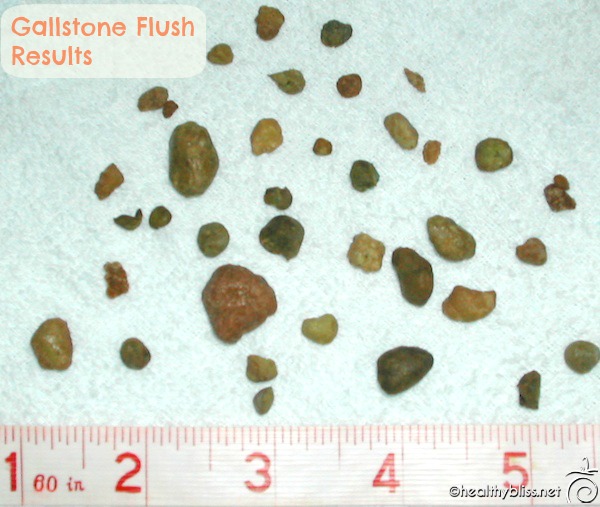
How well did you do? Expect diarrhea in the morning. Use a flashlight to look for gallstones in the toilet with the bowel movement. Look for the green kind since this is proof that they are genuine gallstones, not food residue. Only bile from the liver is pea green. The bowel movement sinks but gallstones float because of the cholesterol inside. Count them all roughly, whether tan or green. You will need to total 2000 stones before the liver is clean enough to rid you of allergies or bursitis or upper back pains permanently. The first cleanse may rid you of them for a few days, but as the stones from the rear travel forward, they give you the same symptoms again. You may repeat cleanses at two week intervals. Never cleanse when you are [acutely] ill.
Sometimes the bile ducts are full of cholesterol crystals that did not form into round stones. They appear as a “chaff” floating on top of the toilet bowl water. It may be tan colored, harboring millions of tiny white crystals. Cleansing this chaff is just as important as purging stones.
How safe is the liver cleanse? It is very safe. My opinion is based on over 500 cases, including many persons in their seventies and eighties. None went to the hospital; none even reported pain. However it can make you feel quite ill for one or two days afterwards, although in every one of these cases the maintenance parasite program had been neglected. This is why the instructions direct you to complete the parasite and kidney cleanse programs first.
CONGRATULATIONS
You have taken out your gallstones without surgery! I like to think I have perfected this recipe, but I certainly can not take credit for its origin. It was invented hundreds, if not thousands, of years ago, THANK YOU, HERBALISTS!
Gallstones can be flushed easily and naturally with no pain!
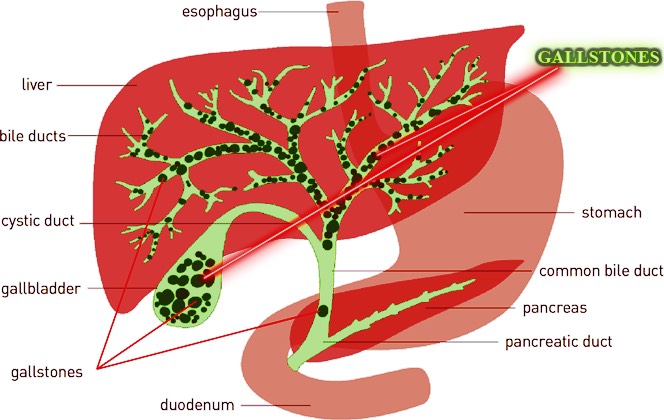
This procedure contradicts many modern medical viewpoints. Gallstones are thought to be formed in the gallbladder, not the liver. They are thought to be few, not thousands. They are not linked to pains other than gallbladder attacks. It is easy to understand why this is thought: by the time you have acute pain attacks, some stones are in the gallbladder, are big enough and sufficiently calcified to see on X-ray, and have caused inflammation there. When the gallbladder is removed the acute attacks are gone, but the bursitis and other pains and digestive problems remain.
Gallstones Released Naturally
The truth is self-evident. People who have had their gallbladder surgically removed still get plenty of green, bile-coated stones, and anyone who cares to dissect their stones can see that the concentric circles and crystals of cholesterol match textbook pictures of “gallstones” exactly.
From the book The Cure for All Advanced Cancers by Dr. Hulda Clark.
Some info from The Liver – Cleansing & Rejuvenating the Vital Organ by Dr. Richard Anderson
Some info from The Liver – Cleansing & Rejuvenating the Vital Organ by Dr. Richard Anderson
This article is not meant to diagnose any disease. For any serious medical concerns, always consult with your doctor.
Those mental toxins have built up from years of taking in distorted, profit-driven messages about what it means to have a healthy and fit female body. Whether it’s health and fitness magazines featuring airbrushed celebrities in bikinis with the latest strategies to get “sleek and sexy” in 3 days without ever moving an inch, or fitspiration models with exposed buttocks, breasts and oiled-up abs all over Instagram and Facebook — you’ve likely got a pretty specific image in your mind of what it means to be a “fit” and “healthy” woman. (We’re not even going to show you an example here, because you already have it in your mind.) This is a trending beauty ideal that is parading as a fitness ideal — made to look attainable for any woman willing to put in enough effort, willpower and sacrifice.
But what about the vast majority of women who will never, ever have six-pack abs, jutting hip bones, cellulite-free thighs that don’t touch, and every other appearance ideal that is held up as a sure indicator of fitness — regardless of how many squats they do, how “clean” they eat, how many marathons they run, etc.? This image of what it looks like to be a fit woman is so ingrained in our cultural wallpaper that we are completely desensitized to it. It is so common and unquestioned that it has become natural and invisible. THIS cleanse will start to rid you of that numbness.
It’s called the media fast. Rather than cutting out food, you cut out media. You cleanse your mind in order to cleanse your body. Choose a time period — 3 days, a week, a month, or more — and avoid media as much as humanly possible. All of it. No Twitter/Instagram/Facebook, TV, Netflix, movies, blogs, radio, any advertising you can avoid. Without this never-ending stream of biased, $-driven, idealized, Photoshopped, self-promoting messages and images (even well-meaning ones from friends and family and people trying to encourage their version/depiction of health), you give your mind the opportunity to become more sensitive to the messages that don’t look like or feel like the truths you experience in real life, face to face, with real fit people and your own health choices. Without those messages, you can see how your life is different and how your feelings toward your own body are affected. When you return to viewing and reading popular media, you will be more sensitive to the messages that hurt you, that hurt your self-perception and those that are unrealistic for you. Then you can make personalized, critical, well-informed media choices for yourself and your household that will uplift and inspire, and promote health rather than objectification and unattainable appearance ideals that may shame you into poor health choices.
The following is a personal story of a Beauty Redefined supporter and health blogger named Kate, who shared her health and fitness journey with a large community of fans at This is Not a Diet — It’s My Life. She has written about her experience with a media fast, and provides some fantastic insight into what makes this type of cleanse crucial for anyone genuinely seeking health and fitness — not just the appearance of health and fitness. Here is her story:
I’ve been a larger person for the great majority of my life. I’ve never experienced being someone who has teeny little invisible-to-others flaws they pick apart in the mirror. In fact, for most of my adult life I thought it would just be fantastic to wear a size 14 so I could shop somewhere that sold clothes I liked. I never coveted a “thigh gap” or a stomach with so little fat you could see my abdominal muscles. I thought it would be great if my thighs didn’t chafe when I walked from all the rubbing.
The closest I ever got to the nit-picking your body phase was at the end of my weight-loss and the year that followed. I flew past original goals, to wear that size 14 and be able to walk anywhere I wanted to without getting out of breath or chafing my thighs. I was wearing size 8, even 6 in some things. My thighs didn’t chafe. In fact, they didn’t touch at all. In clothes, my stomach looked flat. I lost most of my breast tissue and went from a DD-cup to a small C or even a large B.
While I was deep in the process of obsessively losing weight, I became a consumer of a type of media I previously never knew existed: fitness and health. I started looking at pictures of fitness models. I started following them and reading about their workout routines and diets. I worked out at least 6 times a week, for 1-2 hours each time. It was all very intense. No walks in the park for me! I weighed myself every morning and I adjusted my diet accordingly. I was the thinnest I had ever been in my life and I kept it that way with constant vigilance. But I still didn’t look like the fitness models. There was a time when I thought I should, and could, look like them if I just tried a little harder. Why not? I lost 125 pounds. I could do anything. All it takes is enough “will-power” right? If I didn’t get the six-pack, I must be full of lazy-excuses. That’s what those fitness model types said, and look at them! It must be true…
mediafastExcept that it’s not true at all. My body is my body. The reason I do not, and never will, look like one of those headless ab posters actually doesn’t have anything to do with laziness or excuses. It’s just not the way my body is going to look due to my genetics and personal history. It took me a long time to recognize and be able to accept that, especially with all the messaging telling you that if you just Tried a Little Harder, you could make all your perfect body dreams come true.
The fitness and health world is not at all what it seems to be. My outlook on myself was far healthier before I ever started reading about health and fitness. Isn’t that just backwards? Shouldn’t the health industry be promoting actual health and fitness, not obsessive body re-composition?
I had long ago stopped looking at fashion magazines and models. I knew they were underweight and that it was crazy to think I would ever look like them. But the fitness look seemed so “healthy” and that’s how it was promoted. Anybody can do this, they tell you. You just have to want it bad enough. Just eat a “clean” diet, lift weights, and wake up one day looking like Jamie Eason!
Fast forward to now. My outlook is totally different. I’m never going to look like Jamie Eason. I’m me. I look like me. Kate. Hi! Nice to meet you. My thighs touch and my belly is not flat. I am strong and healthy. The 2013 picture was taken a few months ago. I’m wearing the same outfit today, so I must be a similar size. I don’t weigh myself anymore though, so I can’t say for sure.
I went on a new type of diet, you see. I went on a Media Diet. I already didn’t watch much TV or read magazines, but I do spend a lot of time online. Throughout my changing lifestyle I had managed to build up quite the repertoire of places to consume other people’s tight, toned, surgically and digitally enhanced bodies online and read about their endless nit-picking of their imperceptible flaws, Facebook being the most gluttonous.
magazinesThe most important tool of the Media Diet for me is the Facebook UNLIKE button. Does the page post fitspo? Unlike. Does it go on about counting carbs after 3 pm to get the flattest belly? Unlike. Does it tell me I’m not good enough the way I am? Unlike. Does it send me the message that if I don’t look like the model in the picture, I’m a lazy, full of excuses waste of space? UNLIKE at the speed of light!
If it does not lift me up and support actual health and actual fitness, I don’t need to consume it.
We are bombarded with messages about not being good enough every single day. You cannot completely escape this. I can’t stop going to the grocery store and seeing the headlines about which celebrities are too fat and which are too thin. But I can take an active role in many parts of my life. I can choose.
You do not have to buy those magazines or follow those pages to be healthy. If you’re like me, you might be a lot saner and healthier without them. My New Year’s Resolution this year was to stop reading weight/health/nutrition books. I am proud to say that in 2013 I have only read fiction and art books. Come to think of it, ever since I went on my Media Diet, I am doing a lot of things I enjoy that are important to me that I wasn’t doing before. I’m not working out 6 days a week anymore. I am walking in the park. I am hiking. I am practicing yoga. I only go to the gym 1 time a week, for BodyPump, which is just plain FUN. I have drawn in my sketchbook almost every day this year, something I kept telling myself I would do that I never did. I guess I needed to free up the mental space for it. When I get sick or am too exhausted, I do a crazy thing: I REST. I do not worry about what it might do to my weight the next day.
I don’t track anything anymore, except my menstrual cycle. When I exercise, I do it for myself, for my mental and physical health, and because I want to, not for calories burned. I don’t do it to earn my dinner. I’m going to eat dinner either way. And sometimes it’s going to be pizza. I have allowed myself time and space to think about what is really important to me, how I really feel about my body, and to stop comparing myself to anyone else. Comparing yourself to other people is stupid. A person with my body and my history is never going to look like someone who has always been thin. That’s a great big “DUH.” right? But I think a lot of people still don’t get it.
Many people would look at my body and find things to dislike about it, but I am not them, so it’s okay. My hips? They are glorious. My stomach and thighs that touch once more (but don’t chafe) — so nice, so comforting, so warm and soft. Fat is not an enemy, it is part of my body. It gives me my hourglass shape. It gives me my fabulous D-cups. I gives me warmth. I am no longer constantly cold. I don’t feel dizzy. I have a lot more energy. I am more comfortable sleeping. I feel more attractive and less self-conscious.
Contrary to what I thought, being the thinnest ever didn’t make me happier. It didn’t make me better. It just made me look different. I remember how I felt when I took the middle picture you see above, and I kept staring at it thinking “Wow, I am actually thin.” It was strange and intriguing. It was an out of body experience for sure. When I look at the picture of me now, I see me. It’s not weird, it just is. Living the life I want to live naturally returned me to the body I was meant to have. The funny thing is, this is the body I probably would have had if I had never dieted at all. If I had just let my body mature as it was meant to. But everything told me I wasn’t okay the way I was, and I believed it. I don’t believe it now. And anyway, it’s not for anyone else to say.
You shouldn’t consume things that make you feel like crap. That includes food and media. Are there people in real life or online in your life who treat you like crap? Do they talk down to you? Do they act like they know you better than you know yourself? Do they make you doubt yourself? Cut them out. You deserve better. And make sure you’re not one of them.
Thanks to Kate for sharing her work with us! Her original post appeared here. For more information on how Beauty Redefined seeks to turn the conversation from focusing on looking healthy to actually being healthy, see our two-part Healthy Redefined series on how health is traditionally defined and how we’re redefining it. See also our popular piece on how to tell if the fitspiration images/messages you’re viewing are helping or harming your health goals. For in-depth help to reframe your health perceptions and improve your body image, check out our 8-Week Body Image Resilience Program!
A Brand New Nutrient for PCOS Treatment: N-Acetyl-L-Cysteine
Improves Insulin Sensitivity and Fertility while Reducing NDLF and NASH
Hormone-Balance-Specific-Nutrient-N-Acetyl-l-Cysteine
Watch an Expert Talk About PCOS
NAC Proves a Powerful Tool in The Fight Against Hormonal Imbalance
NAC is a stable derivative of the amino acid L-cysteine. It’s main importance in the body can be categorized into two main areas. The first comes from its necessity for the production of glutathione, one of the body’s most powerful antioxidants. Both NAC and glutathione are both strong antioxidants that are vital for protecting your cells from oxidative damage. Women suffering from PCOS tend to need greater amounts of antioxidants as they are under greater oxidant stress.
The second is due to it being one of only two amino acids that contain sulphur, an element plays a major role in metabolism and liver function (Both of which are important for PCOS). Unfortunately, NAC can’t be obtained from your diet and is solely available through nutritional supplementation.
Improves Insulin Sensitivity
Take a Look at What Insulin Resistance can Do to Your Body and Mind
"NAC may be a new treatment for the improvement of circulating insulin levels and insulin sensitivity in hyperinsulinemic patients with polycystic ovary syndrome." (Abu 2010)
Heightened insulin sensitivity is a known symptom of PCOS and a major one!
A 2002 study conducted an experiment to test the impact of NAC on insulin secretion in women with PCOS (Fulghesu 2002). The results of the study showed a clear link between NAC and normal insulin levels. Subjects who had exaggerated insulin levels prior to the trials showed a significant reduction of said levels. The NAC treatment also resulted in a significant decline in testosterone levels. Stabilizing hormone levels treats the PCOS itself and can often lessen or even reduce completely the associated symptoms.
Increases Fertility
"N-Acetyl Cysteine is proved effective in inducing or augmenting ovulation in polycystic ovary patients." (Badawy 2007)
NAC also has the effect of improving fertility in women with PCOS. In one study, the ovulation rates of 573 women with PCOS, taking Clomid, a widely used fertility drug, were monitored. NAC significantly improved ovulation rates by almost 200% from 18% (without NAC) to 52% (with NAC).
Similarly, a study of Clomid-resistant women concluded that NAC makes Clomid more effective. 150 Clomid-resistant women with PCOS were observed. Within those given NAC, 49.3% ovulated and 1.3% became pregnant. In contrast, within those not given NAC, only 21% ovulated and there were no pregnancies. (Rizk 2005)
NAC is Not Only Helpful for PCOS But for Fertility Issues as well
Reduced NFLD and NASH (Non-Alcoholic Fatty Liver Disease)
"NAC...appears to ameliorate several aspects of NASH, including fibrosis."
A shocking 55% of women with PCOS also suffer from a fatty liver degeneration disease called Nonalcoholic Fatty Liver Disease (NFLD). This disease can also worsen to become a more serious medical condition called "nonalcoholic steatohepatitis"(NASH), a form of liver inflammation to which there is no treatment.
Learn about NAFLD as a Progressing Condition
Conclusion
The main causes of both NAFLD and NASH appear to be oxidative stress and insulin resistance, both conditions that women suffering from PCOS also tend to have. A recent study from the University of São Paulo School of Medicine in Brazil has shown that NAC may be effective in treating NASH. After 12 months of a regular daily dose of NAC, both liver fat deposits and liver fibrosis were reduced.
The bottom line is that NAC has been shown to be helpful in treating a lot of PCOS symptoms including weight issues, increased hair growth, irregular menstrual cycle, infertility and more.
A Brand New Nutrient for PCOS Treatment: N-Acetyl-L-Cysteine
Improves Insulin Sensitivity and Fertility while Reducing NDLF and NASH
Watch an Expert Talk About PCOS
NAC is a stable derivative of the amino acid L-cysteine. It’s main importance in the body can be categorized into two main areas. The first comes from its necessity for the production of glutathione, one of the body’s most powerful antioxidants. Both NAC and glutathione are both strong antioxidants that are vital for protecting your cells from oxidative damage. Women suffering from PCOS tend to need greater amounts of antioxidants as they are under greater oxidant stress.
The second is due to it being one of only two amino acids that contain sulphur, an element plays a major role in metabolism and liver function (Both of which are important for PCOS). Unfortunately, NAC can’t be obtained from your diet and is solely available through nutritional supplementation.
Improves Insulin Sensitivity
"NAC may be a new treatment for the improvement of circulating insulin levels and insulin sensitivity in hyperinsulinemic patients with polycystic ovary syndrome." (Abu 2010)
Heightened insulin sensitivity is a known symptom of PCOS and a major one!
A 2002 study conducted an experiment to test the impact of NAC on insulin secretion in women with PCOS (Fulghesu 2002). The results of the study showed a clear link between NAC and normal insulin levels. Subjects who had exaggerated insulin levels prior to the trials showed a significant reduction of said levels. The NAC treatment also resulted in a significant decline in testosterone levels. Stabilizing hormone levels treats the PCOS itself and can often lessen or even reduce completely the associated symptoms.
Increases Fertility
"N-Acetyl Cysteine is proved effective in inducing or augmenting ovulation in polycystic ovary patients." (Badawy 2007)
NAC also has the effect of improving fertility in women with PCOS. In one study, the ovulation rates of 573 women with PCOS, taking Clomid, a widely used fertility drug, were monitored. NAC significantly improved ovulation rates by almost 200% from 18% (without NAC) to 52% (with NAC).
Similarly, a study of Clomid-resistant women concluded that NAC makes Clomid more effective. 150 Clomid-resistant women with PCOS were observed. Within those given NAC, 49.3% ovulated and 1.3% became pregnant. In contrast, within those not given NAC, only 21% ovulated and there were no pregnancies. (Rizk 2005)
Reduced NFLD and NASH (Non-Alcoholic Fatty Liver Disease)
"NAC...appears to ameliorate several aspects of NASH, including fibrosis."
A shocking 55% of women with PCOS also suffer from a fatty liver degeneration disease called Nonalcoholic Fatty Liver Disease (NFLD). This disease can also worsen to become a more serious medical condition called "nonalcoholic steatohepatitis"(NASH), a form of liver inflammation to which there is no treatment.
Conclusion
The main causes of both NAFLD and NASH appear to be oxidative stress and insulin resistance, both conditions that women suffering from PCOS also tend to have. A recent study from the University of São Paulo School of Medicine in Brazil has shown that NAC may be effective in treating NASH. After 12 months of a regular daily dose of NAC, both liver fat deposits and liver fibrosis were reduced.
The bottom line is that NAC has been shown to be helpful in treating a lot of PCOS symptoms including weight issues, increased hair growth, irregular menstrual cycle, infertility and more.


