Inaugural Lanka Impact Investment Summit 2026 kicks off
Wednesday, 11 February 2026
In Sri Lanka
Sri Lanka is seeking to position itself as a convening platform for impact investing in South Asia as more than 200 delegates from home and abroad gathered in Colombo yesterday for the inaugural Lanka Impact Investment Summit 2026 (LIIS), against the backdrop of persistent structural financing gaps in the domestic economy.
The two-day summit, organised by the Lanka Impact Investing Network (LIIN) and Global Steering Group for Impact Investment Sri Lanka, brings together investors, policymakers, development partners and entrepreneurs to examine how private capital aligned with social and environmental outcomes could support Sri Lanka’s recovery and longer-term growth, particularly through small and medium-sized enterprises and climate-aligned businesses.
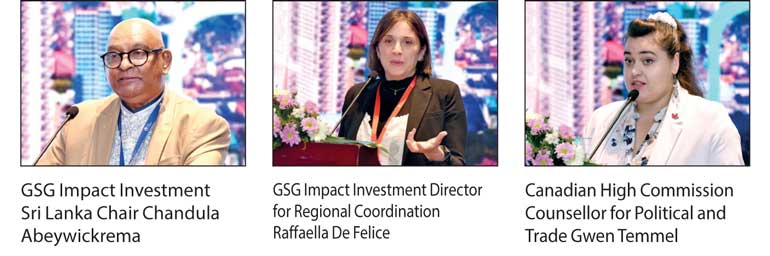
Global Steering Group for Impact Investment Sri Lanka Chair Chandula Abeywickrema said the summit reflected nearly a decade of efforts to build an impact investing ecosystem capable of moving beyond traditional, collateral-driven bank finance. He said Sri Lanka’s core challenge was not the absence of entrepreneurs, but the difficulty of transforming them into commercially viable and scalable enterprises.
“What the country needs is entrepreneur transformation,” Abeywickrema said, arguing that enterprises unable to achieve viability and scale would not deliver durable economic change. He said impact investing offered access to private-equity-style capital for SMEs that remained underserved by conventional finance.
The summit takes place as data from LIIN highlights the scale of Sri Lanka’s financing constraints despite strong global growth in impact capital. The study estimates Sri Lanka’s annual investment demand at $ 7–10 billion to meet sustainable development goals, including $ 3–5 billion for infrastructure and $ 2–3 billion for climate finance, while access to capital remains constrained by high borrowing costs, policy fragmentation and limited non-bank financing channels.
SMEs, which contribute about 52% to GDP and employ nearly half the workforce, have declined from around 1.3 million in 2018 to roughly 1.04 million in 2024 following the economic crisis. Bank lending remains the dominant source of finance, but interest rates ranging from 10% to 27% and collateral requirements often exceeding loan values have sharply limited credit access.
Addressing the summit, Canadian High Commission Counsellor for Political and Trade Gwen Temmel framed impact investing as a market-based response to rising global uncertainty. She said global impact investment assets had reached about $ 1.5 trillion in 2024, but emerging markets accounted for only around 6% of total flows, while South Asia attracted roughly $ 20 billion despite contributing 45% of global GDP.
“Impact investment is not charity and not traditional investment,” Temmel said, describing it as an approach aimed at strengthening markets by delivering social and environmental outcomes alongside financial returns.
She highlighted Sri Lanka’s low female labour force participation and limited formalisation of women-led enterprises as structural constraints, arguing that gender-lens investing could expand the investable pipeline and reduce long-term risk.
LIIN estimates that women-led enterprises face a funding shortfall of nearly $ 700 million, even after recent legislative reforms, while only around 700 to 1,000 SMEs are considered investment-ready due to weaknesses in governance, financial reporting and record-keeping.
Global Steering Group for Impact Investment Director – Regional Coordination Raffaella De Felice said Sri Lanka illustrated how locally driven impact ecosystems could generate solutions tailored to domestic needs while linking into regional and global capital networks. She noted that national partners played a critical role in convening investors, policymakers and enterprises to establish a common framework for impact measurement and capital deployment.
Institutional constraints, however, continue to limit scale. ESG-linked portfolios account for less than 2% of commercial bank lending, while pension and insurance funds remain restricted from investing in impact assets. The absence of a national impact investment policy, tax incentives or a clear definition of impact enterprises has contributed to fragmentation across the ecosystem.
Against this backdrop, LIIN plans to launch Sri Lanka’s first Impact Enterprise Fund in partnership with United Nations Development Program, targeting the “missing middle” of SMEs underserved by traditional finance.
The $ 5 million fund will deploy capital through convertible notes ranging between $ 50,000 and $ 100,000, supported by a first-loss guarantee covering up to 20% of potential defaults, with early investments expected by mid-2026.
The summit concludes today (11 February) with the adoption of a Declaration outlining a shared vision to mobilise capital for inclusive and sustainable development, strengthen cross-border collaboration and lay the groundwork for longer-term mechanisms, including a proposed South Asia Impact Fund.
SPEECH GIVEN AT THE OPENING OF LANKA IMPACT INVESTING SUMMIT 2026 by Chandula Abeywickrema .
Our chief guest and keynote speaker Mr. Dumindu Gangamura, who is the senior advisor to the president and also the managing partner of Constant Sri Lanka. And also we have with us Gel Tamar, Council Political and Trade. High Commission of Canada Rafael Fis Felicia, director regional coordination global sting for impact. you for this unique forum for Sri Lanka for the first time. This is the first ever impact investing forum in Sri Lanka. We are hoping to carry this event annually from this year. Lanka Impact Invest Network which I founded and pioneered, have been working in Sri Lanka for last 10 years. Number of initiatives for creating the social entrepreneur ecosystem and also building our impact industry landscape for economic transformation in this country.
A number of things what we have done silently over the last 10 years is significant and also create massive impact.
We pioneered the first ever TV reality show for social entrepreneurs and impact investors which I founded and it became number one business program in Sri Lanka. And we had two TV sessions. And then we had the , I must tell you, ladies and gentlemen, we'll be starting the bigger version of this TV called On Eagle's Wings (details here) in the middle of this year in all three languages, apart from that we have number of partners. Their names are here on the the screen and in the last 10 years, we have been working in number of initiatives.
When it comes to impact investing, people always find this what is impact investing.
Ladies and gentlemen, I was listening to Elon Musk at the recent world economic forum. (Jan 24, 2026; Elon Musk and Larry Fink take the stage at Davos 2026 to explore how breakthroughs in AI, sustainable energy, and space exploration are shifting the global economy from scarcity to total abundance.) He was telling that his ambition is to take the human consciousness across the universe. He said the consciousness is the most unique thing that the human has, which animals or the birds or the plants doesn't have. And therefore he was thinking of taking the human consciousness into the universe that is us. But we don't have to go that far.
Almost four years ago, even at the same forum, the Oxfam presented a report saying that eight (8) of the global billionaires own the 50% of the global wealth.
And this year (January, 2026) at the World Economic Forum same presented another report saying now it is twelve (12) global billionaires own 50% of the wealth and in the last four years global wealth has increased and it is around now $400 trillion and the wealth of the billionaires have increased. That showcase the significant disparity across the planet and the whole challenge is to bring impact to more people in more places, more often and that's exactly what we have been championing slowly but surely.
It's challenging indeed. And so what we need to do is instead of firstly trying to take human consciousness to the universe, we need to bring impact consciousness to our leaders in every frontier. The business leaders, the political leaders, technocrats and they need to see there is a group of people in this world marginalized majority of the society and those people need to be impacted more often and in more places, otherwise what would happen is what we see in the world. Currently, in different faces and different sides, sizes the kind of turmoils that are taking place. So I think one point if you come to the society will say enough. And in Sri Lanka, also that is a very clear indication the exponential profit generation. Sacrificing one or two or three or four stakeholders is not acceptable anymore. In your organization, we will have four stakeholders. Shareholders, employees, customers, society and environment. You cannot sacrifice one for another for the sake of the profit maximization of the shareholders. If the employees are sacrificed, the journey is not sustainable in the long way. If for the shareholders and employees benefit, if you sacrifice the customers and their values, again it's not sustainable. And if you sacrifice the society for the sake of the shareholders, employees and customers, gain not sustainable. Then again, if you sacrifice the society or environment for the sake of early game is not sustainable.
People talk about in the corporate level the triple bottom line but what I found in Sri Lanka, I've been almost having fifty (50) years of banking and finance expertise in Sri Lanka, little bit nation, people talk about triple bottom line and CSR but what we said it's not triple bottom, bottom line anymore. It has to be called that bottom line the profit that is earned from the planet and the people is not brought back to the planet and the people for their progress there's no suffering.
So the fourth P is the progress. The profit that is earned from the planet and the people need to be poured back to the planet and the people otherwise there is no for their progress otherwise there are no sustainability and that's the conviction we have with that conviction we have initiated number of initiates and this conference is a very challenging conference we need significant support to have this conference. So it's a 10 years of hard work, commitment, dedication and the courage of the conviction. We have done that and tomorrow we are going to have about close 200 people. gives us time and I must tell you layer by layer we are laying significant foundations for the Sri Lanka to obtain economic opportunities.
The impact investing is really also we are talking about creating access to private equity for small and medium level as well as the kind of entrepreneurs that looking for transformation.
I know the finance system. I have been a banker. What they facilitate is the entrepreneur facilitation. What the country need is entrepreneur transformation. Transform entrepreneurs for a long journey.
Because if an entrepreneur and their enterprise is not commercially viable in the short, mid and the long term, if the enterprise is not scalable in the short and midterm, if the enterprise is not sustainable in the short, mid and long time, there's no way that we can bring a revolution of economic transformation to more people in more places more often.
And that is the commitment we have and we have taken that leadership silently and being in the banking and the finance sector in Sri Lanka and involvement in Asia brought this aspect with a great commitment, dedication and conviction.
And we had number of partners who can see the big picture and also see eye to eye to ensure this power is transformed into the lives of the common man.
Ladies and gentlemen, I am going to wish you all very best for this coming tomorrow and I'm thankful to Mr. Langu who is gracing this event and I would like one of the reasons that I want I have known him from the Chevon chamber of time and also being managing partner of the young. We want to really have somebody like that who understand this theme and this discussion well so that it can translate into the lives of the vertically and horizontally to people that matters. Thank you very much ladies.


No comments:
Post a Comment