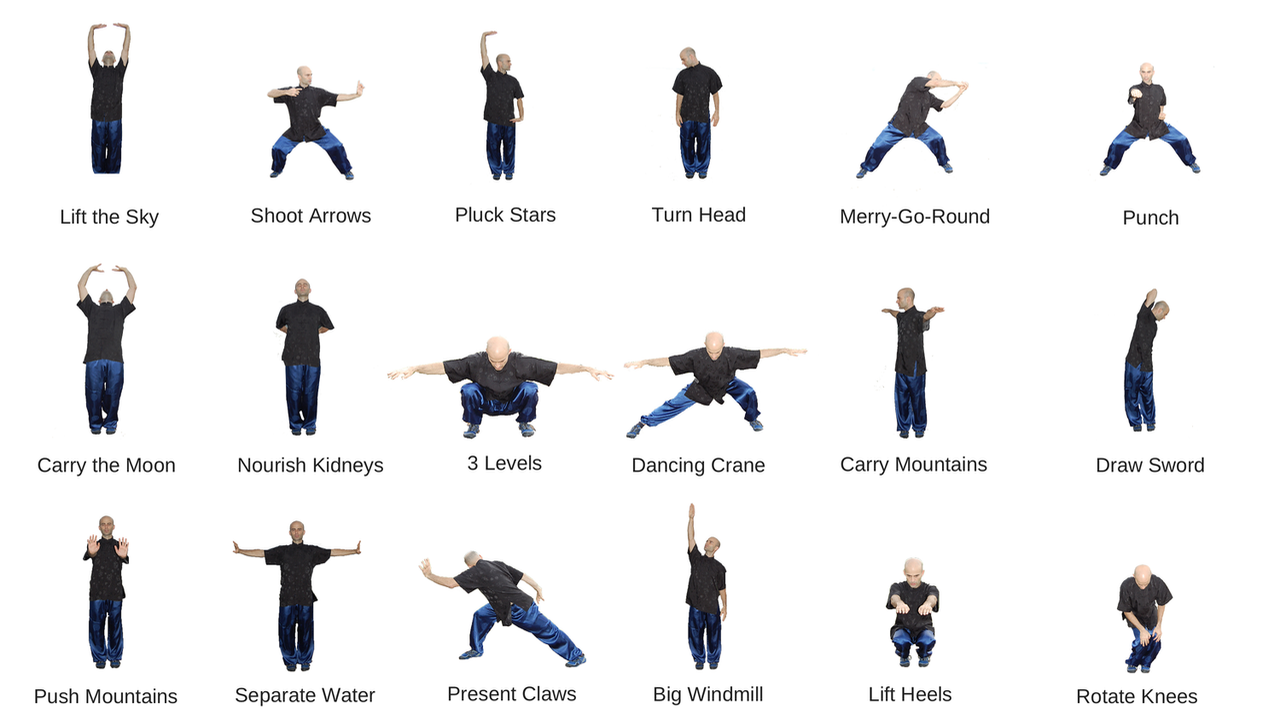
Discover all of the famous 18 Luohan Hands qigong set. If you could only practice one set of qigong exercises for the rest of your life, you'd be well served by the 18 Luohans.
The 4 Primary Skills
Techniques are great, but skills are more important for getting results. You'll learn all 4 of the primary skills of qigong:
1. Discovering the Qi,
2. Circulating the Qi,
3. Aligning the Qi, and
4. Gathering the Qi.
THE HANDS OF THE 18 LUOHAN: Technical Description of the Movements
MEDITATION POSTURE OR WU CHI
TECHNICAL & TEACHING POINTS
“Wu Chi” translates as the great void or emptiness, the one not manifested or the one without limits. This position it encompasses all the other positions. Within it, all principles of the remaining postures may be discovered.
Begin by feeling the soles of the feet touching the earth. Like the roots of a tree, the Yin aspect, the feet become the roots of the posture. Visualize roots extending through the feet to create solidity while at the same time extend the head upwards to the sky, developing the Yang aspect of the posture. Like the saying, “The higher you want to go into heaven, the deeper your roots have to be.” Many people on the spiritual path develop only the aerial aspect and forget the earth element. Balance between these two forces, Yin and Yang, earth and heaven is essential for overall health and well-being.
The body must be very straight and the spine erect. The chin is slightly downward to straighten the neck and release tension from the back of the neck. The arms hang loose and relaxed, drop the shoulders and relax so that the chest is concave and the back is rounded and convex. There is no tension as if very heavy suitcases have just been set down. Relax the groin, the buttocks and the lower back completely. The knees are straight and relaxed, not locked.
The base of the each foot is like a tri-pod with three points of support necessary to bear the weight of the body. These points are: the ball of the foot at the heel, the ball behind the big toe, and the ball behind the little toes. Lean forward a little in this position, feeling the full sole of the foot connecting, not the edges, neither the inside nor outside edge, but the whole foot resting on those three points.
Trained practitioners may hold this meditative posture for an extended period of time however beginners should start holding for less time and build up their ability to stand longer.
This posture is used to center and gather Qi in the low Dan Tien; to center the mind in the low Dan Tien; to discover the center of gravity in the body; and to calm the Shen or the spirit.
When the whole body is relaxed and the spine and the bones are aligned energy will flow in a very natural way. There should not be a “boiled spaghetti” feeling, too limp and without backbone, in the body. The Chinese say, “Bones straight, tendons relaxed” meaning the bone structure should be kept straight while in a relaxed state. This ensures that blood and energy will flow freely. For example, using a hose to water the garden when the hose is bent or crooked will not allow water to flow through. In the same way, if the body is bent, the blood and Qi will not flow. Many injuries (in the lower back and neck, etc.) would be avoided by proper spine alignment. The meditation posture acts as a preventive tool to address many of the muscular and skeletal disorders due incorrect posture.
The front side is called the Yin side, while the whole back is the Yang side. As the palms are turned forward a statement of openness, with nothing to hide, like an open book is being made.
This posture transmits the quality of truthfulness and embodies cultivating honesty within ourselves and to certain principles in our lives. Notice the accompanying phrase, “I keep my body straight and always tell the truth.” In India it is said that the person who never lies and has always spoken the truth speaks words that are so strong that, no matter what is said, they will always become a reality.
YIN-YANG/SUN-MOON PALM
TECHNICAL & TEACHING POINTS
The position is a stretch up and a stretch down at the same time. The upper hand is facing the sky and the lower hand is facing the earth. The fingers of the upper hand are pointed toward the inside of the body and the fingers of the lower hand are pointed to the buttocks. The legs are straight, the neck relaxed and the lower Dan Tien anchors the posture. This is a very good posture to stretch the tendons and ligaments in the arms and shoulders.
Throughout the 18 Luohan stretching is emphasized to balance Yin and Yang in the body and to create blood and energy flow. According to traditional Chinese medicine, disease stems from an imbalance in the flow of these two energies in the body. Each completed stretch emphasizes Yang while the release to a fully relaxed position emphasizes Yin. The stretch must always be accompanied by a state of relaxation with attention paid to body structure to avoid injury.
BEYOND TECHNIQUE
This posture balances the spiritual or lofty and the realistic or grounded element with the hands, one reaching for the sky and the other reaching for the earth to create harmony with the Tao. Note the saying, “I will shine like the sun but I will be humble like the moon” acknowledging the self-assurance and internal power like the sun within everyone as well as the humble quality of the moon, not being arrogant or misdirecting the power within. The opportunity to act according to any given situation is cultivated whether in a more Yang manner, or more Yin manner.
TOPPLE MOUNTAIN RANGE WITH PALMS
TECHNICAL & TEACHING POINTS
In the DING JI MA, most of the weight is on the front leg, and there is a rotation of the hip. The knee should not go over the toe of the front leg. The back leg is completely straight, with the back foot at a 45 degree angle and the hip of the back leg rotated in.
Continue the rotation up the spine through the waist and spinal column making the spine flexible and stretching all the muscles, tendons and ligaments of the back.
If the left leg is forward, the opposite arm is forward and the fingers are facing up while the fingers of the back hand are pointed to the side. The upper torso, from the hip and the waist, are completely turned so there is a straight line from the front hand through both shoulders to the back hand.
Both wrists are stretched to a 90 degree angle in the WILLOW LEAF PALM.
Medically this exercise helps to stretch the back leg, strengthen the front leg, rotate the hip joints and increase flexibility.
BEYOND TECHNIQUE
This posture illustrates the dragon pushing apart a mountain range. It strengthens the mind and the SHEN through a state of deep and powerful determination and concentration by focusing the eyes like the laser eyes of a dragon. Go beyond the physical stretch into a mental stretch; stretch the mind to expand the energy even more.
BLACK TIGER PUSHES THE MOUNTAIN
(click here to see the posture)
TECHNICAL & TEACHING POINTS
When stretching the palms forward there should be a tremendous extension, which stretches the back, and massages the kidney area.
This exercise is very good for lumbago, sciatica and strengthening the kidneys.
BEYOND TECHNIQUE
In Chinese medicine the tiger is related to the bones and kidneys, and this posture helps to strengthen both as well as the bone marrow. Once the physical limit of the push is achieved the consciousness expands beyond the physical body and reaches out more with the mind. “With joy and self-confidence I will overcome any obstacle” is the phrase emphasizing the human value. Harnessing the power of the whole universe, one is able to overcome anything, never giving up, learning from mistakes and never accepting failure. This too is reflected in the natural Yin and Yang cycle; life is a learning process and there is always an up and a down. Learn to see life not as simply good or bad, but as containing many experiences and opportunities from which to learn and grow stronger.
WHITE CRANE SPREADS ITS WINGS
TECHNICAL & TEACHING POINTS
The practitioner raises his hands, which are in crane’s beak formation, above his head, while breathing in. The practitioner simultaneously stands on his toes.
The entire posture should resemble a large and graceful bird, poised to leap into flight.
BEYOND TECHNIQUE
Notice the phrase, “I open my mind and my heart and I am free as a bird.” This emphasizes the control that we as individuals have over the mind and emotions, and that actually we are the ones to control whether we are happy or not.
CHILD WORSHIPING BUDDHA TO THE SKY
TECHNICAL & TEACHING POINTS
All the muscles of the upper body, through the arms, shoulders and back receive a good stretch.
Being on the toes develops the muscles in the lower legs, and will improve agility. These muscles allow for quick movement. Refer to the colloquialism, “being on the ball” or literally on the ball of the foot, fast, ready and stable.
BEYOND TECHNIQUE
Notice the phrase, “I can reach any goal; there are no limits”. Understanding to discard any beliefs of limitations in personal possibility and potential is physically emphasized in this posture. Success is a manifestation of the inner life. Confucius said, “If it takes him ten times, it takes me one hundred. If it takes him one hundred times, it takes me one thousand. If it takes him one thousand times it takes me ten thousand times, and thus the not skillful can becomes skillful.” The Luohan is a GONG; meaning a skill that is developed through practice and time. If desire, perseverance and attitude are positively cultivated any goal may be reached.
CHILD WORSHIPPING BUDDHA
TECHNICAL & TEACHING POINTS
The legs are straight but not locked and the elbows are out from of the body with space under the armpits. The hands are pressing together touching at the base and through the fingers, but inside of the palms there is a hollow area creating a connection between the two LAO GONG (Pericardium 8) points.
The fingertips are pointing to the upper DAN TIEN or “the upper field of elixir” located between the eyebrows. The upper DAN TIEN is related to SHEN or SPIRIT. The lower DAN TIEN is also the seed of the JING or ESSENCE QI of the kidneys. The middle DAN TIEN, centered between the nipples is related to QI, to the breath and to the emotions. These three are called the “three treasures” of man: the JING, or the essence, the QI, the energy and breath, and the SHEN, the spirit.
BEYOND TECHNIQUE
This position helps to illustrate how body positions affect the mind, the emotions and thoughts. Feelings of deep silence, humility, and gratitude are palpable in this posture, and help to connect the practitioner to the TAO. It is often said, “the TAO that can be explained in language is not the real TAO,” so it is important for the practitioner to develop sensitivity to how the physical movements affect them on deeper levels.
Within the 18 Luohan a relationship to silence and peace may be discovered. A great deal of energy is expended through talking. Silence helps conserve energy and is a great healer.
THE EMPEROR HOLDS UP THE TOWER
TECHNICAL & TEACHING POINTS
Stretch the palms, facing up to heaven with the middle fingers touching. Once stretched fully, relax the upper gate and lean back a little bit or as much as is comfortable.
The legs are straight and the Yin side of the body, particularly the stomach muscles as well as the Yang side, the spine and the back, are stretched.
BEYOND TECHNIQUE
This is a powerful archetypal position; the emperor is so strong that he can hold up a tower. In studying the phrase, “Honesty gives me strength and everybody trusts me,” the theme of strength and the ability to stand one’s ground through honest interactions is continued. Honesty helps develop greater strength in word and action by being guided by higher moral values. Honesty establishes the pillars of happiness, health and peace.
VENERATING THE ORIGIN
TECHNICAL & TEACHING POINTS
The posture is done as though being pulled in both directions through the front and back hand.
Keep the back straight and the eyes forward, looking far to the horizon.
BEYOND TECHNIQUE
Venerating the Origin refers to reflecting on and honoring ones own source, home, family, traditions, and experiences. There are two ways of learning through experience: to learn from the mistakes and experiences of other people or, the hard way, to always learn through personal experience. Learning from others by listening, being receptive, carefully observing, and respecting the lessons and opinions that are given, even if, in the moment they do not seem correct, is a path to honoring and respecting one’s origin.
THE SNAKE COMES OUT OF THE CAVE
TECHNICAL & TEACHING POINTS
Unlike the other DING JI MA postures, this has the back leg bent and the front leg completely straight. Both hips are turned to the front, so that they are parallel to the direction of the front leg as well as the whole torso. The elbow should be perpendicular to the sky and the opposite fingers touching the shoulder. The other forearm should be touching the kidneys.
“Venerating the Origin” and “The Snake comes out of the Cave” are done in sequence. This undulating movement helps to simulate a snake and support the flow of energy. Learning to move in this very biodynamic way helps to avoid injury and conserves energy by using minimal effort.
Bodhidharma believed that there were things to be learned from observing the snake. In nature he saw that the snake was very relaxed, and very fluid, like water. At the same time it can become very hard and powerful, like a boa constrictor or python. The strength of the snake is like the power of water flowing through a hose: the mass of water is confined to a very small space, and so the force of the water is more powerful. In this context, a very soft thing like water is strong, and it is the same with the power of energy. The relationship between softness and strength and the energy of the snake represents QI and the ability of energy to flow freely through the body.
BEYOND TECHNIQUE
The associated phrase, “I always do my duties and obligations with care” illustrates the value of always doing things to the best of your ability.
Each movement should be performed as perfectly as possible given that moment and time. In order to fully experience the health, energetic and spiritual benefits, the techniques should be performed exactly as they are taught; the benefits are proportional to the correct technique. However, this does not mean that one should trapped by perfection. My grandfather used to say, “Perfection is the enemy of getting things done.” At the same time it is important to strive to cultivate something in life in which one may excel, whether it is qigong, painting, playing the piano, being a good doctor, a scientist or a computer expert. Developing mastery in one’s life leads to greater joy and peace, as well as benefiting our health. Accordingly, medical science is now confirming that people who enjoy what they are doing live longer and healthier lives.
OPEN THE BOW TO SHOOT THE VULTURE
TECHNICAL & TEACHING POINTS
The DING JI MA position must be correctly executed, turning through the hips as much as possible, then through low, middle and upper back.
The front hand is stretched all the way forward in a hollow fist and the back hand pulls back strongly with a hollow fist. Both of the little fingers are facing up towards the sky as the pull is completed.
BEYOND TECHNIQUE
The human value illustrated in the saying, “I choose a good objective and I concentrate all my attention to reach it” emphasizes the merit of wholly choosing a worthwhile path, goal, or objective and then applying concentration and perseverance. The ability to clearly focus one’s attention on a goal allows the essence of the subject to be fully realized.
In every exercise of the form, absolute concentration on the physical technique, the breath, the body sensations, and the intent is essential. Mastering these skills in the form then permeate into any daily activity and support the pursuit of health, peace, wisdom and happiness through persistent self-development. Embedded deeply within traditional Chinese culture, including the martial arts and techniques for self-defense, is the pursuit of self-development. For example, in archery, the emphasis is not necessarily on always hitting the bull’s-eye, but to develop the ability of the archer to become one with shooting an arrow, and to feel that the arrow is a part of them. If the archer is able to feel at one with the arrow, the level of concentration and presence within the moment will be so deep as to go beyond the physical act of archery into the realm of a spiritual development. In not worrying about the target, only focusing on the moment, and allowing nature to take its course, one will have arrived at the complete realization of whatever it is that is being done.
THE POWERFUL TIGER STRETCHES ITS BACK
TECHNICAL & TEACHING POINTS
This position emphasizes the importance of circles in the practice of Qigong. The energy of the circle allows for relaxation, the ability to gather energy and to allow that energy to flow smoothly. Note the circularity in the posture all the way through the spine, from the heel to the head; the circle between the arms, within the hands and also in the back. The line between the two hands resembles the line the separates the Yin from the Yang in the Yin/Yang symbol.
This is a strong exercise to strengthen the back muscles, the legs and hips and well as stretch the spine. Keeping the spine healthy and flexible will help keep the body young. Stretching is a powerful tool to keep the body healthy and young because it not only facilitates the movement of blood and energy to every part of the body but also dredges the energy channels of blockages in the process.
BEYOND TECHNIQUE
The human value emphasized is “I help others and I have the power of the tiger.” With honest compassion and caring, not attempting to maintain power over anyone or anything, one can be generous to all and begin to see the web of connection between all living creatures. There is a very beautiful saying, “You cannot pick a flower without affecting a star,” so deep is the connection that ties us all together.
GOLDEN COCK STANDS ON ONE LEG
TECHNICAL & TEACHING POINTS
This powerful position begins a series of one-legged postures. In the leg that is raised, the foot is completely extended while the other leg is slightly bent. Feel all the way to the tip of the foot.
The upper body is virtually the same as the movement “Open the bow to shoot a vulture”. The arm that is up should also stretch forward in order to get the rotation of the spine. The back hand pulling back is in the hollow fist position.
Drop the shoulders and drop the weight to the DAN TIEN. Strive to fully stretch but maintain the relaxation, so that only the minimal muscles needed to execute the movements are used.
BEYOND TECHNIQUE
The rising YANG energy of this posture, like the rooster greeting the rising sun is associated with the phrase “I smile and I am happy when I wake up.” Starting off each day from the first thought upon waking with a smile and a positive thought helps achieve happiness and peace in each and every day.
There is a saying, “All the faces in the world are mirrors.” It is up to you to decide what face you decide to show the world.
A few minutes of Qigong every morning, whether only 5 minutes or 30 sets the attitude to be carried into life. The transition from the world of unconsciousness into the physical world is aided by stretching and gathering energy, and by allowing the body time to wake up and get the energy flowing. Just like animals in nature, as they get up, they stretch a little bit, they move, they keep on stretching and moving a little bit and then slowly they begin to walk.
The Chinese say that the five wheels (or ways) in life to stay healthy and happy are:
1) to walk with the spine erect,
2) to have beautiful projects in your mind and to plan beautiful things,
3) to listen to music to enhance the life experience,
4) to walk in nature, enjoy and be one with nature,
5) and to smile.
There is scientific evidence that endorphins and other beneficial hormones are secreted when people are happy and laughing. This reiterates the relationship between the body, mind and emotions. It is difficult to feel sad when smiling. When looking for a problem a problem will be found. When looking for solution a solution will be found. Start with a positive attitude and the end result will be positive.
COMMON MISTAKES TO AVOID
WHITE TIGER LOOKS DOWN THE ROAD
TECHNICAL & TEACHING POINTS
In the first aspect of this movement, the body leans back in the direction of the arms and though technically difficult to do, eventually the leg and trunk are in nearly a straight line.
In the second and third parts of this position the hands are held in a tiger claw with the wrists flexed. The leg that is raised is kept straight and the foot pointed.
There is tremendous rotation of the spine; movement of the hip joint and hip area; and movement of the internal organs.
BEYOND TECHNIQUE
The name of the movement calls attention to the importance of developing skills in observation and attentiveness. It is tremendously useful to see the reality of situations that others don’t normally see. Encourage improvement not only in observation but also in every other sense to its fullest while simultaneously improving the capacity for deep concentration. The ability to see detail and become one with it allows us to penetrate to its essence. Then one will experience not only with the eyes, but also feel, understand and begin to know with the whole body.
Wisdom is likewise gained by paying attention to the elements. For example, the nature of water is very adaptable to its environment. It does not fight, but rather yields, nurtures, remains soft and because of that is powerful and strong. It is the one drop of water, that drop by drop, penetrates the rock. By observing the earth, the structure, stability and strength of the mountain is understood. The power and energy of fire to get things done with passion is recognizable; and from air the free and ethereal sense that not being tied down is learned.
The seasons, winter, spring, summer, and autumn, instruct in the cyclical and changing ways of living, thinking, dressing, eating throughout the year so as to harmonize with the season and create well-being. So the human value expressed in the saying, “I take care of nature” might be better understood as “I take care and harmonize and learn from nature.” As one delves deeper into silence, into these exercises and into introspection, an understand of this in a natural way, not from intellectual discourse, but from a living experience will manifest. Much of this wisdom is already innate.
Everyone agreed. And this is how it has been since that time. Man is always searching for happiness without knowing that happiness is within himself.
WHITE CRANE STRETCHES
TECHNICAL & TEACHING POINTS
This is a balancing posture with the two hands held in a cranes beak—fingers held together with, the tips of the fingers facing each other, the wrist flexed, and the arms outstretched.
One of the legs is stretched back and toe is pointed. The leg is turned so that the buttocks are facing to the back rather than up due to the rotation of the hip. Look forward and focus the awareness to the forward hand as well as back to the tip of the toe. The arms and leg that are in a straight line.
BEYOND TECHNIQUE
A crane stretching to fly brings to mind the migration of the birds. In order to migrate the birds must inherit all the knowledge they need to travel such long distances. They know how and where to fly innately and follow their natural course. The phrase “With perseverance and effort I reach what I want,” sums up the formula for success in life and, just like the birds, if one puts all of ones effort into reaching a destination, any goal will be reached.
This position provides an opportunity to put that perseverance into play. At the beginning it seems to be very difficult. Over time, improvement in the posture will develop. Often when students begin this posture, they are worried and say that it is very difficult to do. Yes, these positions are very difficult to do but I tell them, “You know difficult and easy, it just really doesn’t matter. These are words that I don’t even deal with. We must do things and so we do them.” The real question is whether it is worth doing, or not worth doing? If the movement is not thought of or interpreted as easy or hard, but worth doing, then, instead of conquering it in one day, it slowly and gradually unfolds over time. Patience is required to understand that things done well take time.
KICK WITH THE HEEL
TECHNICAL & TEACHING POINTS
Feel the heel of the foot and the toe straight up. The opposite foot and hand are forward based on the rotation through the upper body.
The back should be kept straight, and the weighted leg may be kept bent or straight, which is more difficult.
BEYOND TECHNIQUE
In this exercise you develop stability and balance to maintain well-being and happiness. This is evident in the phrase, “I keep my balance to be happy.” Learning the way to harmoniously bring together duty and pleasure, work and fun is the most exquisite balance, and is the way to lasting and true happiness.
FAST KICK
TECHNICAL & TEACHING POINTS
The “Fast Kick”, is the only movement that is done quickly in the whole sequence. This exercise is used for coordination, stretching of the legs, loosening of the arms and a continued connection to the DAN TIEN.
It stresses elasticity and the flexibility of the joints and the legs while keeping balance and keeping the lower foot fully connected to the ground.
BEYOND TECHNIQUE
The phrase and associated human value refers to “Fast outside, calm inside.” This is means by which to move through life; allowing for the ability to move quickly without losing one’s stability or center while maintaining a sense of peace and calm. The Chinese say, “Stillness in movement, movement in stillness.” This is a very healthy attitude because energy is conserved. My first teacher said, “We should be like a hurricane in certain emotions and in certain times of our daily life. We act fast like the hurricane where the outside is moving very fast, but the inside is very calm.” The same teacher also said, “Go through life like a fish in a fish tank. The fish swims around very slowly in the fish tank, calmly without wasting energy but if you put a hand in there they are capable of moving very quickly. And then they return to peaceful, calm movement.”
In the Luohan, the movements are learned in a very calm and elegant way, but are capable of moving very fast as well. The ability to move quickly is related to the flow of blood and energy. While observing a cat it is obvious that it is not always moving but it stretches from time to time, allowing energy to flow, keeping the joints warm and lubricated and the muscles toned. When the cat decides to hunt it proceeds slowly and calmly with tremendous intention in the eyes, and it is ready to jump in a second.
TURN THE BODY WITH TWISTED STEPS
TECHNICAL & TEACHING POINTS
The entire sole of one foot is on the floor and the other foot connects with the ball of the foot. The both feet point forward and the weight is on both legs.
The hips should rotate so that they are oriented to the back with the body kept straight and the shoulders relaxed.
BEYOND TECHNIQUE
The phrase notes, “I am flexible and I adapt to different situations.” Adapting with flexibility to any given moment or situation and to act accordingly will improve the quality of life. Water is a perfect example of the ability to adapt, with the least effort, moving around until it reaches its goal and returns to the sea. Those who are very rigid and structured suffer without finding solutions to problems. In the Orient, it is said, “One of the first lessons we must learn is that there are many rules and laws to be learned and the most important one is that there is no strategy, there are no rules and one should be able to change very quickly.” As the different cycles of life are experienced many values, desires, and goals modify and must be changed accordingly. There is a saying from an Indian poet, “Do not cry because the sun has set, because the tears will not let you see the beauty of the stars.” The inability to change because of need and attachment does not allow for the possibilities of a new situation. Perhaps this new situation is much better. Learning to let go shows faith in nature and the willingness to take full advantage of all the possibilities that are offered.
LUOHAN DRIES HIS GOWN IN THE SUN
TECHNICAL & TEACHING POINTS
This is performed with the feet parallel and the arms relaxed while stretched out to the sides. The hips thrust forward while the legs are kept straight. The torso bends backwards, with the neck, the upper gate, relaxed and the arms hang like a piece of cloth.
This is a very powerful extension and flexion of the spine. As in all the other movements of the form, be sure that it is done carefully.
SWORD FINGERS
TECHNICAL & TEACHING POINTS
The last posture is done in a HORSE STANCE position in which the legs and the feet are parallel to each other facing the front. The knees are extended out as if being held open by a piece of wood, which helps to strengthen the muscles on the inside of the leg.
This position strengthens and opens the hip and is a very stable position related to the structure and power of the earth element.
The index and middle finger are put together while holding the ring and little finger with the thumb. The sword fingers are extended out to each side as if touching objects very far away, while extending the concentration and consciousness equally far away. It should have a very dignified, powerful and solid feeling.
BEYOND TECHNIQUE
The phrase, “I am courageous and guided by justice and honor” highlights the human value in this posture. Throughout the course of life many situations will demand courage, and the belief that courage is inherent will generate the power to overcome any obstacle. Actions, guided by a clear sense of justice and treating others as we would like to be treated, will reinforce our sense of honor and will provide peace and health.
In the last pages of the coloring book, a Luohan walks away during a full moon and it says “And Luohan continued his way observing, listening, meditating; trying to learn something new every day.” Life is the school and the learning process with each day provides an opportunity to learn to be better people, to be more peaceful and wise, to be more loving, more just, more honorable, because that is what will bring deep, true and lasting happiness. Observe oneself first, the feelings, emotions, thoughts, actions, and words and meditate on those. Mindfully observe others, and nature, and meditate on that to discover peace, health and happiness.
At the end it says “And it is said that Luohan is on the search of another grand adventure” indicating that there is always more to come in this very beautiful adventure that is life.
MEDITATION POSTURE OR WU CHI
TECHNICAL & TEACHING POINTS
“Wu Chi” translates as the great void or emptiness, the one not manifested or the one without limits. This position it encompasses all the other positions. Within it, all principles of the remaining postures may be discovered.
Begin by feeling the soles of the feet touching the earth. Like the roots of a tree, the Yin aspect, the feet become the roots of the posture. Visualize roots extending through the feet to create solidity while at the same time extend the head upwards to the sky, developing the Yang aspect of the posture. Like the saying, “The higher you want to go into heaven, the deeper your roots have to be.” Many people on the spiritual path develop only the aerial aspect and forget the earth element. Balance between these two forces, Yin and Yang, earth and heaven is essential for overall health and well-being.
The body must be very straight and the spine erect. The chin is slightly downward to straighten the neck and release tension from the back of the neck. The arms hang loose and relaxed, drop the shoulders and relax so that the chest is concave and the back is rounded and convex. There is no tension as if very heavy suitcases have just been set down. Relax the groin, the buttocks and the lower back completely. The knees are straight and relaxed, not locked.
The base of the each foot is like a tri-pod with three points of support necessary to bear the weight of the body. These points are: the ball of the foot at the heel, the ball behind the big toe, and the ball behind the little toes. Lean forward a little in this position, feeling the full sole of the foot connecting, not the edges, neither the inside nor outside edge, but the whole foot resting on those three points.
Trained practitioners may hold this meditative posture for an extended period of time however beginners should start holding for less time and build up their ability to stand longer.
This posture is used to center and gather Qi in the low Dan Tien; to center the mind in the low Dan Tien; to discover the center of gravity in the body; and to calm the Shen or the spirit.
When the whole body is relaxed and the spine and the bones are aligned energy will flow in a very natural way. There should not be a “boiled spaghetti” feeling, too limp and without backbone, in the body. The Chinese say, “Bones straight, tendons relaxed” meaning the bone structure should be kept straight while in a relaxed state. This ensures that blood and energy will flow freely. For example, using a hose to water the garden when the hose is bent or crooked will not allow water to flow through. In the same way, if the body is bent, the blood and Qi will not flow. Many injuries (in the lower back and neck, etc.) would be avoided by proper spine alignment. The meditation posture acts as a preventive tool to address many of the muscular and skeletal disorders due incorrect posture.
The front side is called the Yin side, while the whole back is the Yang side. As the palms are turned forward a statement of openness, with nothing to hide, like an open book is being made.
This posture transmits the quality of truthfulness and embodies cultivating honesty within ourselves and to certain principles in our lives. Notice the accompanying phrase, “I keep my body straight and always tell the truth.” In India it is said that the person who never lies and has always spoken the truth speaks words that are so strong that, no matter what is said, they will always become a reality.
YIN-YANG/SUN-MOON PALM
TECHNICAL & TEACHING POINTS
The position is a stretch up and a stretch down at the same time. The upper hand is facing the sky and the lower hand is facing the earth. The fingers of the upper hand are pointed toward the inside of the body and the fingers of the lower hand are pointed to the buttocks. The legs are straight, the neck relaxed and the lower Dan Tien anchors the posture. This is a very good posture to stretch the tendons and ligaments in the arms and shoulders.
Throughout the 18 Luohan stretching is emphasized to balance Yin and Yang in the body and to create blood and energy flow. According to traditional Chinese medicine, disease stems from an imbalance in the flow of these two energies in the body. Each completed stretch emphasizes Yang while the release to a fully relaxed position emphasizes Yin. The stretch must always be accompanied by a state of relaxation with attention paid to body structure to avoid injury.
BEYOND TECHNIQUE
This posture balances the spiritual or lofty and the realistic or grounded element with the hands, one reaching for the sky and the other reaching for the earth to create harmony with the Tao. Note the saying, “I will shine like the sun but I will be humble like the moon” acknowledging the self-assurance and internal power like the sun within everyone as well as the humble quality of the moon, not being arrogant or misdirecting the power within. The opportunity to act according to any given situation is cultivated whether in a more Yang manner, or more Yin manner.
TOPPLE MOUNTAIN RANGE WITH PALMS
TECHNICAL & TEACHING POINTS
In the DING JI MA, most of the weight is on the front leg, and there is a rotation of the hip. The knee should not go over the toe of the front leg. The back leg is completely straight, with the back foot at a 45 degree angle and the hip of the back leg rotated in.
Continue the rotation up the spine through the waist and spinal column making the spine flexible and stretching all the muscles, tendons and ligaments of the back.
If the left leg is forward, the opposite arm is forward and the fingers are facing up while the fingers of the back hand are pointed to the side. The upper torso, from the hip and the waist, are completely turned so there is a straight line from the front hand through both shoulders to the back hand.
Both wrists are stretched to a 90 degree angle in the WILLOW LEAF PALM.
Medically this exercise helps to stretch the back leg, strengthen the front leg, rotate the hip joints and increase flexibility.
BEYOND TECHNIQUE
This posture illustrates the dragon pushing apart a mountain range. It strengthens the mind and the SHEN through a state of deep and powerful determination and concentration by focusing the eyes like the laser eyes of a dragon. Go beyond the physical stretch into a mental stretch; stretch the mind to expand the energy even more.
BLACK TIGER PUSHES THE MOUNTAIN
(click here to see the posture)
TECHNICAL & TEACHING POINTS
When stretching the palms forward there should be a tremendous extension, which stretches the back, and massages the kidney area.
This exercise is very good for lumbago, sciatica and strengthening the kidneys.
BEYOND TECHNIQUE
In Chinese medicine the tiger is related to the bones and kidneys, and this posture helps to strengthen both as well as the bone marrow. Once the physical limit of the push is achieved the consciousness expands beyond the physical body and reaches out more with the mind. “With joy and self-confidence I will overcome any obstacle” is the phrase emphasizing the human value. Harnessing the power of the whole universe, one is able to overcome anything, never giving up, learning from mistakes and never accepting failure. This too is reflected in the natural Yin and Yang cycle; life is a learning process and there is always an up and a down. Learn to see life not as simply good or bad, but as containing many experiences and opportunities from which to learn and grow stronger.
WHITE CRANE SPREADS ITS WINGS
TECHNICAL & TEACHING POINTS
The practitioner raises his hands, which are in crane’s beak formation, above his head, while breathing in. The practitioner simultaneously stands on his toes.
The entire posture should resemble a large and graceful bird, poised to leap into flight.
BEYOND TECHNIQUE
Notice the phrase, “I open my mind and my heart and I am free as a bird.” This emphasizes the control that we as individuals have over the mind and emotions, and that actually we are the ones to control whether we are happy or not.
CHILD WORSHIPING BUDDHA TO THE SKY
TECHNICAL & TEACHING POINTS
All the muscles of the upper body, through the arms, shoulders and back receive a good stretch.
Being on the toes develops the muscles in the lower legs, and will improve agility. These muscles allow for quick movement. Refer to the colloquialism, “being on the ball” or literally on the ball of the foot, fast, ready and stable.
BEYOND TECHNIQUE
Notice the phrase, “I can reach any goal; there are no limits”. Understanding to discard any beliefs of limitations in personal possibility and potential is physically emphasized in this posture. Success is a manifestation of the inner life. Confucius said, “If it takes him ten times, it takes me one hundred. If it takes him one hundred times, it takes me one thousand. If it takes him one thousand times it takes me ten thousand times, and thus the not skillful can becomes skillful.” The Luohan is a GONG; meaning a skill that is developed through practice and time. If desire, perseverance and attitude are positively cultivated any goal may be reached.
CHILD WORSHIPPING BUDDHA
TECHNICAL & TEACHING POINTS
The legs are straight but not locked and the elbows are out from of the body with space under the armpits. The hands are pressing together touching at the base and through the fingers, but inside of the palms there is a hollow area creating a connection between the two LAO GONG (Pericardium 8) points.
The fingertips are pointing to the upper DAN TIEN or “the upper field of elixir” located between the eyebrows. The upper DAN TIEN is related to SHEN or SPIRIT. The lower DAN TIEN is also the seed of the JING or ESSENCE QI of the kidneys. The middle DAN TIEN, centered between the nipples is related to QI, to the breath and to the emotions. These three are called the “three treasures” of man: the JING, or the essence, the QI, the energy and breath, and the SHEN, the spirit.
BEYOND TECHNIQUE
This position helps to illustrate how body positions affect the mind, the emotions and thoughts. Feelings of deep silence, humility, and gratitude are palpable in this posture, and help to connect the practitioner to the TAO. It is often said, “the TAO that can be explained in language is not the real TAO,” so it is important for the practitioner to develop sensitivity to how the physical movements affect them on deeper levels.
Within the 18 Luohan a relationship to silence and peace may be discovered. A great deal of energy is expended through talking. Silence helps conserve energy and is a great healer.
THE EMPEROR HOLDS UP THE TOWER
TECHNICAL & TEACHING POINTS
Stretch the palms, facing up to heaven with the middle fingers touching. Once stretched fully, relax the upper gate and lean back a little bit or as much as is comfortable.
The legs are straight and the Yin side of the body, particularly the stomach muscles as well as the Yang side, the spine and the back, are stretched.
BEYOND TECHNIQUE
This is a powerful archetypal position; the emperor is so strong that he can hold up a tower. In studying the phrase, “Honesty gives me strength and everybody trusts me,” the theme of strength and the ability to stand one’s ground through honest interactions is continued. Honesty helps develop greater strength in word and action by being guided by higher moral values. Honesty establishes the pillars of happiness, health and peace.
VENERATING THE ORIGIN
TECHNICAL & TEACHING POINTS
The posture is done as though being pulled in both directions through the front and back hand.
Keep the back straight and the eyes forward, looking far to the horizon.
BEYOND TECHNIQUE
Venerating the Origin refers to reflecting on and honoring ones own source, home, family, traditions, and experiences. There are two ways of learning through experience: to learn from the mistakes and experiences of other people or, the hard way, to always learn through personal experience. Learning from others by listening, being receptive, carefully observing, and respecting the lessons and opinions that are given, even if, in the moment they do not seem correct, is a path to honoring and respecting one’s origin.
THE SNAKE COMES OUT OF THE CAVE
TECHNICAL & TEACHING POINTS
Unlike the other DING JI MA postures, this has the back leg bent and the front leg completely straight. Both hips are turned to the front, so that they are parallel to the direction of the front leg as well as the whole torso. The elbow should be perpendicular to the sky and the opposite fingers touching the shoulder. The other forearm should be touching the kidneys.
“Venerating the Origin” and “The Snake comes out of the Cave” are done in sequence. This undulating movement helps to simulate a snake and support the flow of energy. Learning to move in this very biodynamic way helps to avoid injury and conserves energy by using minimal effort.
Bodhidharma believed that there were things to be learned from observing the snake. In nature he saw that the snake was very relaxed, and very fluid, like water. At the same time it can become very hard and powerful, like a boa constrictor or python. The strength of the snake is like the power of water flowing through a hose: the mass of water is confined to a very small space, and so the force of the water is more powerful. In this context, a very soft thing like water is strong, and it is the same with the power of energy. The relationship between softness and strength and the energy of the snake represents QI and the ability of energy to flow freely through the body.
BEYOND TECHNIQUE
The associated phrase, “I always do my duties and obligations with care” illustrates the value of always doing things to the best of your ability.
Each movement should be performed as perfectly as possible given that moment and time. In order to fully experience the health, energetic and spiritual benefits, the techniques should be performed exactly as they are taught; the benefits are proportional to the correct technique. However, this does not mean that one should trapped by perfection. My grandfather used to say, “Perfection is the enemy of getting things done.” At the same time it is important to strive to cultivate something in life in which one may excel, whether it is qigong, painting, playing the piano, being a good doctor, a scientist or a computer expert. Developing mastery in one’s life leads to greater joy and peace, as well as benefiting our health. Accordingly, medical science is now confirming that people who enjoy what they are doing live longer and healthier lives.
OPEN THE BOW TO SHOOT THE VULTURE
TECHNICAL & TEACHING POINTS
The DING JI MA position must be correctly executed, turning through the hips as much as possible, then through low, middle and upper back.
The front hand is stretched all the way forward in a hollow fist and the back hand pulls back strongly with a hollow fist. Both of the little fingers are facing up towards the sky as the pull is completed.
BEYOND TECHNIQUE
The human value illustrated in the saying, “I choose a good objective and I concentrate all my attention to reach it” emphasizes the merit of wholly choosing a worthwhile path, goal, or objective and then applying concentration and perseverance. The ability to clearly focus one’s attention on a goal allows the essence of the subject to be fully realized.
In every exercise of the form, absolute concentration on the physical technique, the breath, the body sensations, and the intent is essential. Mastering these skills in the form then permeate into any daily activity and support the pursuit of health, peace, wisdom and happiness through persistent self-development. Embedded deeply within traditional Chinese culture, including the martial arts and techniques for self-defense, is the pursuit of self-development. For example, in archery, the emphasis is not necessarily on always hitting the bull’s-eye, but to develop the ability of the archer to become one with shooting an arrow, and to feel that the arrow is a part of them. If the archer is able to feel at one with the arrow, the level of concentration and presence within the moment will be so deep as to go beyond the physical act of archery into the realm of a spiritual development. In not worrying about the target, only focusing on the moment, and allowing nature to take its course, one will have arrived at the complete realization of whatever it is that is being done.
THE POWERFUL TIGER STRETCHES ITS BACK
TECHNICAL & TEACHING POINTS
This position emphasizes the importance of circles in the practice of Qigong. The energy of the circle allows for relaxation, the ability to gather energy and to allow that energy to flow smoothly. Note the circularity in the posture all the way through the spine, from the heel to the head; the circle between the arms, within the hands and also in the back. The line between the two hands resembles the line the separates the Yin from the Yang in the Yin/Yang symbol.
This is a strong exercise to strengthen the back muscles, the legs and hips and well as stretch the spine. Keeping the spine healthy and flexible will help keep the body young. Stretching is a powerful tool to keep the body healthy and young because it not only facilitates the movement of blood and energy to every part of the body but also dredges the energy channels of blockages in the process.
BEYOND TECHNIQUE
The human value emphasized is “I help others and I have the power of the tiger.” With honest compassion and caring, not attempting to maintain power over anyone or anything, one can be generous to all and begin to see the web of connection between all living creatures. There is a very beautiful saying, “You cannot pick a flower without affecting a star,” so deep is the connection that ties us all together.
GOLDEN COCK STANDS ON ONE LEG
TECHNICAL & TEACHING POINTS
This powerful position begins a series of one-legged postures. In the leg that is raised, the foot is completely extended while the other leg is slightly bent. Feel all the way to the tip of the foot.
The upper body is virtually the same as the movement “Open the bow to shoot a vulture”. The arm that is up should also stretch forward in order to get the rotation of the spine. The back hand pulling back is in the hollow fist position.
Drop the shoulders and drop the weight to the DAN TIEN. Strive to fully stretch but maintain the relaxation, so that only the minimal muscles needed to execute the movements are used.
BEYOND TECHNIQUE
The rising YANG energy of this posture, like the rooster greeting the rising sun is associated with the phrase “I smile and I am happy when I wake up.” Starting off each day from the first thought upon waking with a smile and a positive thought helps achieve happiness and peace in each and every day.
There is a saying, “All the faces in the world are mirrors.” It is up to you to decide what face you decide to show the world.
A few minutes of Qigong every morning, whether only 5 minutes or 30 sets the attitude to be carried into life. The transition from the world of unconsciousness into the physical world is aided by stretching and gathering energy, and by allowing the body time to wake up and get the energy flowing. Just like animals in nature, as they get up, they stretch a little bit, they move, they keep on stretching and moving a little bit and then slowly they begin to walk.
The Chinese say that the five wheels (or ways) in life to stay healthy and happy are:
1) to walk with the spine erect,
2) to have beautiful projects in your mind and to plan beautiful things,
3) to listen to music to enhance the life experience,
4) to walk in nature, enjoy and be one with nature,
5) and to smile.
There is scientific evidence that endorphins and other beneficial hormones are secreted when people are happy and laughing. This reiterates the relationship between the body, mind and emotions. It is difficult to feel sad when smiling. When looking for a problem a problem will be found. When looking for solution a solution will be found. Start with a positive attitude and the end result will be positive.
COMMON MISTAKES TO AVOID
WHITE TIGER LOOKS DOWN THE ROAD
TECHNICAL & TEACHING POINTS
In the first aspect of this movement, the body leans back in the direction of the arms and though technically difficult to do, eventually the leg and trunk are in nearly a straight line.
In the second and third parts of this position the hands are held in a tiger claw with the wrists flexed. The leg that is raised is kept straight and the foot pointed.
There is tremendous rotation of the spine; movement of the hip joint and hip area; and movement of the internal organs.
BEYOND TECHNIQUE
The name of the movement calls attention to the importance of developing skills in observation and attentiveness. It is tremendously useful to see the reality of situations that others don’t normally see. Encourage improvement not only in observation but also in every other sense to its fullest while simultaneously improving the capacity for deep concentration. The ability to see detail and become one with it allows us to penetrate to its essence. Then one will experience not only with the eyes, but also feel, understand and begin to know with the whole body.
Wisdom is likewise gained by paying attention to the elements. For example, the nature of water is very adaptable to its environment. It does not fight, but rather yields, nurtures, remains soft and because of that is powerful and strong. It is the one drop of water, that drop by drop, penetrates the rock. By observing the earth, the structure, stability and strength of the mountain is understood. The power and energy of fire to get things done with passion is recognizable; and from air the free and ethereal sense that not being tied down is learned.
The seasons, winter, spring, summer, and autumn, instruct in the cyclical and changing ways of living, thinking, dressing, eating throughout the year so as to harmonize with the season and create well-being. So the human value expressed in the saying, “I take care of nature” might be better understood as “I take care and harmonize and learn from nature.” As one delves deeper into silence, into these exercises and into introspection, an understand of this in a natural way, not from intellectual discourse, but from a living experience will manifest. Much of this wisdom is already innate.
Everyone agreed. And this is how it has been since that time. Man is always searching for happiness without knowing that happiness is within himself.
WHITE CRANE STRETCHES
TECHNICAL & TEACHING POINTS
This is a balancing posture with the two hands held in a cranes beak—fingers held together with, the tips of the fingers facing each other, the wrist flexed, and the arms outstretched.
One of the legs is stretched back and toe is pointed. The leg is turned so that the buttocks are facing to the back rather than up due to the rotation of the hip. Look forward and focus the awareness to the forward hand as well as back to the tip of the toe. The arms and leg that are in a straight line.
BEYOND TECHNIQUE
A crane stretching to fly brings to mind the migration of the birds. In order to migrate the birds must inherit all the knowledge they need to travel such long distances. They know how and where to fly innately and follow their natural course. The phrase “With perseverance and effort I reach what I want,” sums up the formula for success in life and, just like the birds, if one puts all of ones effort into reaching a destination, any goal will be reached.
This position provides an opportunity to put that perseverance into play. At the beginning it seems to be very difficult. Over time, improvement in the posture will develop. Often when students begin this posture, they are worried and say that it is very difficult to do. Yes, these positions are very difficult to do but I tell them, “You know difficult and easy, it just really doesn’t matter. These are words that I don’t even deal with. We must do things and so we do them.” The real question is whether it is worth doing, or not worth doing? If the movement is not thought of or interpreted as easy or hard, but worth doing, then, instead of conquering it in one day, it slowly and gradually unfolds over time. Patience is required to understand that things done well take time.
KICK WITH THE HEEL
TECHNICAL & TEACHING POINTS
Feel the heel of the foot and the toe straight up. The opposite foot and hand are forward based on the rotation through the upper body.
The back should be kept straight, and the weighted leg may be kept bent or straight, which is more difficult.
BEYOND TECHNIQUE
In this exercise you develop stability and balance to maintain well-being and happiness. This is evident in the phrase, “I keep my balance to be happy.” Learning the way to harmoniously bring together duty and pleasure, work and fun is the most exquisite balance, and is the way to lasting and true happiness.
FAST KICK
TECHNICAL & TEACHING POINTS
The “Fast Kick”, is the only movement that is done quickly in the whole sequence. This exercise is used for coordination, stretching of the legs, loosening of the arms and a continued connection to the DAN TIEN.
It stresses elasticity and the flexibility of the joints and the legs while keeping balance and keeping the lower foot fully connected to the ground.
BEYOND TECHNIQUE
The phrase and associated human value refers to “Fast outside, calm inside.” This is means by which to move through life; allowing for the ability to move quickly without losing one’s stability or center while maintaining a sense of peace and calm. The Chinese say, “Stillness in movement, movement in stillness.” This is a very healthy attitude because energy is conserved. My first teacher said, “We should be like a hurricane in certain emotions and in certain times of our daily life. We act fast like the hurricane where the outside is moving very fast, but the inside is very calm.” The same teacher also said, “Go through life like a fish in a fish tank. The fish swims around very slowly in the fish tank, calmly without wasting energy but if you put a hand in there they are capable of moving very quickly. And then they return to peaceful, calm movement.”
In the Luohan, the movements are learned in a very calm and elegant way, but are capable of moving very fast as well. The ability to move quickly is related to the flow of blood and energy. While observing a cat it is obvious that it is not always moving but it stretches from time to time, allowing energy to flow, keeping the joints warm and lubricated and the muscles toned. When the cat decides to hunt it proceeds slowly and calmly with tremendous intention in the eyes, and it is ready to jump in a second.
TURN THE BODY WITH TWISTED STEPS
TECHNICAL & TEACHING POINTS
The entire sole of one foot is on the floor and the other foot connects with the ball of the foot. The both feet point forward and the weight is on both legs.
The hips should rotate so that they are oriented to the back with the body kept straight and the shoulders relaxed.
BEYOND TECHNIQUE
The phrase notes, “I am flexible and I adapt to different situations.” Adapting with flexibility to any given moment or situation and to act accordingly will improve the quality of life. Water is a perfect example of the ability to adapt, with the least effort, moving around until it reaches its goal and returns to the sea. Those who are very rigid and structured suffer without finding solutions to problems. In the Orient, it is said, “One of the first lessons we must learn is that there are many rules and laws to be learned and the most important one is that there is no strategy, there are no rules and one should be able to change very quickly.” As the different cycles of life are experienced many values, desires, and goals modify and must be changed accordingly. There is a saying from an Indian poet, “Do not cry because the sun has set, because the tears will not let you see the beauty of the stars.” The inability to change because of need and attachment does not allow for the possibilities of a new situation. Perhaps this new situation is much better. Learning to let go shows faith in nature and the willingness to take full advantage of all the possibilities that are offered.
LUOHAN DRIES HIS GOWN IN THE SUN
TECHNICAL & TEACHING POINTS
This is performed with the feet parallel and the arms relaxed while stretched out to the sides. The hips thrust forward while the legs are kept straight. The torso bends backwards, with the neck, the upper gate, relaxed and the arms hang like a piece of cloth.
This is a very powerful extension and flexion of the spine. As in all the other movements of the form, be sure that it is done carefully.
SWORD FINGERS
TECHNICAL & TEACHING POINTS
The last posture is done in a HORSE STANCE position in which the legs and the feet are parallel to each other facing the front. The knees are extended out as if being held open by a piece of wood, which helps to strengthen the muscles on the inside of the leg.
This position strengthens and opens the hip and is a very stable position related to the structure and power of the earth element.
The index and middle finger are put together while holding the ring and little finger with the thumb. The sword fingers are extended out to each side as if touching objects very far away, while extending the concentration and consciousness equally far away. It should have a very dignified, powerful and solid feeling.
BEYOND TECHNIQUE
The phrase, “I am courageous and guided by justice and honor” highlights the human value in this posture. Throughout the course of life many situations will demand courage, and the belief that courage is inherent will generate the power to overcome any obstacle. Actions, guided by a clear sense of justice and treating others as we would like to be treated, will reinforce our sense of honor and will provide peace and health.
In the last pages of the coloring book, a Luohan walks away during a full moon and it says “And Luohan continued his way observing, listening, meditating; trying to learn something new every day.” Life is the school and the learning process with each day provides an opportunity to learn to be better people, to be more peaceful and wise, to be more loving, more just, more honorable, because that is what will bring deep, true and lasting happiness. Observe oneself first, the feelings, emotions, thoughts, actions, and words and meditate on those. Mindfully observe others, and nature, and meditate on that to discover peace, health and happiness.
At the end it says “And it is said that Luohan is on the search of another grand adventure” indicating that there is always more to come in this very beautiful adventure that is life.


