Showing posts with label system. Show all posts

Tuesday, October 31, 2017

Chapter 3 -“Anti-virus software” and the meridian system


“Anti-virus software” and the meridian system (“杀毒软件”与经络系统)

“Can Lajin cure tinnitus?” “Can it cure headaches?” “Diabetes?” “What about hypertension?” All these questions have one thing in common — they are asked in terms of “disease names”. Yet what I want to emphasize is that people should first ignore the “disease names”. When you are trying only to suppress symptoms, problems will arise. For instance, “hypertensive” patients try all they can merely to reduce blood pressure to standard levels; and “diabetic” patients try every possible means just to lower blood sugar levels. (“拉筋能治耳鸣吗?”“拉筋能治头痛吗?”“糖尿病?”“高血压呢?”这些问题都有一个共同点,都是以“病名”来问的。但我想强调的是,大家首先要忽略“病名”,当你一味地抑制症状时,问题就来了,比如“高血压”患者想尽一切办法只是为了把血压降到标准水平;“糖尿病”患者想尽一切办法只是为了降低血糖。)

People should realize that according to Chinese medicine, all diseases are complex diseases, i.e. diseases are all interrelated. Do not look at a “disease” as an isolated phenomenon; instead, treat related diseases altogether. I call it “carpet bombing”. And, whether there are diseases or not, just drop the bombs first, as there could be various potential diseases lurking in your body that you might not even be aware of. Diseases that are detectable by modern medicine are just tip of the iceberg, there are many more yet to be detected. Often times, medication against one disease leads to onset of other diseases. However, what frequently happens with Paida and Lajin is that: when one disease is targeted, other diseases are cured as well. I encountered this when I cured some gynaecological disorders by chance while treating people with other diseases. I have thus become a “gynaecological expert” without realizing it. It is indeed quite amusing. (人们应该认识到,中医认为,一切疾病都是复合病,也就是疾病都是相互关联的。不要把一种“病”当作一个孤立的现象,而要把相关的疾病一起治,我把这叫做“地毯式轰炸”。不管有病没病,先扔炸弹,你的身体里可能还潜伏着各种你不知道的潜在疾病。现代医学能发现的疾病只是冰山一角,还有更多的疾病没有被发现。很多时候,治好了一种病,其他的病也跟着来了。然而,拍打拉筋经常发生的是,治好了一种病,其他的病也跟着好了。我就遇到过这种情况,我在给别人看病时,偶然治好了妇科病,就此不知不觉地成了“妇科专家”,说起来,还挺有意思。)

The human body has an innate “self-healing system” that cannot be seen or touched; it is known in Chinese medicine as the meridian system (system of energy channels). In Western medicine, it might be described as the “nervous system” or the “urinary system”. Chinese medicine holds that where ‘Qi’ flows smoothly, there will be natural blood flow”, and the actual work of driving blood flow is done by “Qi”. Furthermore, “Qi” is not visible to the naked eye, but cutting-edge scientific instruments can now detect the existence of “Qi”. I have a physicist friend named Zhang Changlin, whose book Invisible Rainbow elaborates on scientific proof of the existence of “Qi”. (人体具有与生俱来的看不见、摸不着的“自愈系统”,中医称之为经络系统,西医称之为“神经系统”或“泌尿系统”。中医认为“气行则血行”,而真正推动血行的是“气”。另外,“气”虽然肉眼看不见,但先进的科学仪器可以探测到“气”的存在。我有一个物理学家朋友,张长林,他的《看不见的彩虹》一书详细阐述了“气”存在的科学依据。)

When practicing Paida and Lajin, we are actually activating the “anti-virus software” in our body, i.e. the self-healing power. Once activated, it scans the entire body to cleanse all stagnant or blocked meridians. That is why one feels such sensations as soreness, numbness, swelling, pain, itchiness, cold, heat, etc. during the process. One feels pain where meridians are blocked. Where there is a minor obstruction (like a narrowed water pipe), when the “anti-virus software” is activated through Paida and/or Lajin, “Qi” will move faster and you will feel some numbing and swelling sensations; sometimes, all the sensations of soreness, numbness, swelling, and itchiness will sweep over you; sometimes, you will feel a warm sensation after the meridians are cleared; sometimes, you can even feel the cold being expelled from your body. (我们拍打拉筋的时候,其实就是启动了身体的“杀毒软件”,也就是自愈能力,它启动之后会扫描全身,把淤堵的经络都清理掉,所以才会有酸、麻、肿、痛、痒、冷、热等感觉。经络不通的地方就会有疼痛的感觉。如果有一点堵塞(比如水管变窄),拍打拉筋启动“杀毒软件”之后,“气”就会运行得更快,会有麻、肿的感觉;有时候酸、麻、肿、痒的感觉全都来了;有时候经络打通了,会有温热的感觉;有时候甚至能感觉到寒气从身体里排出来。)

People are accustomed to treating a disease as an isolated phenomenon, and are prone to being misled by the disease name; they only want to get rid of the disease without being otherwise bothered. Unfortunately, this is not the way to treat diseases.
Then, what should be done? Remember the analogy of “anti-virus software” I just mentioned? (人们习惯于把疾病当成一个孤立的现象,容易被疾病的名称误导,只想摆脱疾病,而不去理会其他事情。不幸的是,这并不是治疗疾病的方法。那么,该怎么办呢?还记得我刚才提到的“杀毒软件”的比喻吗?)


Whenever I am asked if this or that disease can be cured, my answer would be, “Please remember anti-virus’! ‘anti-virus’!” By that, I mean in treatment of diseases, we should target the entire body, as a holistic system. Try to recall which meridian hurts most when doing Lajin, the Urinary Bladder Meridian, right? That’s the one located behind the knees. It runs from head to toe, and is the largest detoxification channel in our body. Cleansing this meridian cures numerous diseases, such as lower back and leg pain, liver problems, kidney disorders, gynaecological disorders, prostate disorders and so on. This is because the Urinary Bladder Meridian is linked to the lower back and legs, and is connected to the Spleen, Liver and Kidney Meridians. Some people can neither straighten the raised leg on the Lajin bench, nor can they have the lowered leg touch the ground. This indicates problems with the Urinary Bladder, Liver, Spleen, and Kidney Meridians. There are three “yin” meridians (the Spleen, Liver, and Kidney Meridians) along the inner side of the legs, and once cleared, diabetes, hypertension, gynaecological and prostate disorders will all be cured. Some people like to slap the Gall Bladder Meridian on the outer side of the legs; actually, it is more crucial to Paida the inner side of the thighs, which will deliver benefits that you may have never expected. (每当有人问我这个病那个病能不能治好的时候,我的回答都是:“请记住‘抗病毒’!‘抗病毒’!”我的意思是治病要从全身着眼,整体着眼。大家回忆一下拉筋的时候最疼的经络是膀胱经,对吧?就是膝盖后面的那个经络,从头到脚,是身体最大的排毒通道。疏通这个经络可以治很多病,比如腰腿痛、肝病、肾病、妇科病、前列腺病等等。因为膀胱经通腰腿,又通脾经、肝经、肾经。有些人在拉筋凳上抬起的腿不能伸直,放下的腿也不能碰到地。 这表明膀胱、肝、脾、肾经有问题。腿部内侧有三条“阴”经(脾、肝、肾经),一旦疏通,糖尿病、高血压、妇科病和前列腺病都会好起来。有些人喜欢拍打腿部外侧的胆经;实际上,拍打大腿内侧更为重要,这将带来你可能从未想过的好处。)

I recently discovered an additional type of disease that can be treated with Lajin. Guess what can be most effectively treated among males, especially in older men? The answer is prostate disorders. A leader with the Department of Retired Officials told me that over 90% of the retired officials have prostate problems. They would travel great distances looking for all sorts of remedies, but the effects were only temporary. However, by practicing Paida and Lajin, the efficacy is almost immediate, and the effective rate is above 90%. (最近我发现一种病可以用拉筋来治疗,你猜什么病对男性,特别是老年男性最有效?答案就是前列腺疾病。一位离退休干部局的领导告诉我,离退休干部90%以上都有前列腺问题,他们不远千里去找各种药,但效果都比较短暂,而拍打拉筋则立竿见影,有效率在90%以上。)

Why does Huang Di Nei Jing place so much emphasis on meridians? Because by cleansing meridians, health problems can be solved once and for all. But how come some people give up on meridian therapies shortly after applying knowledge of the meridian system in treatment of diseases? The answer is that the meridian system is quite complex, and that the number of acupoints along the meridians makes it an even greater challenge. Thus people find it hard to even start. This is the reason why I have chosen Lajin, because in Lajin, once the key principle is grasped, the rest will fall in place. The truest path is the simplest. The Lajin method may appear simple, but it stretches and clears all the meridians. Stretch as much as you can, and the pain will target blockages along the meridians. The moment you activate this “anti-virus software”, it starts to scan your entire body, carrying out diagnosis and treatment at the same time. Self-healing is that simple! (《黄帝内经》为什么重视经络?因为疏通经络,健康问题就能一劳永逸地解决。但为什么有些人在运用经络知识治病后不久就放弃了经络疗法呢?因为经络系统非常复杂,经络上的穴位众多,难度更大,让人难以下手。这也是我选择拉筋的原因,因为拉筋只要掌握了要点,其他的就都水到渠成了。真正的道,其实就是最简单的。拉筋的方法看似简单,但却是把所有的经络都拉通了,你能拉多大,痛就痛在经络上的堵塞处。当你启动这个“杀毒软件”的那一刻,它就开始扫描你的全身,一边诊断,一边治疗,自愈就是这么简单! )

Tuesday, September 12, 2017

DIGESTIVE SYSTEM

Image result for DIGESTIVE SYSTEM

32 - parotid gland
33 - submandibular
34 - sublingual gland
35 - mouth / tongue
36 - oesophagus
37 - stomach
38 - pylorus
39 - duodenum
40 - gall bladder
41 - pancreas
42 - liver
43 - jejunum
44 - ileum
45 - small intestine
46 - colon
47 - caecum
48 - appendix
49 - sigmoid
50 - anus

MAIN BODY FUNCTION
SALIVARY GLAND The three pairs of salivary glands produce the enzyme ptyalin, required for the initial conversion of cooked starch into the form of maltose. 

STOMACH The stomach produces an enzyme, pepsin, from a combination of the enzyme pepsinogen and hydrochloric acid, for the initial conversion of protein foods.

PANCREAS, GALL BLADDER, DUODENUM The pancreas produces an enzyme, trypain, for the conversion of protein (proteose and peptones) into peptides, assisted by the gall bladder which produce bile. This takes place within the duodenum and also the conversion of fats and oils (lipids) are converted by the enzyme lipase (pancreas) plus bile into fatty acids and glycerol.

SMALL INTESTINE, LIVER, COLON In the small intestine, the enzyme amylase converts uncooked starch into maltose, plus the maltase converts maltose into glucose. Also within the small intestine, the jejunum converts peptides into amino acids; they pass into the bloodstream and go to the liver. The colon collects all the unused food materials and disposes of the waste via the rectum. 

VITAL NUTRIENTS
Calcium is essential for the involuntary muscular movements of the digesive system, termed peristaltic action. Natural foods: tahini, yoghurt, almonds, hazel nuts, sunflower seeds, dreid apricots, walnuts.

Phosphorus is required for the movement of fatty acids and phospholipids and distribution of fats. Natural foods: pepitas, sunflower seeds, tahini,  Brazil  nuts, cashews, garlic.

Sodium stimulates the production of carbohydrate digestive enzymes such as saliva. Natural foods: celery, olives, spinach, cheese, eggs, beetroot, carrots, pears.

Sulphur keeps the digestive system clean, for pancreatic enzymes, insulin and protein digestion. Natural foods: Brazil nuts, scallops, crustacea, garlic, onions, spinach.

Chlorine is essential for the production of the protein enzyme pepsin in the stomach. Natural foods: tomato, celery, lettuce, cabbage, papaya, radish.

Magnesium ingredient of enzymes for protein and carbohydrate digestion and glucose conversion. Natural foods: Brazil nuts, tahini, pepitas, almonds, cashews, bananas.

Manganese production of bile, insulin and essential for metabolism. Natural foods: wheatgerm, hazel nuts, nuts, oats, garlic, seeds, apples.

Copper protein metabolism, enzyme component. Natural foods: tahini, sunflower seeds, cashews.

Iodine thyroid gland, digestion, body metabolism. Natural foods: wheatgerm, sunflower seeds.

Zinc component of insulin and many enzymes. Natural foods: wheatgerm, sunflower seeds.

Chromium glucose conversion, insulin activity. Natural foods: eggs, whole grains, cheese.

Vitamin D essential for digestion and metabolism. Natural foods: regular moderate sunlight.

Vitamin B complex, vitamin A and K

** Nutrients are measured in milligrams(mg) per 100 gram of food.

Image result for RDI chart in Laugh with Health

Tuesday, August 29, 2017

CIRCULATORY SYSTEM

Image result for CIRCULATORY SYSTEM

1 - superficial temporal
2 - occipital
3 - maxillary
4 - vertebral
5 - facial 
6 - lingual
7 - common carotid
8 - subclavian
9 - arch of aorta
10 - superior vena cava
11 - heart 
12 - superior mesenteric
13 - inferior vena cava
14 - liver
15 - renal
16 - kidneys
17 - spleen
18 - radial 
19 - ulnar
20 - common iliac
21 - hypogastric
22 - external iliac
23 - femoral
24 - saphenous right
25 - popliteal
26 - post, tibial
27 - anterior tibial
28 - saphenous left
29 - dorsalis pedis
30 - dorsalis venous
31 - arcuate

VITAL NUTRIENTS
Calcium regulates and assists the smooth functioning of the heartbeat. Magnesium and calcium nourish the circulatory system.

Phosphorus is essential for proper blood circulation, regulation of blood pressure levels and heart muscle contractions.

Potassium is essential for the heart muscle, proper blood circulation, heart muscle contractions and a regular heartbeat.

Iron is required to carry oxygen.

Magnesium assists nerve impulses for the heart.

Silicon assists blood circulation.

Iodine protects against heart palpitations.

Sodium maintain blood pressure.

Vanadium regulates blood circulation.

Vitamin E promotes the ability of red blood cells to carry oxygen, it assists the heart muscles to use oxygen more efficiently and protects against blood clots.

Vitamin C and P promote strong blood capillaries. Vitamin P is a rarely used collective term for a plant classification known as flavonoids, or bioflavonoids -- the terms more commonly used. What foods are high in vitamin P?
Flavonols: Vegetables, fruits, onions, grape seed, pine bark.
Flavanones: Citrus fruit, licorice.
Flavones: Celery, parsley, red peppers, chamomile, mint, ginkgo biloba.
Flavanolols: Milk thistle, propolis.
Flavanols: Tea, cocoa, chocolate, azaleas, grape seed.

Vitamin B15 protects against hardened arteries. In Europe, vitamin B15 has been used to treat premature aging because of both its circulatory stimulus and its antioxidant effects. It helps protect the body from pollutants, especially carbon monoxide. Pangamic acid (and possibly DMG) offers support for anyone living in a large polluted city or under high-stress.  Food sources of pangamic acid include beef blood, whole grains such as brown rice, brewer's yeast, pumpkin and sunflower seeds and apricot seeds. 

(to study heart  I click here)

CIRCULATORY SYSTEM
HEART The human heart pumps blood at 72 beats per minute (60seconds) for as adult, 90 beats per minute for a child, and 110 beats per minute for an infant.

LIVER The human liver removes toxins from the bloodstream at a rate of at least 1.5 litres every minute (60 seconds).

KIDNEYS The human kidneys are a part of filters with remarkable ability to regulate the amount of blood salt and acid levels. The kidneys filter blood at the rate of 1.3 litres per minute (60 seconds) with millions of tiny tubes called nephrons.

Image result for nephrons


SPLEEN The spleen destroys old red blood cells and blood platelets and provide lymphocytes for new blood.
Image result for lymphocytes

ARTERIES The blood leaves the heart via the pulmonary artery and enters the lungs where oxygen is added. The combined network of arteries and veins within the circulatory system measure approx. 96,000 kilometres. 

VEINS Veins carry oxygenated blood throughout the human body. 

BENEFICIAL NATURAL FOODS
1. tahini, cheese, almonds, hazel nuts, sunflower seeds, dried apricots, spinach.
2. pepitas, sunflower seeds, tahini, Brazil nuts, cashews, walnuts, almonds, lecithin.
3. dried apricots, dried fruits, fresh wheatgrass, legumes, almonds, sunflower seeds.
4. pepitas, tahini, parsley.
5. Brazil nuts, tahini, almonds, cashews, lettuce, spinach, strawberry.
6. kelp, watermelon, capsicum.
7. celery, olives, spinach, cheese.
8. fresh fruits, tuna, kelp, seafood.
9. sunflower seeds, tahini, almonds, hazel nuts, fresh wheatgerm, peanut, apples, lettuce, walnuts, Brazil nuts.
10. guava, capsicum, citrus fruits.
11. pepitas, tahini, oats, wheatgerm.

Tahini is made from sesame seeds that are soaked in water and then crushed to separate the bran from the kernels. The crushed seeds are soaked in salt water, causing the bran to sink. The floating kernels are skimmed off the surface, toasted, and ground to produce an oily paste.
Pepitas are pumpkin seeds. They're eaten as a snack or added to salads for a little crunch. You can find them roasted, raw or salted, in the shell or hulled. Pumpkin seeds contain healthy fats as well as protein, fiber, potassium, iron and zinc.

4 Alkaline Minerals for Ph Balance in Your Body.

There are many acidic foods that may erode your alkaline health one meal at a time. A proven way to counter yourself and your family from the side effects of acidic foods is to follow the 80/20 rule of the alkaline diet. Simply put, for every 20 percent of acid-forming foods you consume you should add 80 percent of alkalizing foods to your diet. That way you’ll keep your Ph levels and body happy.

(Note: Not all acidic foods are acid-forming in your body. The lemon, for example, is an acidic fruit. However, when consumed it is alkaline forming in your body, because it is loaded with calcium, magnesium and potassium.)

Supplement your diet with alkaline minerals.


There are certain alkaline minerals that help restore Ph balance in your body–and they’re easy to get.
The main alkalizing minerals are calcium, magnesium, sodium and potassium. These minerals complement each other in your body. For example, calcium is needed to contract a muscle and magnesium is needed to relax it. So, you need both.

Calcium and Magnesium

Without calcium our brain, muscles, and nerves would not work properly.

The best source of calcium in food is green leafy vegetables. Some fresh vegetables, such as broccoli, cabbage, and spinach, contain calcium. So do almonds, sesame seeds, and soft-boned fish, like sardines and salmon.

The body requires magnesium to maintain energy and vitality. When magnesium is deficient in the body, the body forms lactic acid. Low levels of magnesium are associated with migraine headaches, nervousness, insomnia, and heart palpitations. So, make sure you get adequate amounts of magnesium.

Eat Potassium-rich Foods

What about potassium? Potassium is essential for muscular activity, particularly so for that tireless muscle, the heart.
If you do not get enough potassium, you may suffer from weakness of muscles, poor reflexes, back pain, headaches, constipation or sleeplessness. You may also find yourself subject to apathy, listlessness, depression or mental confusion. Extreme lack of potassium can increase the risk of a heart attack.

What’s more, at a cellular level your cells maintain a balance of potassium inside and sodium outside, but this pumping of potassium and sodium requires magnesium.

The calcium concentration in cells is controlled by sodium. You see all four of these minerals work together in the body. Most importantly, these minerals are critical in keeping your body, organs and tissue Ph balanced.

Problems arise in the body when one or more of the minerals are deficient or when the minerals are out of balance with each other.

Things like stress, age, pollution, diet and many other factors deplete your body of these critical minerals and make your body less efficient at removing waste and acid deposits from your blood, tissues and organs. And so your body becomes dangerously acidic!

Conclusion…
STEP 1 – you should supplement your diet with these critical minerals to restore Ph balance to your body.
STEP 2 – you must eat more alkalizing foods to help your body eliminate waste effectively and resort its critical Ph balance.
STEP 3 – Drink ionized alkaline water that has these minerals in them.
It makes absolute sense to assist your body in eliminating wastes and toxins by eating liberal amounts of alkaline-rich foods. The Alkaline Cookbook provides a simple alkaline diet eating plan to help your cleanse and nourish your body, mind and soul using alkalizing foods. You see, your body will thrive on alkalizing foods! As a result, you will have more energy, increased stamina, less stress in your life and your body will be better equipped to ward off disease, viruses and infections.

It makes absolute sense to assist your body in eliminating wastes and toxins by eating liberal amounts of alkaline-rich foods. The Alkaline Cookbook provides a simple alkaline diet eating plan to help your cleanse and nourish your body, mind and soul using alkalizing foods. You see, your body will thrive on alkalizing foods! As a result, you will have more energy, increased stamina, less stress in your life and your body will be better equipped to ward off disease, viruses and infections.


The Alkaline Cookbook easy-to-make recipes make you feel FULL and satisfied with every meal. Yes, you will feel fantastic with every meal!


Monday, August 14, 2017

Virtues of the Human Digestive System

Welcome to the world of digestion! 
Now is the good moment to decipher the demands of your gut and to create a friendly relationship with your second brain - digestion system.

  Here you can discover the physiological, emotional, and intellectual potential that we have in our human digestive  systems, and to teach you to listen, to learn from, and to work with your gut. When you do this, it will bring purely digestive benefits and also lead to physical, psychological, and emotional well-being. Through this trip , there will be various stops at particular points of interest.

  The average adult's digestive tract has a total length of 8 to 12 meters (25 to 40 feet). It is long (about the height of two-storey building) and also wide. The total area of your intestines spread out flat in two dimensions would cover 300 square meters (3000 sq.ft.) That means you are carrying the equivalent  area of a tennis court hidden in your gut! 

Image result for tennis court hidden in your gut!

Image result for tennis court hidden in your gut!

Over a lifetime, approximately 7- tons of food and 100 tons of liquid pass through your digestive system. Your gut is able to process, analyze, absorb, and eliminate this industrial quantity without breakdown or the need for replacement parts ― if, that is, it is treated well. That is a big if , as we so often mistreat our own , one and only, digestive systems, even though they are alerting us to alterations in their normal functioning by sending us signal and warnings that they are in urgent need of "service."

  The human digestive system has a spectacular design. 
Image result for human digestive system has a spectacular design

Image result for human digestive system has a spectacular design

Image result for human digestive system has a spectacular design

Image result for human digestive system has a spectacular design

One example: the inner lining of the small intestine is "folded" into thousands of villi and on the surface of these are thousands of microvilli (smaller folds). 

Image result for human digestive system has a spectacular design

Image result for microvilli structure

Under a microscope, the lining of the small intestine looks like a dense brush or a piece of velvet fabric. These anatomical intricacies enable the mucosa to completely absorb all the vital nutrients in our food and exert inmmunological control ― 70 percent of the total immune defences of the body are found in the belly. 

Image result for intestinal mucosa

Saturday, July 1, 2017

how your digestive system works

How long does it take to digest food — from the time you eat it to the time you excrete it? 
The digestion process takes between 24 and 72 hours, Elimination of undigested residue food  usually begins after 24 hours. Complete elimination from the body may take several days. 

Answers from Michael F. Picco, M.D.
Digestion time varies between individuals and between men and women. After you eat, it takes about six to eight hours for food to pass through your stomach and small intestine. Food then enters your large intestine (colon) for further digestion, absorption of water and, finally, elimination of undigested food.

In the 1980s, Mayo Clinic researchers measured digestion time in 21 healthy people. Total transit time, from eating to elimination in stool, averaged 53 hours (although that figure is a little overstated, because the markers used by the researchers passed more slowly through the stomach than actual food). The average transit time through just the large intestine (colon) was 40 hours, with significant difference between men and women: 33 hours for men, 47 hours for women.

Two British doctors studied digestion time in children. They fed 35 children juice containing a red marker and asked the children's mothers to note when the stool first turned red. The mean time of transit from mouth to anus for the group was 33 hours (meaning half the children had digestion times slower than this and half had digestion times greater than this).

With Regards,
Michael F. Picco, M.D.


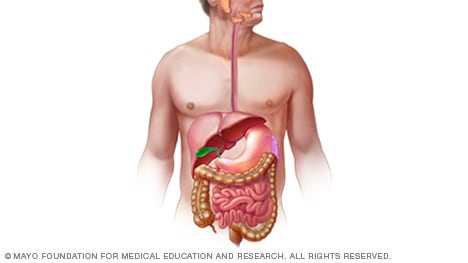
Illustration of digestive system

Your digestive system gears up
A fresh-baked apple pie has just come out of the oven. Just the sight and smell of it are enough to make you start salivating. So even before you take a bite, your digestive system has swung into action.

After the first morsel enters your mouth, the many organs of your digestive tract kick into high gear. Here's a look at how your digestive system works, from top to bottom.

Illustration of mouth and salivary glands

Mouth and salivary glands
After you take your first bite of pie, your salivary glands produce saliva — a mixture of secretions that help lubricate and break down food. Besides the salivary glands in the lining of your mouth, you have three pairs of larger salivary glands — the parotid, sublingual and submandibular glands. You typically produce about 2 pints (about 1 liter) of saliva a day.

Not all of the work is chemical, though. As you savor the bite of pie, your teeth work to break down the pie while your tongue mixes it with saliva. This action transforms it into a soft, moist, rounded mass (bolus) suitable for swallowing.

Illustration of esophagus

Esophagus
As you swallow the bite of pie, muscles in your mouth and throat propel it to your upper esophagus, the tube that connects your throat to your stomach. Muscles in the wall of your esophagus create synchronized waves — one after another — that propel the pie into your stomach. In this process, called peristalsis, muscles behind the bolus of pie contract, squeezing it forward, while muscles ahead of it relax, allowing it to advance without resistance.

When the bolus reaches the lower end of your esophagus, pressure from the food signals a muscular valve — the lower esophageal sphincter — to relax and let the food enter your stomach.

Illustration of stomach

Stomach
After entering your stomach, the pie is broken down further. With its powerful muscles, the stomach begins churning and mixing the food into smaller and smaller pieces. Your digestive glands in your stomach lining produce stomach acid and enzymes, which mix with the food to form a murky semifluid or paste called chyme.

Once the chyme is well-mixed, waves of muscle contractions propel it through a valve called the pylorus and into the first section of your small intestine (duodenum). The pylorus might release about an eighth of an ounce (about 4 milliliters) of chyme at a time. The rest is held back for more mixing.

Illustration of pancreas, liver and gallbladder

Pancreas, liver and gallbladder
In your duodenum, digestion continues as chyme from the stomach mixes with a variety of digestive juices from your pancreas, liver and gallbladder:

Pancreas. The pancreas produces digestive enzymes that help break down proteins, carbohydrates and fats.

Liver. The liver produces bile, a solution that helps you digest fats.

Gallbladder. The gallbladder stores bile. As fatty food enters the upper portion of your small intestine (the duodenum), the gallbladder squeezes bile into the small intestine through the bile ducts.

Illustration of small intestine

Small intestine
As bile and pancreatic digestive juices mix with other juices secreted by the wall of your small intestine, digestion continues. What was once apple pie is propelled into the second portion of your small intestine, the jejunum. Here it's further broken down into smaller molecules of nutrients that can be absorbed. Then it moves into the final and longest portion of your small intestine — the ileum — where virtually all of the remaining nutrients are absorbed through the lining of the ileum's wall.

What remains of the food when it reaches the end of the ileum is a combination of water, electrolytes — such as sodium and chloride — and waste products, such as plant fiber and dead cells shed from the lining of your digestive tract.

Illustration of large intestine

Large intestine
As this residue passes through the colon, nearly all of the water is absorbed, leaving a usually soft but formed substance called stool. Muscles in the wall of your colon separate the waste into small segments that are pushed into your lower colon and rectum. As the rectal walls are stretched, they signal the need for a bowel movement.

When the sphincter muscles in your anus relax, the rectal walls contract to increase pressure. These coordinated muscle contractions expel the stool.

The End of Slide Show.