Showing posts with label lungs. Show all posts

Thursday, February 16, 2017

"Bad Cholesterol": A Myth and a Fraud

We in the medical profession, totally oblivious of the vital roles of cholesterol in the body, have been duped into thinking that it is this substance that causes arterial disease of the heart and the brain. The pharmaceutical industry has capitalized on the slogan of "bad cholesterol" and has produced toxic-to-the-body chemicals that minimally lower the level of cholesterol in the body and in the process cause liver damage to thousands of people, some who die as a result of using the medication.

It is surprising that none of the frequently quoted and media-popularized doctors has reflected on the fact that cholesterol levels are measured from blood taken from the veins, yet nowhere in medical literature is there a single case of cholesterol having caused obstruction of the veins. Venous blood moves far slower than arterial blood and thus would be more inclined to have cholesterol deposits if the assumption of "bad cholesterol" were accurate. This mistake by us in the medical community, and its capitalization by the pharmaceutical industry, has caused an ongoing fraud against society.

In truth, the so-called "bad" cholesterol is actually far more beneficial than is appreciated. The reason for its rise in the body is because of complications caused by chronic unintentional dehydration and insufficient urine production. Dehydration produces concentrated, acidic blood that becomes even more dehydrated during its passage through the lungs before reaching the heart - because of evaporation of water in the lungs during breathing. The membranes of the blood vessels of the heart and main arteries going up to the brain become vulnerable to the shearing pressure produced by the thicker, acidic blood. This shearing force of toxic blood causes abrasions and minute tears in the lining of the arteries that can peel off and cause embolisms of the brain, kidneys and other organs. To prevent the damaged blood vessel walls from peeling, low-density (so-called "bad") cholesterol coats and covers up the abrasions and protects the underlying tissue like a waterproof bandage until the tissue heals.

Thus, the vital, life-saving role of low-density cholesterol proves this substance is of utmost importance in saving the lives of those who do not adequately hydrate their bodies so that their blood can flow easily through the blood vessels without causing damage.

Cholesterol is an element from which many of our hormones are made. Vitamin D is made by the body from cholesterol in our skin that is exposed to sunlight. Cholesterol is used in the insulating membranes that cover our nerve systems. There is no such a thing as bad cholesterol. If all the primary ingredients are available for its normal functions, the human body does not engage in making things that are bad for its survival. Until now we did not know water was a vital nutrient that the body needed at all times - and in sufficient quantity.

Water itself - not caffeinated beverages that further dehydrate - is a better cholesterol-lowering medication than any chemical on the market. It is absolutely safe and is not harmful to the body like the dangerous medications now used. Please share this information with those you care for.

For more information about my medical breakthrough on the topic of chronic unintentional dehydration and the diseases it causes, other than what is posted on this site, refer to my books and tapes - products of over 20 years of fulltime research.

F. Batmanghelidj, M.D.

Saturday, November 26, 2016

Human Body Energy Clock


“Why do I keep waking up at 3am?” I couldn’t figure it out. It was driving me crazy. I would go to bed exhausted, usually some time between 11:30pm and 1am, sleep a few hours, and then wake up with a mind full of stress, worries, anxiety, negativity, etc. When I looked over at the time, it would be around 3am. It was happening just about every night. It got to the point where any time I woke up, I was like “Oh, it must be 3am” and sure enough, when I looked at the time, it was 3:08 or 3:15 or some time right around 3am.
Of course, if you google “waking up at 3am”, you will come up with all kinds of different reasons including many that are supernatural or demonic (after all, it’s referred to as the witching hour). However, I decided to dig deeper. I had remembered reading somewhere that 3am is the time that the liver goes into its cleansing mode so I began digging around there. Soon I found myself learning all about the Chinese Body Clock.
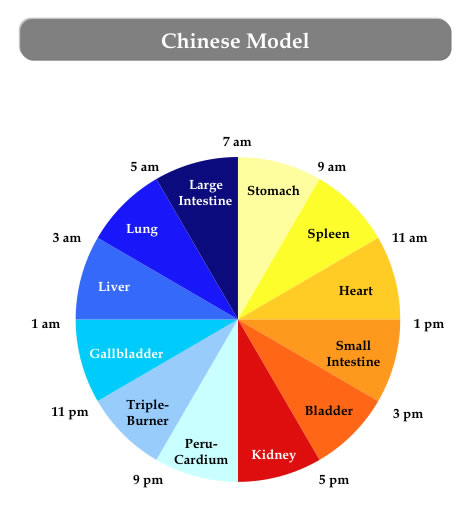
The Chinese Body Clock is based on Chinese medicine and the body organ Qi(energy) cycle. It’s the idea that there is a cyclic flow of energy through the body that moves in two hour intervals through the various organ systems. See diagram above. Click on the diagram for a larger version.
So for each two hour window, there is an organ system operating a peak energy. As per – http://pathways4health.org/2010/03/04/the-chinese-body-clock-energy-patterns-through-24-hours/
“When one organ is at its peak energy, the organ at the opposite side of the clock, 12 hours away, is at its lowest ebb. For example, between 1-3 a.m., the liver reaches its peak, doing its work to cleanse the blood, while the small intestine, the organ responsible for the absorption and assimilation of many key nutrients, is at its ebb. What does this tell us? Principally, that it must be taxing to the system to deal with late night meals and snacking. The body is not programmed to accommodate the modern habit of late-night screen-based stimulation and the eating habits that go with it. When we eat late at night, food is not well absorbed by the small intestine and the liver has little opportunity to do its job of housekeeping.
The idea, then, is to try when you can to plan daily activity around an organ system’s peak energy, while avoiding actions that can tax a system when its energy is at its lowest ebb. Think of lifestyle habits you might modify in order to better synchronize your system’s energy ebbs and flows:
Lungs: With the lungs at their peak energy in the early morning, you might want to schedule aerobic exercise at this time rather than later in the day. And, if you must speak through the long work day, presentations given earlier in the day benefit from greater lung energy. Laryngitis can set in late afternoon when lung energy is depleted .
Large Intestine: To get the day off to a good start, give yourself enough time early in the morning to honor the normal elimination function of the large intestine.
Stomach/Pancreas/Small Intestine: Try to eat heavier meals early in the day—at breakfast when the stomach is at its peak, and at lunch, to catch Qi’s expanding/warming energy as it crests at midday. Eating larger meals of the day early delivers nourishment to the small intestine when it is strongest, which aids absorption and assimilation.
Kidneys: The kidneys are aligned with the adrenals, the glands that produce cortisol to help us spring out of bed in the morning. Early morning, from 5 a.m.-7 a.m., is when kidney energy is weakest—a reason that people with depleted kidney energy often have trouble waking up to a new day.
Liver: The liver stores and cleanses the blood, a fact that becomes more interesting as we consider personal experience. Have you ever partied too much in the evening, and awakened in the wee hours of the morning feeling “off” and unable to fall back to sleep? Chances are good that you were tossing and turning between the hours of 1 a.m. and 3 a.m. when your alcohol over-loaded liver was struggling to do its work. The timing of the liver’s peak activity also speaks to consuming the last meal of the day as early as possible. The liver’s daily programming assumes an early dinner and bedtime. Before electricity and the light bulb, people ate supper and retired early, allowing time for the last meal of the day to digest so that the liver could be most effective in its peak hours of activity. The “work shift” of the liver, then, reinforces the concept of making the last meal of the day a light one that is consumed on the early side. The more time that passes after food is eaten before peak activity of the liver, the better the liver will be able to carry out its myriad of functions.”
I found that very interesting because I had a very hard time getting out of bed in the morning, and I also tended to eat dinner very late, usually making it my biggest meal of the day. Maybe that was why I kept waking up at 3am? In fact, nothing in my daily routine corresponded with the organ energy cycle. I also thought it was very interesting because I’m always trying to maximize how much I can get done in a day and in order to do that, it requires sustaining a good level of energy throughout the day. There were some days when I just had no energy, and I felt like I just couldn’t get going.
Before rearranging my schedule and my life, I decided to become more conscious of my body in relation to this energy clock theory. So as I went about my day, I kept in mind the various organ cycles.
I noticed that if I ever got gas (the intestinal kind), it was usually in the early morning, before I really woke up. I made it a point to look at the time – 5:30am. Hmmm. Large intestine cycle. My stomach would start growling around 8am. I always figured it was because I hadn’t eaten since the night before and it wanted breakfast which I always put off for another hour or two. Maybe it was because my body was in the stomach cycle? I always liked to sit down and get work done in the morning around 10am or so because I felt clear-headed and efficient. That corresponded to the chart. And I’ll be damned if I wasn’t always peeing in the late afternoon. Bladder cycle. I thought “Maybe I should give this body clock thing a try and see what happens”.
It’s been over a week now and I feel great! I’ve made some adjustments to my schedule to correspond to the organ cycles and I’m kind of amazed by it. I go to sleep around or by 11pm with a 50 oz. bottle of water on the night table next to my bed. I set my alarm for 6am. I don’t wake up at 3am anymore but sleep straight through to 6am when my alarm goes off. I still hit snooze once or twice, but by 6:20 I’m usually sitting up and have started drinking the water. I drink about 24 to 32 ounces before even getting out of bed. I can literally feel it traveling through my system and hydrating my body. I have breakfast around 7:30 or 8am and make lunch at the same time. I get as much food related activities out of the way while I’m in the stomach cycle. Prepare snacks, clean the kitchen, plan dinner, etc. At 9am I’m at my computer working and being productive, getting stuff done. Once the heart cycle rolls around at 11am, I send and respond to emails, reach out to family and friends, head to my office, and have lunch. At 1pm, it’s back to work tackling problems, responding to emails and issues, and analyzing data. Between 3pm and 5pm, I love having a cup of tea and making more work progress, perhaps delving into some research and analysis. I now try to have dinner before 7pm and start winding down my daily activities by 9pm or 10pm the latest. With some quiet time to just relax and read before sleeping.
To help with staying on these cycles, I’ve been setting the alarm on my phone to go off at the start of each cycle from 7am until 9pm. Mostly just as a conscious reminder. Some days I’m truly amazed at how great I feel, how much energy I have, and how much I can accomplish. Other days, when it seems everyone in my world needs me to drop everything and solve their problems, it can be more of a challenge. Sometimes there’s no time for lunch before 1pm or no time for dinner until after 7pm, but I can adjust to live more in harmony with the cycles. The most amazing thing for me has just been the fact that I’ve been up, out of bed, awake and with good energy before 7am! And of course, not waking up at 3am anymore is an added bonus.

Here’s a link for more information – http://www.spiritualcoach.com/chinese-body-clock/
“Why do I keep waking up at 3am?” I couldn’t figure it out. It was driving me crazy. I would go to bed exhausted, usually some time between 11:30pm and 1am, sleep a few hours, and then wake up with a mind full of stress, worries, anxiety, negativity, etc. When I looked over at the time, it would be around 3am. It was happening just about every night. It got to the point where any time I woke up, I was like “Oh, it must be 3am” and sure enough, when I looked at the time, it was 3:08 or 3:15 or some time right around 3am.

Of course, if you google “waking up at 3am”, you will come up with all kinds of different reasons including many that are supernatural or demonic (after all, it’s referred to as the witching hour). However, I decided to dig deeper. I had remembered reading somewhere that 3am is the time that the liver goes into its cleansing mode so I began digging around there. Soon I found myself learning all about the Chinese Body Clock.

The Chinese Body Clock is based on Chinese medicine and the body organ Qi(energy) cycle. It’s the idea that there is a cyclic flow of energy through the body that moves in two hour intervals through the various organ systems. See diagram above. Click on the diagram for a larger version.

So for each two hour window, there is an organ system operating a peak energy. As per – http://pathways4health.org/2010/03/04/the-chinese-body-clock-energy-patterns-through-24-hours/

“When one organ is at its peak energy, the organ at the opposite side of the clock, 12 hours away, is at its lowest ebb. For example, between 1-3 a.m., the liver reaches its peak, doing its work to cleanse the blood, while the small intestine, the organ responsible for the absorption and assimilation of many key nutrients, is at its ebb. What does this tell us? Principally, that it must be taxing to the system to deal with late night meals and snacking. The body is not programmed to accommodate the modern habit of late-night screen-based stimulation and the eating habits that go with it. When we eat late at night, food is not well absorbed by the small intestine and the liver has little opportunity to do its job of housekeeping.

The idea, then, is to try when you can to plan daily activity around an organ system’s peak energy, while avoiding actions that can tax a system when its energy is at its lowest ebb. Think of lifestyle habits you might modify in order to better synchronize your system’s energy ebbs and flows:

Lungs: With the lungs at their peak energy in the early morning, you might want to schedule aerobic exercise at this time rather than later in the day. And, if you must speak through the long work day, presentations given earlier in the day benefit from greater lung energy. Laryngitis can set in late afternoon when lung energy is depleted .

Large Intestine: To get the day off to a good start, give yourself enough time early in the morning to honor the normal elimination function of the large intestine.

Stomach/Pancreas/Small Intestine: Try to eat heavier meals early in the day—at breakfast when the stomach is at its peak, and at lunch, to catch Qi’s expanding/warming energy as it crests at midday. Eating larger meals of the day early delivers nourishment to the small intestine when it is strongest, which aids absorption and assimilation.

Kidneys: The kidneys are aligned with the adrenals, the glands that produce cortisol to help us spring out of bed in the morning. Early morning, from 5 a.m.-7 a.m., is when kidney energy is weakest—a reason that people with depleted kidney energy often have trouble waking up to a new day.

Liver: The liver stores and cleanses the blood, a fact that becomes more interesting as we consider personal experience. Have you ever partied too much in the evening, and awakened in the wee hours of the morning feeling “off” and unable to fall back to sleep? Chances are good that you were tossing and turning between the hours of 1 a.m. and 3 a.m. when your alcohol over-loaded liver was struggling to do its work. The timing of the liver’s peak activity also speaks to consuming the last meal of the day as early as possible. The liver’s daily programming assumes an early dinner and bedtime. Before electricity and the light bulb, people ate supper and retired early, allowing time for the last meal of the day to digest so that the liver could be most effective in its peak hours of activity. The “work shift” of the liver, then, reinforces the concept of making the last meal of the day a light one that is consumed on the early side. The more time that passes after food is eaten before peak activity of the liver, the better the liver will be able to carry out its myriad of functions.”

I found that very interesting because I had a very hard time getting out of bed in the morning, and I also tended to eat dinner very late, usually making it my biggest meal of the day. Maybe that was why I kept waking up at 3am? In fact, nothing in my daily routine corresponded with the organ energy cycle. I also thought it was very interesting because I’m always trying to maximize how much I can get done in a day and in order to do that, it requires sustaining a good level of energy throughout the day. There were some days when I just had no energy, and I felt like I just couldn’t get going.

Before rearranging my schedule and my life, I decided to become more conscious of my body in relation to this energy clock theory. So as I went about my day, I kept in mind the various organ cycles.

I noticed that if I ever got gas (the intestinal kind), it was usually in the early morning, before I really woke up. I made it a point to look at the time – 5:30am. Hmmm. Large intestine cycle. My stomach would start growling around 8am. I always figured it was because I hadn’t eaten since the night before and it wanted breakfast which I always put off for another hour or two. Maybe it was because my body was in the stomach cycle? I always liked to sit down and get work done in the morning around 10am or so because I felt clear-headed and efficient. That corresponded to the chart. And I’ll be damned if I wasn’t always peeing in the late afternoon. Bladder cycle. I thought “Maybe I should give this body clock thing a try and see what happens”.

It’s been over a week now and I feel great! I’ve made some adjustments to my schedule to correspond to the organ cycles and I’m kind of amazed by it. I go to sleep around or by 11pm with a 50 oz. bottle of water on the night table next to my bed. I set my alarm for 6am. I don’t wake up at 3am anymore but sleep straight through to 6am when my alarm goes off. I still hit snooze once or twice, but by 6:20 I’m usually sitting up and have started drinking the water. I drink about 24 to 32 ounces before even getting out of bed. I can literally feel it traveling through my system and hydrating my body. I have breakfast around 7:30 or 8am and make lunch at the same time. I get as much food related activities out of the way while I’m in the stomach cycle. Prepare snacks, clean the kitchen, plan dinner, etc. At 9am I’m at my computer working and being productive, getting stuff done. Once the heart cycle rolls around at 11am, I send and respond to emails, reach out to family and friends, head to my office, and have lunch. At 1pm, it’s back to work tackling problems, responding to emails and issues, and analyzing data. Between 3pm and 5pm, I love having a cup of tea and making more work progress, perhaps delving into some research and analysis. I now try to have dinner before 7pm and start winding down my daily activities by 9pm or 10pm the latest. With some quiet time to just relax and read before sleeping.

To help with staying on these cycles, I’ve been setting the alarm on my phone to go off at the start of each cycle from 7am until 9pm. Mostly just as a conscious reminder. Some days I’m truly amazed at how great I feel, how much energy I have, and how much I can accomplish. Other days, when it seems everyone in my world needs me to drop everything and solve their problems, it can be more of a challenge. Sometimes there’s no time for lunch before 1pm or no time for dinner until after 7pm, but I can adjust to live more in harmony with the cycles. The most amazing thing for me has just been the fact that I’ve been up, out of bed, awake and with good energy before 7am! And of course, not waking up at 3am anymore is an added bonus.

Here’s a link for more information – http://www.spiritualcoach.com/chinese-body-clock/


The Chinese “Body Clock”


The Body-Energy Clock is built upon the concept of the cyclical ebb and flow of energy throughout the body. During a 24-hour period (see diagram that follows) Qi moves in two-hour intervals through the organ systems. During sleep, Qi draws inward to restore the body. This phase is completed between 1 and 3 a.m., when the liver cleanses the blood and performs a myriad of functions that set the stage for Qi moving outward again.

In the 12-hour period following the peak functioning of the liver—from 3 a.m. onward—energy cycles to the organs associated with daily activity, digestion and elimination: the lungs, large intestine, stomach/pancreas, heart, small intestine. By mid-afternoon, energy again moves inward to support internal organs associated with restoring and maintaining the system. The purpose is to move fluids and heat, as well as to filter and cleanse—by the pericardium, triple burner (coordinates water functions and temperature), bladder/kidneys and the liver.

Lessons Based on the Body Clock

When one organ is at its peak energy, the organ at the opposite side of the clock, 12 hours away, is at its lowest ebb. For example, between 1-3 a.m., the liver reaches its peak, doing its work to cleanse the blood, while the small intestine, the organ responsible for the absorption and assimilation of many key nutrients, is at its ebb. What does this tell us? Principally, that it must be taxing to the system to deal with late night meals and snacking. The body is not programmed to accommodate the modern habit of late-night screen-based stimulation and the eating habits that go with it. When we eat late at night, food is not well absorbed by the small intestine and the liver has little opportunity to do its job of housekeeping.

The idea, then, is to try when you can to plan daily activity around an organ system’s peak energy, while avoiding actions that can tax a system when its energy is at its lowest ebb. Think of lifestyle habits you might modify in order to better synchronize your system’s energy ebbs and flows:

Lungs: With the lungs at their peak energy in the early morning, you might want to schedule aerobic exercise at this time rather than later in the day. And, if you must speak through the long work day, presentations given earlier in the day benefit from greater lung energy. Laryngitis can set in late afternoon when lung energy is depleted .

Large Intestine: To get the day off to a good start, give yourself enough time early in the morning to honor the normal elimination function of the large intestine.

Stomach/Pancreas/Small Intestine: Try to eat heavier meals early in the day—at breakfast when the stomach is at its peak, and at lunch, to catch Qi’s expanding/warming energy as it crests at midday. Eating larger meals of the day early delivers nourishment to the small intestine when it is strongest, which aids absorption and assimilation.

Kidneys: The kidneys are aligned with the adrenals, the glands that produce cortisol to help us spring out of bed in the morning. Early morning, from 5 a.m.-7 a.m., is when kidney energy is weakest—a reason that people with depleted kidney energy often have trouble waking up to a new day.


Liver: The liver stores and cleanses the blood, a fact that becomes more interesting as we consider personal experience. Have you ever partied too much in the evening, and awakened in the wee hours of the morning feeling “off” and unable to fall back to sleep? Chances are good that you were tossing and turning between the hours of 1 a.m. and 3 a.m. when your alcohol over-loaded liver was struggling to do its work. The timing of the liver’s peak activity also speaks to consuming the last meal of the day as early as possible. The liver’s daily programming assumes an early dinner and bedtime. Before electricity and the light bulb, people ate supper and retired early, allowing time for the last meal of the day to digest so that the liver could be most effective in its peak hours of activity. The “work shift” of the liver, then, reinforces the concept of making the last meal of the day a light one that is consumed on the early side. The more time that passes after food is eaten before peak activity of the liver, the better the liver will be able to carry out its myriad of functions.

Friday, November 18, 2016

The Aging Process - 4

Metabolic Effects of Aging
  
As you get older, it's normal to gain weight, right? It may be normal -- if you define "normal" as "common" -- but it's not desirable, and it's not inevitable either. Chances are, you weigh more now than you did ten years ago. Or maybe your waistline has expanded, but the scale's remained steady.

Understanding what happens with weight as your body ages will help you to control it. Beginning around age 25, total body fat starts to increase, while muscle mass and body water decrease. As a result, you may weigh more as you age or lose some of your youthful muscle tone.

Why has your shape gone south? A lower basal metabolic rate (BMR) is to blame. BMR is the number of calories you burn daily to fuel involuntary body functions, such as your heartbeat, brain function, and digestion. BMR is dependent upon body composition. The more muscle you have, the more calories you burn, 24 hours a day. That's because muscle is a high-maintenance tissue and requires more calories than fat to sustain itself.

The decline in muscle mass that begins in your twenties, coupled with a decrease in activity level, means that you need fewer calories in your sixties than you did in your teens. For example, a 180-pound male's BMR accounts for about 1,930 calories a day between the ages of 18 and 30.

After age 60, his body needs about 350 fewer calories to maintain his weight and good health. If you're still eating like a teenager by the time you're 60, and you haven't increased your physical activity, you'll definitely be putting on pounds.

For women, menopause often means weight gain. When the ovaries stop producing the hormone estrogen, muscle mass may diminish to the point of lowering BMR. When that happens, women gain a significant amount of fat, usually in the abdomen, even without consuming more calories.

Speaking of the abdomen, where you store extra fat also affects your health.

If you're shaped like an apple -- packing fat in your mid-section -- you're at greater risk for heart disease than if you're shaped like a pear -- gaining weight around your hips and buttocks. Excess weight in any location also boosts your chances for developing certain cancers and diabetes, and it also aggravates arthritis in your hips and knees.

Respiratory Changes
As you age, your lungs become less elastic, and your chest wall stiffens. In addition, the expansion of your trachea contributes to a decreased surface area in your lungs. You can't cough as forcefully, which also diminishes your ability to clear germs from your lungs. That's why older people are more prone to upper respiratory infections, such as colds.

If you ever smoked, your respiratory potential is reduced in your later years. Older adults also experience some difficulties with swallowing, which increases the chances of aspirating particles of food or other substances into the lungs. Aspiration is a common cause of pneumonia in older adults.

Lung capacity and function drop off with time, which means you may be more winded after climbing a flight of stairs or taking a walk than you were 20 years ago, but exercise heads off some of the changes to the lungs and entire respiratory system. Physically active older people who regularly participate in aerobic exercises, including walking and cycling, are way ahead of the curve.

Their aerobic capacity is far greater than their peers who don't exercise, and better than younger, sedentary people. In fact, well-conditioned older people may reach levels of lung function that exceed those of much younger people. A generous intake of vitamin C also helps maintain pulmonary function as you age. Loss of pulmonary function is a major predictor of disease and death in older adults.

Exercise Your Acumen
If new situations make you squirm, maybe you should exercise more often. What's the connection? As you age, it takes more time for your brain to process new information, so you may avoid unfamiliar surroundings for the sake of comfort. But that limits your world.

Regular exercise can help you expand your horizons. Studies show that the most physically fit older people best tolerate unfamiliar surroundings. Physical fitness helps you react more quickly to new situations, new faces, or a new social setting, perhaps adapting as quickly as someone much younger.


Continue to the next and final post of this article to learn about the sensory effects of aging and find out if you're at risk.

Tuesday, August 23, 2016

Drawing Life from Death

(except from  The Spark Of Life , Electricity in The Human Body, by Frances Ashcroft) [Time 8:23AM, 24/08/2016, counter @ 2088 3098]

Aya Soliman had a most unusual start in life, being born by Caesarean section two days after her mother Jayne was declared brain death.
Jayne, a champion ice skater, had a fatal brain haemorrhage when she was twenty-five weeks pregnant. She was flown by air ambulance to hospital in Oxford, but died shortly after arrival .
Although Jayne's brain was dead, doctors decided to keep her body alive to provide vital time for her daughter's lungs to mature.

Within the womb, the fetus floats in a cushioning sac of water. Its developing lungs are filled with fluid and it does not breath air, but obtains all the oxygen it needs via the umbilical cord that links it to the placenta. At birth, the water withing the lungs must be rapidly removed as the newborn child switches over to breathing air.This is achieved with the help of specialized epithelial sodium channels (ENaC channels) that are present in the cells that line the lung.
At birth the ENaC channels open, allowing sodium ions in the lung fluid to flow down their concentration gradient into the lung cells. because sodium ions  drag water with them, the lungs quickly dry out and so long as ENaC channels are present and functional, the lungs are rapidly cleared of fluid. Without ENaC, however, babies are at risk of drowning in their own fluid at birth, and may suffer from 'wet' lung.

During normal development ,  a rise in  steroid hormones switches on ENaC production a few weeks prior to birth, ensuring the lungs are fully mature when the baby  is delivered.
At twenty-five weeks of pregnancy, however, lung development is incomplete and the number of ENaC channels in the cells lining the lung is still very small. A chemical called surfactant that reduces the surface tension of the tiny air sacs in the lungs and so prevents their collapse is also low. Thus if a baby must be delivered early, and conditions permit, steroids are administered to the mother before birth. These cross over the placenta and help her premature baby's lungs mature. As a mother's womb is the optimal incubator for a baby, Jayne's body was kept alive (but brain death) on a life-support machine while steroids were given to provide her daughter with the best possible chance of life.

There is a further twist to this story. It turns out that at birth ENaC channels are stimulated to open more completely by stress hormone adrenaline, which rises dramatically in the mother's blood during the trauma of labour. This may explain why babies born by Cesarean section, where this stimulus is lacking, may have more difficulty clearing their lungs than those born naturally, and why they experience a higher incidence of respiratory complications in the postnatal period.


Monday, December 17, 2012

Obesity, Cancer, Depression : DNA DAMAGE

  To simplify complications is the FIRST essential of success. (Click here) 

It has become an established trend to silence the pains of the body (your body) with some sort of chemical without knowing the wider physiological implications of the pain mechanism and its significant association with the level of acidity in the body. Pain means that an area is acidic. This can cause severe damage to the DNA structure of the cells within area.

Medical specialists limit their responsibility to one aspect or another of the body's mechanical parts, and do not simultaneously deal with different diseases. They have mostly forgotten their knowledge of physiological and have acquired the skills of producing temporary relief by the use of chemical products. However, when pain medications are used, the cause of pain is not taken away; the acidic state of the body continues to cause other symptoms and damage that may be outside a specialist's field of interest. Thus patients go from one specialist to another and end up using several different chemicals-drugs with their body's increasing variety of cries for water. Cancer formation is one such cry for water. It is the survival strategy installed in the primitive form of single-cell life in a chemically hostile environment.

It's true that many people develop cancer without having had pain. How can this be?   To simplify complications is the FIRST essential of success. (Click here)

Pain is one of the many indicators of dehydration in the human body. Not all parts of the body that become dehydrated possess pain-sensing nerves - think of the breast, the pancreas, the prostate gland, the lungs - hence their silent cancers. Water distribution is  a highly sophisticated process operated on the basis of a very strict rationing program. The level of dehydration might be subclinical -- without symptoms -- but sufficiently present over a period of many years to cause damage to the DNA repair system, decrease the rate of receptor production on the cell membranes, and eventually negatively affect the immune system's efficiency of functions.

The onset of dehydration might well be established with the first prescription of diuretics to lower the blood pressure, without the doctor realizing that hypertension itself is one of the indicators of dehydration - one of the body's drought-management programs.

Water has to be forced into vital cells against the osmotic draw of blood pulling water out of them; extra pressure is needed to inject some water through "water-specific holes" in the membranes of these vital but dehydrated cells.

In short, the rise in injection pressure of the emergency water distribution system in a dehydrated body is labeled hypertension. It is treated with chemicals that further dehydrate -- diuretics -- when water itself is the best natural diuretic there is. Can you imagine that? Yes! In this most advance country in the world today, more than 60 million dehydrated people have been labeled as hypertensives and receive this kind of treatment every day. No wonder heart disease and cancer are the number 1 and 2 killers -- over 700,000 thousand die of heart disease and more than 500,000 die of cancer each year. Not surprisingly, over 250,000 die of prescription medications. Save your body today, drink the amount of water regularly, follow a time table to get the habit until the body do not sent pain signal anymore to your conscious mind. 

 To simplify complications is the FIRST essential of success. (Click here) 

Monday, June 16, 2008

How Dehydration cause Obesity

 To simplify complications is the FIRST essential of success. (Click here)

In general, body mass index (BMI)above 27 is considered obese.

Losing weight through proper hydration of the human body, some natural salt intake, and exercise like casual walking is more prudent than drastic dieting. Complications of drastic dieting and of focusing only on the readings of the weight scale can cause an unbalance intake of essential ingredients and precipitate deficiency diseases.

The good thing about water, yes, plain water as the primary source of clean energy is the fact that any excess is passed out in the form of urine. Fat, on the other hand, has to be burned through many steps until it is converted to carbon dioxide and passed out in the lungs.

It is prudent to slim down before trying to run; not trying to run to slim down.
Finola Hughes, star of the television series All My Children , who lost thirty (30) pound without dieting. A radio talk-show host lost forty(40) pounds without effort and has gone down from a size 20 to a size 14. She not only lost her flab, she also got rid of her hot flashes, fatigue, aching joints, and sinus headaches, all in one sweep. Children in affluent societies showing an astounding tendency to gain weight and very fast too. These fat citizens turn obese has become an issue in the media and within the government.

The reason is twofold. One, they are being pushed into overeating by the food industry's constant advertising that promotes different fast foods. Two, these children are pushed to drink sweetened drinks instead of plain water. Any form of sweetness sensed by the tongue will stimulate the pancreas to secrete insulin. Insulin is a weight-gain-promoting (anabolic) hormone; it promotes fat cells to convert sugar and carbohydrates in the diet into fat.

The importance of natural salt to weight loss. When the human body becomes dehydrated and needs to increase its water reserves, it can do so only if salt (sodium chloride) is available to expand the extracellular water content of the body. In dehydration, the human body seeks natural salt in the foods that are eaten. This search for salt is another reason for overeating. The salt found in the fast food chains are not natural salt, hence, the human body cannot use it, compare to natural unrefined salt, as sea salt.

To simplify complications is the FIRST essential of success. (Click here)

If ever you wonder about the validity of plain water as the natural "preventive" medication in staying slim and fit and rugged and in avoiding the many diseases today, remember: DEHYDRATION MEANS SHORTAGE OF WATER IN THE BODY. It means that a rationing system goes into effect for the available water in the human body to determine when, why, and where water should reach various parts or organs of the human body. Naturally, the area that become comparatively dry cannot function normally. These regional or local abnormally functioning areas often produce pain and, eventually, the degenerative disease condition. Water cure: drugs kills, in short. Obesity :The Deadly Disease of Dehydration.


It is never too late or too early to revise and be wise again for the rest of our journey.......

Use Water-cure.
Rather be thankful for the timely warning, and do something about it.

Drink at least 10% of your own daily water-quota (31.42 ml multiply by your present body weight(kg), every 90 minutes. Use 1/4 teaspoon of sea-salt in your daily diet, for every 1250 ml water drank.

Pain is a sign/signal produced by dehydration in the human body. Pain may be common but it is not normal.

To simplify complications is the FIRST essential of success.
 To simplify complications is the FIRST essential of success. (Click here)

Monday, April 7, 2008

Stop Cough?

.....cough, coughing, or coughed? The noise of cough is noisesome and attracts many staring from others around you. Why does human body "cough"?

Technically, a cough is a reflex, a sudden noisy expulsion of air from the lungs. It is the human body's natural instinct to free the lungs of foreign matter. Coughing is your body's attempt to cleanse itself by forcing toxic matter out of an overload system.

Try these simple and effective natural method.
Roasting an onion and drinking the squeezed juice or combining cooked onions and honey into a thick syrup. Try either remedy as needed to overcome the most stubborn coughs.

Have you watch the film "Where the Lilies Bloom"? One day orphaned children discovered a neighbour dying from pneumonia. To save him, they resort to a traditional mountain remedy : a bath of onions. Once he is immersed in the onions, his body weeps out the toxins of pneumonia, and he recovers.

There are points on human tongue and cheek that will relieve coughs. Gently press the middle of your tongue with a tablespoon or tongue depressor for three to four minutes. Repeat as needed in half-hour intervals.

Ground ginger with sugar cure cough! "Don't worry that it burns the throat. It stop the cough." Combine a pinch of ground ginger with 1/4 teaspoon of sugar. Put on the tongue just before bedtime and let it dissolve.

To soothe coughs and obstructions of the lungs and windpipe, drink lime blossom (linden) tea. Drinking linden tea will induce perspiration and discard internal toxins. Use as needed.

The chest mustard plaster is effective against stubborn cough. It heals by bringing blood to the surface of the skin. This breaks up internal chest congestion.

The Chinese have a fun food remedy for coughs which combines healing honey with either apple or pear. Make a hole in the side of a pear or an apple. Pour honey into the hole, then steam the pear or apple until cooked through. Mash and eat.

No cough is a joy and peace to everyone around you. Share the remedies, stop cough.


It is never too late or too early to revise and be wise again for the rest of our journey.......

Use Water-cure.
Rather be thankful for the timely warning, and do something about it.


Drink at least 10% of your own daily water-quota (31.42 ml multiply by your present body weight(kg), every 90 minutes. Use 1/4 teaspoon of sea-salt in your daily diet, for every 1250 ml water drank.

Pain is a sign/signal produced by dehydration in the human body. Pain may be common but it is not normal.

To simplify complications is the FIRST essential of success.