BY MEIR SCHNEIDER, Ph.D.
practicing these powerful eye exercises regularly will rapidly improve your vision to the point where you can often avoid the need for surgery or glasses.
practicing these powerful eye exercises regularly will rapidly improve your vision to the point where you can often avoid the need for surgery or glasses.
If you take care of your eye health, not only will you see better, you will also feel better, and you will positively affect your whole body’s health. In addition to the eye exercises aimed at combating specific disorders and conditions, I have developed ten important vision exercises that are perfect for incorporating into your daily life. These exercises are based on my nine principles of healthy vision:
1. Deep Relaxation
2. Adjusting to Light Frequencies
3. Looking at Details
4. Looking into the Distance
5. Expanding Your Periphery
6. Balanced Use of the Two Eyes
7. Balanced Use within Each Eye
8. Body and Eye Coordination
9. Having Adequate Blood Flow to Nourish the Eyes
10. Vision and Body
These are the essential principles of vision health, and can be attained by consistently practicing the fundamental eye exercises in this article.
Exercise 1: The Long Swing
I will never forget when I met Alan. He was a young French-Canadian banker who, while driving home after a long and tiring meeting at his bank, fell asleep at the wheel and found himself in intensive care three days later. By the time he woke up, they had replaced his forehead with platinum. He had lost all his vision. The optic nerve in his left eye was destroyed, in addition to most of the optic nerve in his right eye. But that little bit of nerve tissue remained, so Alan discovered that he still had some visual sensation.
The physicians thought that only four percent of his potentially functional nerve was not enough to regain any vision or eye health. Alan heard about my book The Handbook of Self-Healing. In it, I suggested that people who are legally blind start working with blinking lights in a dark room. Alan experimented with the techniques and eye exercises to improve vision in the book, and sure enough, the little bit of remaining optic nerve woke up. He called me in San Francisco and soon came out for a series of therapy sessions to improve his eyesight naturally. Alan’s girlfriend held his hand to walk him into the office because he couldn’t see most objects. His brain did not yet know how to use that little bit of remaining healthy nerve tissue in his right eye.
During our first session, we practiced an eye exercise called the long swing. As he did this exercise, he said, “I’m noticing twelve objects that I’ve never noticed before in the room.” Within minutes, his sense of orientation built up even more. When the series of sessions finished, he no longer needed to be led around. The long swing is what is called an integrative eye exercise to improve vision. It allowed Alan to perceive a sense of space.
The long swing vision exercise develops a sense of fluidity and flexibility that will allow you to look at details with more ease, to adapt to light more easily, and to adapt to new, livelier visual habits, as well as experience better overall eye health.
How to Do the Long Swing
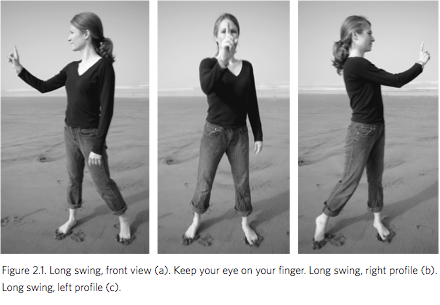
Stand with your legs slightly more than hip width apart, and your knees slightly bent. Hold your index finger about one foot in front of your face, pointing up to the ceiling. Look at your finger with a soft gaze. If you are legally blind, or even with correction have very poor vision, you can look at your index and middle fingers together to perform this eye exercise. While looking at your finger, swing your body from side to side. As you swing to the right, twist your body so that your left heel rises slightly off the ground. As you twist your body to the left, your right heel raises slightly off the ground. If your hand becomes tired, you can switch hands. Do this at least twenty times.
You will notice the sensation that everything in the background seems to be moving in the opposite direction of your finger, like scenery passing by you as you look out the window of a train. Allow yourself to feel the sense of relaxation that comes when you don’t need to place a hard focus on any one object. Move to the right, and the world moves to the left. Move the left, and the world moves to the right. Move slowly, and the world will move fast for you in this eye exercise to improve eyesight.
(Click Here for photos guide)
Figure 2.1. Long swing , front view (a)↑.
Keep your eye on your finger. Long swing,
right profile ↖(b).
Long swing left profile ↗(c).
Now hold your finger horizontally in front of your face. Move your finger up and down in front of you, moving your head vertically along with your finger. Remember to continue to hold a soft gaze as you do this eye exercise. When you move up, everything in the background seems to be moving down. When you move down, everything seems to be moving up.
Next, hold your finger in front of you and do the long swing, pointing your finger to the ceiling as in the first explanation, but this time, as you swing to one side, bend at the waist and sweep down in a half circle—just to knee level. Don’t lower your head below your knees, but continue the swing until your arm is fully extended and you are looking up at your finger. This part of the long swing eye exercise should relax your eyes further, one of the principles of how to improve eyesight and vision health.
The next step of this eye exercise to improve vision is very important. This is where we visualize the long swing. We close our eyes and do the movement with our bodies, and visualize in our mind’s eye that the world is swinging back and forth, passing in front of our eyes. Everything you visualize is moving directly opposite. When you move to the right, the neighborhood moves to the left. When you move to the left, the neighborhood moves to the right. Remember how you saw objects this way. Now visualize the whole world moving in the opposite direction of your swing. Now you open your eyes and continue the eye exercise.
When you look in this way, you stop yourself from freezing. It becomes easier to look at details and much easier to blink. Remind yourself to blink. Blinking is vital to eye health will help you to relax.
When I started to work on improving my eyesight and vision health, my eyes had a constant nystagmus, which is an involuntary rapid movement of the eyes caused by continuous strain from trying to see the world with a total lack of success.
So, I practiced the long swing for about forty minutes a day, and it immediately eased the involuntary flutter of my eyes. I had a feeling of more light entering my eyes. Details started to appear in the background, and when I started to look at details like windows and books on shelves, they gradually became clearer and clearer to me. Long swinging helped improve my vision naturally and prepared my brain for new vision exercises.
When you practice the rest of the eye exercises to improve vision in this article followed by long swinging, you will absorb the eye exercises better because long swinging alleviates tension and stiffness in the brain, in addition to preparing us to learn and benefit from new visual techniques.
I will never forget the time when I was walking in the streets of Tel Aviv with my eye instructor, Jacob, who was then only sixteen years old. Jacob told me to look at a building full of windows. In the corner of the windows I could see tiny, fuzzy black squares, which I later realized were air conditioners. At Jacob’s instruction, I looked from window to air conditioner, back and forth for a whole summer, not understanding why I was doing this. Slowly, by looking at windows and air conditioners, looking at patterns of squares, a new habit that improved my eyesight developed in me: a habit of looking and not freezing. Long swinging helped to prepare me for this eye exercise and alleviated the rigidity that prevented me from looking at details, which allowed the program to sink in.
The reason that long swinging is referred to as an integrative vision exercise is that it takes you away from the stress you’re used to with poor eye health. When people wear thick glasses that have a very specific focal point, they often strain their eyes so much that it becomes very difficult for them to look with vitality at the world. They look without seeing details, partially from fatigue and partially from the habits they have developed by straining to see. Long swinging breaks that tension. You cannot stare with this eye exercise to improve vision, so more light enters your eyes through the movement; therefore you won’t need to strain to bring the new programming to your brain.
The long swinging eye exercise will also help you develop your peripheral vision and create a better sense of orientation. You don’t have to swing for forty minutes at a time. In fact, even two minutes of twenty swings can help you loosen up. Think of it as warming up before a workout.
Exercise 2: Looking into the Distance
It is no coincidence that our school is located near the beach. In fact, it took us almost five years to convince San Francisco authorities and neighbourhood groups to allow us to operate in this residential area. The reason this location is ideal for us is that we look at the waves on a daily basis and use their sparkling beauty in our work on how to improve eyesight naturally. They shine in sunlight and have different coloration, even in the fog. You can almost always see waves here, even when the weather is gray, which is perfect for eye exercises.
Look at the waves. Look at the sky. Look at the clouds. Look at the hills and valleys. If you are not near the beach, look out your window at the many other buildings.
When you look near, as when staring at a computer screen, you unknowingly strain your eyes. The ciliary muscles contract, and this changes the shape of your lens from flat to round. When you look into the distance, however, the ciliary muscles relax and the suspensory ligaments keep the lens flat, and more flexible, which is necessary to improve eyesight and for good eye health.
Many people in our culture are used to eyestrain from looking at computers, televisions, and books so much of the time. They pay attention to the contents and not to their eye health, which causes them to strain and affects their vision health. Looking close makes you strain. Looking with boredom makes you strain. When you strain your eyes—even when you are aware of the strain—you push on with the computer project, or the television show, or the book.
Pay attention so that your face is relaxed and your jaw is not clenched. Release and rest your eyes. If it is possible, give yourself a few hours away from close work. Even if it is a deadline you are struggling to meet, do yourself a favor and take ten minutes to do one of the simplest eye exercises to improve your vision. Rest your eyes by looking into the distance. Look at the movements of the waves or the clouds. Look into the distance.
Never look closer than forty yards away, because you need to look far enough to rest the eyes from looking near. Know that when you look into the distance, you don’t have to stay focused on one point; in a soft way, you can scan or look from point to point at various details of what you see in the distance or the horizon. With this eye exercise, remember to blink and never strain to see the distance or the horizon. If it is fuzzy, let it be fuzzy. From time to time, rapidly wave your hands to the side of your face, without looking at your hands, just noticing them or their movement. Do not do this all the time. As you are practicing this eye exercise to improve vision, massage your face from the bridge of the nose to the temples over the eyebrows on the frontal bone. Massage below your eyes from the nose to the ears, over the cheekbone, while looking into the distance. Waving your hands to the side quickly to improve vision health will help you adjust to the light more easily by expanding the areas of the retina that absorb it, and create balance.
Look into the distance for at least twenty minutes a day to improve vision naturally and eye health. If you wear corrective lenses, be brave: take your contact lenses out, take your glasses off, and allow your eyes to enjoy a breath of fresh air. One student in San Francisco came to me and said that after two and a half weeks of not wearing her lenses, she had started to feel comfortable, because of “the air bouncing on her eyes.” Using this habit along with the eye exercise to improve vision will reduce your dependency on glasses or lenses, and it will gradually strengthen your visual system.
And while I prefer that you look into the distance eight to ten minutes three times a day, it may not be part of your reality. The minimum that anyone should do this eye exercise is in intervals of four to six minutes. So if you did it twenty minutes a day in four- to six-minute intervals, four times a day, it may end up preventing cataracts, and it will also relax your eyes.
Looking into the Distance Can Help Prevent Cataracts
If you can share this simple concept with other people of how to improve eyesight naturally, you will help to create a revolution in the world by helping to prevent the predictable cataract. Today, most physicians believe that, sooner or later, most people will develop cataracts. Looking into the distance can prevent the onset of cataracts because it gives the lens its full mobility and more life.
I admit that even if you practice this eye exercise every day, you will probably not look into the distance as much as life requires you to look near. Nevertheless, looking into the distance for eight to ten minutes, three times a day, will at least allow your eyes to rest, and will compensate for the strain of looking near.
Exercise 3: Exploring the Periphery
It is impossible to strain your eyes while looking centrally if you remember to simultaneously focus on your periphery, which is the next eye exercise to improve vision. In our culture, we suppress parts of the eye that help us to see well naturally. It is a subconscious suppression. The reason we suppress the periphery is because we make it irrelevant to our lives. As we focus on objects in front of us, we simply don’t pay attention to what’s around us—a habit that is detrimental to our eye health. On the other hand, our ancient fathers and mothers, our predecessors, had to pay attention to it; in the jungle, you wouldn’t last more than a week without noticing the periphery. In fact, you would be eaten or you would starve to death if you don’t notice what was around you.
But we ignore the periphery (a crucial piece of how to improve eyesight naturally) so we can focus on computers and paperwork all day without being distracted by our environment. We try to concentrate on the task at hand, not to be distracted by the commotion around us. When we don’t notice the periphery, the strain on our central vision becomes much greater, which in time makes us use it poorly and affects our vision health. This causes us to strain our central vision, decreasing its clarity and eventually losing it. The old adage that says “use it or lose it” holds true here with eye health. With time, we lose the connection between our brain, our optic nerve, and the rod cells of the periphery. Along with genetic tendencies, this can be a cause of glaucoma.
What we need to do right now is to exercise our periphery. Try the eye exercises below to get started. You will feel that there is integration of the periphery and the center, and as a result you’ll have a sense of more brightness and more light in your eyes.
Step 1: Look into the Distance
For this vision exercise, sit somewhere comfortable where you can see something in the distance that you enjoy looking at. As you look into the distance, start to wave your hands quickly to the side of your head to notify your eyes that a periphery exists. Don’t look at your hands waving, just look into the distance. Allow your eyes to recognize the movement of your hands. Wave your hands quickly in such a way that your fingers point toward you and your wrists are loose. Do this eye exercise to improve vision for a minute or two. As you do this, you should feel your eyes release their tension; this relaxation in your eyes is vitally important to vision health.
Step 2: Small Pieces of Paper
Cut out a small piece of opaque paper, about one and a half inches by two inches, and tape the paper horizontally on the bridge of your nose, so that it is centered between your eyes. This vision exercise works to improve eyesight naturally by disrupting part of your central vision.
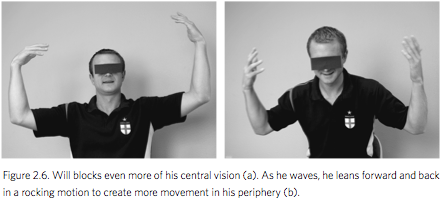
For this eye exercise that improves vision, walk around in a familiar environment with this paper on your nose for a minute or two. Now sit down and wave your hands quickly to the side of your head like you did before. Then, rock forward toward your thighs and back up again, bending at the hips, while you wave your hands to the side quickly. Stand up and sit down several times, moving your whole body up and down, as you wave your hands quickly to the side. As you do this, it reveals to your brain the existence of a moving periphery with which it normally does not connect unless you regularly practice vision exercises like this.
 (Click here for photos guide.)
Figure2.6. He blocks even more of his central
vision(a)↑. As he waves, he leans forward and back in a rocking motion to create more movement in his periphery (b)↗.
In the past, people used to walk at night, sometimes in total darkness and sometimes with light from the stars and the moon. Imagine how important it was for them to notice things moving in their periphery at night! For millions of years, our ancestors used to walk this way. Now we have the city lights at night, and our peripheral cells are hardly being used, because they are mainly designed for night vision, which can obviously affect vision and eye health.
Waving our hands to our sides in this eye exercise wakes up the peripheral cells because the rods of the retina respond to movement rather than to still images; conversely, the cones respond better to a still picture. These cones are mainly in the central part of the retina—the area called the macula—and are used to look at details. An overwhelming number of the retina’s cells are the rods, which respond mostly to the impression of movement. When we exercise these rods to improve eyesight, we take away a lot of stress from the overworked cones, and we make it easier for them to function more correctly and for overall eye and vision health to improve. Instead of the brain forcing the eye to freeze and strenuously see a picture, the brain will command the eye to look gently and easily in order to see the entire landscape better.
Next, put a longer piece of paper, one inch by five inches, on the bridge of your nose, and repeat this exercise. Then, use a paper that is one inch by seven inches. By blocking so much of your central vision through this vision exercise, and even some of your peripheral vision, you will discover a periphery that you hardly ever use consciously. Now go back to the medium-size paper and repeat the eye exercise to improve vision. Then use the small piece of paper and repeat the eye exercise a final time. You may find that a small paper now seems even smaller in your perception. That is because much of your brain that had been suppressed is now engaged in peripheral vision. To finish, take the small paper off, stand, and do the long swing so your brain will absorb the exercise you have just performed.
Exercise 4: Sunning and Skying
Surrendering to the sun briefly each day can make a huge difference in terms of our overall feeling of well-being and for our vision health.
Since the 1980s, physicians have warned us against the dangers of exposure to the sun. Now they understand the benefits of sunlight, and recommend that we have some exposure to it daily. The sun is one of the best nurturers that nature has given us. It is important, however, to adapt your eyes to the strong light of the sun. Sunning, an eye exercise to improve vision and eye health is a great eye exercise for this purpose because it is relaxing to the eyes and it can also help you with your sleep.
I once had a patient who complained about terrible insomnia. She had not slept for many nights and had a tremendous amount of tension. I taught her the sunning exercise, and massaged her in the sun. After her first session, she went home and slept right through the night; after taking only three sessions at the clinic of the school, she reported that she had slept much better. That was years ago. To this day, she practices the sunning technique to improve eyesight and has no more sleep deprivation.
Today, physicians suggest that we should not expose ourselves to the sun, except before 10 a.m. and after 5 p.m. In my opinion, we should sometimes expose ourselves to the sun even at midday. If you are sensitive to sunlight, you should start by practicing the sunning vision exercise early in the morning or near dusk, or for just five minutes at a time in the middle of the day.
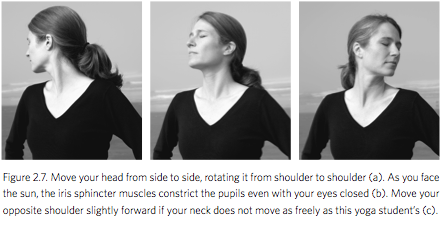
To begin sunning, all you need to do is close your eyes and face the sun. Now move your head from side to side, rotating it from shoulder to shoulder. As you face the sun, the iris sphincter muscles constrict the pupils. As you move your head away toward one shoulder, the radial dilator muscles dilate the pupils, even though your eyes are closed. Engaging both of these muscles on a regular basis helps improve eyesight and vision. For some people, it is easy to move their head 180 degrees from shoulder to shoulder. If you find this full range of motion difficult, simply bring your opposite shoulder forward slightly; it will help you move your head all the way toward the side, and compensate for the limited range of motion until you loosen up. The more you practice this eye exercise to improve vision, the more your range of motion and flexibility will increase.
The movements should not be fast, but they should not be slow either. Just relax, breathe deeply and slowly, and visualize that the sun, with its energy and light, is penetrating your face and nurturing your eyes as well as your mind. Your eyelids should be closed softly; don’t squeeze your eyelids shut. You want the eyelids to close as gently as if you were about to go to sleep for maximum vision enhancement. The less you squeeze your eyelids, the more relaxed your eyes will become. Remember, relaxation is one of the principles of how to improve eyesight naturally.
When I was in high school, I was doing this sunning eye exercise on a camping trip. Seeing me rotate my head back and forth, a girl asked, “Why do you keep saying no? Can’t you say yes?” So I moved my head up and down as if to nod “yes,” and I had a revelation. I noticed that this movement led to a greater variability in the angles at which light reached my eyes, thus awakening more parts of them. This additional exercise allowed for greater stimulation and increased sensation of lightness and darkness. I recommend this additional eye exercise to improve vision be included during sunning.
 (Click here for photos guide)
Figure 2.7. Move your head from side to side, rotating it from shoulder to shoulder ↖(a). As you face the sun, the iris sphincter muscles constrict the pupils even with your eyes closed ↑(b). Move your opposite shoulder slightly forward if your neck does not move as freely as this student's ↗(c).
Whenever you experience that difference between extremes of dark and light, your pupils become stronger. The pupils of most modern people are very weak because they wear sunglasses when they’re outside, which weakens the pupils. Automatic activities, like those of the eye’s iris muscles that affect the pupils, are influenced by function and use. The more you constrict and expand your pupils, the stronger the iris muscles become. Your retina also benefits from more concentrated light, and blood flows much better to the eye as a result of the pupils contracting and expanding. There are several additional benefits to your eye health. One is that it wakes up your macula and reinforces its function, which is the most important part of the retina for clear central vision. Two, this eye exercise for improving vision boosts your optimism when sunlight meets the red blood cells: it stimulates their activity, especially of the hemoglobin in them, which leads to secretion of serotonin from the brain, which creates a good mood more effectively than any drug. Three, it boosts your immune system. It also helps boost vitamin D, which helps your bones and muscle contraction and improves blood flow.
The sunning exercise is mandatory for people who want to improve their vision naturally. Like any exercise, it doesn’t create drastic change for everyone. But quite a few of my clients have experienced huge vision health improvement and have reduced the strength of their eyeglasses prescriptions when they have diligently practiced sunning. When you have a break at work or school, I recommend sunning instead of smoking cigarettes or drinking coffee.
Skying
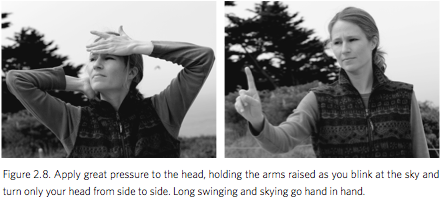
Skying is a simple eye exercise to improve vision. It is similar to sunning, but you do this when there is no sun. You just put one hand behind the back of your head and one hand on your forehead, applying pressure so that you massage your head as you turn it from side to side. Now move your head from side to side like you are sunning and blink rapidly at the sky.
 (Click here for photos guide)
Figure 2.8. ↖Apply great pressure to the head. holding thr arms raised as you blink at the sky and turn only your head from side to side. ↗Long swinging and skying go hand in hand.
After two minutes of skying, do one minute of the long swing. Stand with your legs slightly more than hip width apart, and your knees slightly bent. Hold your index finger about one foot in front of your face, pointing up to the ceiling. Look at your finger with a soft gaze. While looking at your finger, swing your body from side to side. As you swing to the right, twist your body so that your left heel rises slightly off the ground. As you twist your body to the left, your right heel raises slightly off the ground. Then do three minutes of skying and two minutes of swinging. Then do three more minutes of skying and two more minutes of swinging. This is an anti-squinting eye exercise to improve eyesight naturally and, as you sky and then swing, you are letting more light into your eyes and stopping the tendency to squint. You may find that the light bothers you less after doing the long swing.
This article on eye exercises for improving vision is excerpted fromthe book Vision for Life, Revised Edition: Ten Steps to Natural Eyesight Improvement by Meir Schneider.
About The Author
Meir Schneider, Ph.D. is the founder and head teacher of the School for Self-Healing in San Francisco, which offers programs that satisfy the continuing education requirements of the American Massage Therapy Association (AMTA) and the National Certification Board for Therapeutic Massage and Bodywork (NCBTMB). The School for Self-Healing has helped hundreds of thousands of people seeking solutions to chronic health conditions, including many people with vision problems. Born blind, Schneider taught himself to see and over 40 years developed a pioneering program of healing and recovery for the sighted and the blind, sharing his remarkable results not only at the School for Self-Healing, but also in popular books, CDs, and DVDs. Visit his website: self-healing.org
practicing these powerful eye exercises regularly will rapidly improve your vision to the point where you can often avoid the need for surgery or glasses.
practicing these powerful eye exercises regularly will rapidly improve your vision to the point where you can often avoid the need for surgery or glasses.
If you take care of your eye health, not only will you see better, you will also feel better, and you will positively affect your whole body’s health. In addition to the eye exercises aimed at combating specific disorders and conditions, I have developed ten important vision exercises that are perfect for incorporating into your daily life. These exercises are based on my nine principles of healthy vision:
1. Deep Relaxation
2. Adjusting to Light Frequencies
3. Looking at Details
4. Looking into the Distance
5. Expanding Your Periphery
6. Balanced Use of the Two Eyes
7. Balanced Use within Each Eye
8. Body and Eye Coordination
9. Having Adequate Blood Flow to Nourish the Eyes
10. Vision and Body
These are the essential principles of vision health, and can be attained by consistently practicing the fundamental eye exercises in this article.
Exercise 1: The Long Swing
I will never forget when I met Alan. He was a young French-Canadian banker who, while driving home after a long and tiring meeting at his bank, fell asleep at the wheel and found himself in intensive care three days later. By the time he woke up, they had replaced his forehead with platinum. He had lost all his vision. The optic nerve in his left eye was destroyed, in addition to most of the optic nerve in his right eye. But that little bit of nerve tissue remained, so Alan discovered that he still had some visual sensation.
The physicians thought that only four percent of his potentially functional nerve was not enough to regain any vision or eye health. Alan heard about my book The Handbook of Self-Healing. In it, I suggested that people who are legally blind start working with blinking lights in a dark room. Alan experimented with the techniques and eye exercises to improve vision in the book, and sure enough, the little bit of remaining optic nerve woke up. He called me in San Francisco and soon came out for a series of therapy sessions to improve his eyesight naturally. Alan’s girlfriend held his hand to walk him into the office because he couldn’t see most objects. His brain did not yet know how to use that little bit of remaining healthy nerve tissue in his right eye.
During our first session, we practiced an eye exercise called the long swing. As he did this exercise, he said, “I’m noticing twelve objects that I’ve never noticed before in the room.” Within minutes, his sense of orientation built up even more. When the series of sessions finished, he no longer needed to be led around. The long swing is what is called an integrative eye exercise to improve vision. It allowed Alan to perceive a sense of space.
The long swing vision exercise develops a sense of fluidity and flexibility that will allow you to look at details with more ease, to adapt to light more easily, and to adapt to new, livelier visual habits, as well as experience better overall eye health.
How to Do the Long Swing
Stand with your legs slightly more than hip width apart, and your knees slightly bent. Hold your index finger about one foot in front of your face, pointing up to the ceiling. Look at your finger with a soft gaze. If you are legally blind, or even with correction have very poor vision, you can look at your index and middle fingers together to perform this eye exercise. While looking at your finger, swing your body from side to side. As you swing to the right, twist your body so that your left heel rises slightly off the ground. As you twist your body to the left, your right heel raises slightly off the ground. If your hand becomes tired, you can switch hands. Do this at least twenty times.
You will notice the sensation that everything in the background seems to be moving in the opposite direction of your finger, like scenery passing by you as you look out the window of a train. Allow yourself to feel the sense of relaxation that comes when you don’t need to place a hard focus on any one object. Move to the right, and the world moves to the left. Move the left, and the world moves to the right. Move slowly, and the world will move fast for you in this eye exercise to improve eyesight.
(Click Here for photos guide)
Figure 2.1. Long swing , front view (a)↑.
Keep your eye on your finger. Long swing,
right profile ↖(b).
Long swing left profile ↗(c).
Now hold your finger horizontally in front of your face. Move your finger up and down in front of you, moving your head vertically along with your finger. Remember to continue to hold a soft gaze as you do this eye exercise. When you move up, everything in the background seems to be moving down. When you move down, everything seems to be moving up.
Next, hold your finger in front of you and do the long swing, pointing your finger to the ceiling as in the first explanation, but this time, as you swing to one side, bend at the waist and sweep down in a half circle—just to knee level. Don’t lower your head below your knees, but continue the swing until your arm is fully extended and you are looking up at your finger. This part of the long swing eye exercise should relax your eyes further, one of the principles of how to improve eyesight and vision health.
The next step of this eye exercise to improve vision is very important. This is where we visualize the long swing. We close our eyes and do the movement with our bodies, and visualize in our mind’s eye that the world is swinging back and forth, passing in front of our eyes. Everything you visualize is moving directly opposite. When you move to the right, the neighborhood moves to the left. When you move to the left, the neighborhood moves to the right. Remember how you saw objects this way. Now visualize the whole world moving in the opposite direction of your swing. Now you open your eyes and continue the eye exercise.
When you look in this way, you stop yourself from freezing. It becomes easier to look at details and much easier to blink. Remind yourself to blink. Blinking is vital to eye health will help you to relax.
When I started to work on improving my eyesight and vision health, my eyes had a constant nystagmus, which is an involuntary rapid movement of the eyes caused by continuous strain from trying to see the world with a total lack of success.
So, I practiced the long swing for about forty minutes a day, and it immediately eased the involuntary flutter of my eyes. I had a feeling of more light entering my eyes. Details started to appear in the background, and when I started to look at details like windows and books on shelves, they gradually became clearer and clearer to me. Long swinging helped improve my vision naturally and prepared my brain for new vision exercises.
When you practice the rest of the eye exercises to improve vision in this article followed by long swinging, you will absorb the eye exercises better because long swinging alleviates tension and stiffness in the brain, in addition to preparing us to learn and benefit from new visual techniques.
I will never forget the time when I was walking in the streets of Tel Aviv with my eye instructor, Jacob, who was then only sixteen years old. Jacob told me to look at a building full of windows. In the corner of the windows I could see tiny, fuzzy black squares, which I later realized were air conditioners. At Jacob’s instruction, I looked from window to air conditioner, back and forth for a whole summer, not understanding why I was doing this. Slowly, by looking at windows and air conditioners, looking at patterns of squares, a new habit that improved my eyesight developed in me: a habit of looking and not freezing. Long swinging helped to prepare me for this eye exercise and alleviated the rigidity that prevented me from looking at details, which allowed the program to sink in.
The reason that long swinging is referred to as an integrative vision exercise is that it takes you away from the stress you’re used to with poor eye health. When people wear thick glasses that have a very specific focal point, they often strain their eyes so much that it becomes very difficult for them to look with vitality at the world. They look without seeing details, partially from fatigue and partially from the habits they have developed by straining to see. Long swinging breaks that tension. You cannot stare with this eye exercise to improve vision, so more light enters your eyes through the movement; therefore you won’t need to strain to bring the new programming to your brain.
The long swinging eye exercise will also help you develop your peripheral vision and create a better sense of orientation. You don’t have to swing for forty minutes at a time. In fact, even two minutes of twenty swings can help you loosen up. Think of it as warming up before a workout.
Exercise 2: Looking into the Distance
It is no coincidence that our school is located near the beach. In fact, it took us almost five years to convince San Francisco authorities and neighbourhood groups to allow us to operate in this residential area. The reason this location is ideal for us is that we look at the waves on a daily basis and use their sparkling beauty in our work on how to improve eyesight naturally. They shine in sunlight and have different coloration, even in the fog. You can almost always see waves here, even when the weather is gray, which is perfect for eye exercises.
Look at the waves. Look at the sky. Look at the clouds. Look at the hills and valleys. If you are not near the beach, look out your window at the many other buildings.
When you look near, as when staring at a computer screen, you unknowingly strain your eyes. The ciliary muscles contract, and this changes the shape of your lens from flat to round. When you look into the distance, however, the ciliary muscles relax and the suspensory ligaments keep the lens flat, and more flexible, which is necessary to improve eyesight and for good eye health.
Many people in our culture are used to eyestrain from looking at computers, televisions, and books so much of the time. They pay attention to the contents and not to their eye health, which causes them to strain and affects their vision health. Looking close makes you strain. Looking with boredom makes you strain. When you strain your eyes—even when you are aware of the strain—you push on with the computer project, or the television show, or the book.
Pay attention so that your face is relaxed and your jaw is not clenched. Release and rest your eyes. If it is possible, give yourself a few hours away from close work. Even if it is a deadline you are struggling to meet, do yourself a favor and take ten minutes to do one of the simplest eye exercises to improve your vision. Rest your eyes by looking into the distance. Look at the movements of the waves or the clouds. Look into the distance.
Never look closer than forty yards away, because you need to look far enough to rest the eyes from looking near. Know that when you look into the distance, you don’t have to stay focused on one point; in a soft way, you can scan or look from point to point at various details of what you see in the distance or the horizon. With this eye exercise, remember to blink and never strain to see the distance or the horizon. If it is fuzzy, let it be fuzzy. From time to time, rapidly wave your hands to the side of your face, without looking at your hands, just noticing them or their movement. Do not do this all the time. As you are practicing this eye exercise to improve vision, massage your face from the bridge of the nose to the temples over the eyebrows on the frontal bone. Massage below your eyes from the nose to the ears, over the cheekbone, while looking into the distance. Waving your hands to the side quickly to improve vision health will help you adjust to the light more easily by expanding the areas of the retina that absorb it, and create balance.
Look into the distance for at least twenty minutes a day to improve vision naturally and eye health. If you wear corrective lenses, be brave: take your contact lenses out, take your glasses off, and allow your eyes to enjoy a breath of fresh air. One student in San Francisco came to me and said that after two and a half weeks of not wearing her lenses, she had started to feel comfortable, because of “the air bouncing on her eyes.” Using this habit along with the eye exercise to improve vision will reduce your dependency on glasses or lenses, and it will gradually strengthen your visual system.
And while I prefer that you look into the distance eight to ten minutes three times a day, it may not be part of your reality. The minimum that anyone should do this eye exercise is in intervals of four to six minutes. So if you did it twenty minutes a day in four- to six-minute intervals, four times a day, it may end up preventing cataracts, and it will also relax your eyes.
Looking into the Distance Can Help Prevent Cataracts
If you can share this simple concept with other people of how to improve eyesight naturally, you will help to create a revolution in the world by helping to prevent the predictable cataract. Today, most physicians believe that, sooner or later, most people will develop cataracts. Looking into the distance can prevent the onset of cataracts because it gives the lens its full mobility and more life.
I admit that even if you practice this eye exercise every day, you will probably not look into the distance as much as life requires you to look near. Nevertheless, looking into the distance for eight to ten minutes, three times a day, will at least allow your eyes to rest, and will compensate for the strain of looking near.
Exercise 3: Exploring the Periphery
It is impossible to strain your eyes while looking centrally if you remember to simultaneously focus on your periphery, which is the next eye exercise to improve vision. In our culture, we suppress parts of the eye that help us to see well naturally. It is a subconscious suppression. The reason we suppress the periphery is because we make it irrelevant to our lives. As we focus on objects in front of us, we simply don’t pay attention to what’s around us—a habit that is detrimental to our eye health. On the other hand, our ancient fathers and mothers, our predecessors, had to pay attention to it; in the jungle, you wouldn’t last more than a week without noticing the periphery. In fact, you would be eaten or you would starve to death if you don’t notice what was around you.
But we ignore the periphery (a crucial piece of how to improve eyesight naturally) so we can focus on computers and paperwork all day without being distracted by our environment. We try to concentrate on the task at hand, not to be distracted by the commotion around us. When we don’t notice the periphery, the strain on our central vision becomes much greater, which in time makes us use it poorly and affects our vision health. This causes us to strain our central vision, decreasing its clarity and eventually losing it. The old adage that says “use it or lose it” holds true here with eye health. With time, we lose the connection between our brain, our optic nerve, and the rod cells of the periphery. Along with genetic tendencies, this can be a cause of glaucoma.
What we need to do right now is to exercise our periphery. Try the eye exercises below to get started. You will feel that there is integration of the periphery and the center, and as a result you’ll have a sense of more brightness and more light in your eyes.
Step 1: Look into the Distance
For this vision exercise, sit somewhere comfortable where you can see something in the distance that you enjoy looking at. As you look into the distance, start to wave your hands quickly to the side of your head to notify your eyes that a periphery exists. Don’t look at your hands waving, just look into the distance. Allow your eyes to recognize the movement of your hands. Wave your hands quickly in such a way that your fingers point toward you and your wrists are loose. Do this eye exercise to improve vision for a minute or two. As you do this, you should feel your eyes release their tension; this relaxation in your eyes is vitally important to vision health.
Step 2: Small Pieces of Paper
Cut out a small piece of opaque paper, about one and a half inches by two inches, and tape the paper horizontally on the bridge of your nose, so that it is centered between your eyes. This vision exercise works to improve eyesight naturally by disrupting part of your central vision.
For this eye exercise that improves vision, walk around in a familiar environment with this paper on your nose for a minute or two. Now sit down and wave your hands quickly to the side of your head like you did before. Then, rock forward toward your thighs and back up again, bending at the hips, while you wave your hands to the side quickly. Stand up and sit down several times, moving your whole body up and down, as you wave your hands quickly to the side. As you do this, it reveals to your brain the existence of a moving periphery with which it normally does not connect unless you regularly practice vision exercises like this.
(Click here for photos guide.)Figure2.6. He blocks even more of his central
vision(a)↑. As he waves, he leans forward and back in a rocking motion to create more movement in his periphery (b)↗.
In the past, people used to walk at night, sometimes in total darkness and sometimes with light from the stars and the moon. Imagine how important it was for them to notice things moving in their periphery at night! For millions of years, our ancestors used to walk this way. Now we have the city lights at night, and our peripheral cells are hardly being used, because they are mainly designed for night vision, which can obviously affect vision and eye health.
Waving our hands to our sides in this eye exercise wakes up the peripheral cells because the rods of the retina respond to movement rather than to still images; conversely, the cones respond better to a still picture. These cones are mainly in the central part of the retina—the area called the macula—and are used to look at details. An overwhelming number of the retina’s cells are the rods, which respond mostly to the impression of movement. When we exercise these rods to improve eyesight, we take away a lot of stress from the overworked cones, and we make it easier for them to function more correctly and for overall eye and vision health to improve. Instead of the brain forcing the eye to freeze and strenuously see a picture, the brain will command the eye to look gently and easily in order to see the entire landscape better.
Next, put a longer piece of paper, one inch by five inches, on the bridge of your nose, and repeat this exercise. Then, use a paper that is one inch by seven inches. By blocking so much of your central vision through this vision exercise, and even some of your peripheral vision, you will discover a periphery that you hardly ever use consciously. Now go back to the medium-size paper and repeat the eye exercise to improve vision. Then use the small piece of paper and repeat the eye exercise a final time. You may find that a small paper now seems even smaller in your perception. That is because much of your brain that had been suppressed is now engaged in peripheral vision. To finish, take the small paper off, stand, and do the long swing so your brain will absorb the exercise you have just performed.
Exercise 4: Sunning and Skying
Surrendering to the sun briefly each day can make a huge difference in terms of our overall feeling of well-being and for our vision health.
Since the 1980s, physicians have warned us against the dangers of exposure to the sun. Now they understand the benefits of sunlight, and recommend that we have some exposure to it daily. The sun is one of the best nurturers that nature has given us. It is important, however, to adapt your eyes to the strong light of the sun. Sunning, an eye exercise to improve vision and eye health is a great eye exercise for this purpose because it is relaxing to the eyes and it can also help you with your sleep.
I once had a patient who complained about terrible insomnia. She had not slept for many nights and had a tremendous amount of tension. I taught her the sunning exercise, and massaged her in the sun. After her first session, she went home and slept right through the night; after taking only three sessions at the clinic of the school, she reported that she had slept much better. That was years ago. To this day, she practices the sunning technique to improve eyesight and has no more sleep deprivation.
Today, physicians suggest that we should not expose ourselves to the sun, except before 10 a.m. and after 5 p.m. In my opinion, we should sometimes expose ourselves to the sun even at midday. If you are sensitive to sunlight, you should start by practicing the sunning vision exercise early in the morning or near dusk, or for just five minutes at a time in the middle of the day.
To begin sunning, all you need to do is close your eyes and face the sun. Now move your head from side to side, rotating it from shoulder to shoulder. As you face the sun, the iris sphincter muscles constrict the pupils. As you move your head away toward one shoulder, the radial dilator muscles dilate the pupils, even though your eyes are closed. Engaging both of these muscles on a regular basis helps improve eyesight and vision. For some people, it is easy to move their head 180 degrees from shoulder to shoulder. If you find this full range of motion difficult, simply bring your opposite shoulder forward slightly; it will help you move your head all the way toward the side, and compensate for the limited range of motion until you loosen up. The more you practice this eye exercise to improve vision, the more your range of motion and flexibility will increase.
The movements should not be fast, but they should not be slow either. Just relax, breathe deeply and slowly, and visualize that the sun, with its energy and light, is penetrating your face and nurturing your eyes as well as your mind. Your eyelids should be closed softly; don’t squeeze your eyelids shut. You want the eyelids to close as gently as if you were about to go to sleep for maximum vision enhancement. The less you squeeze your eyelids, the more relaxed your eyes will become. Remember, relaxation is one of the principles of how to improve eyesight naturally.
When I was in high school, I was doing this sunning eye exercise on a camping trip. Seeing me rotate my head back and forth, a girl asked, “Why do you keep saying no? Can’t you say yes?” So I moved my head up and down as if to nod “yes,” and I had a revelation. I noticed that this movement led to a greater variability in the angles at which light reached my eyes, thus awakening more parts of them. This additional exercise allowed for greater stimulation and increased sensation of lightness and darkness. I recommend this additional eye exercise to improve vision be included during sunning.
(Click here for photos guide) Figure 2.7. Move your head from side to side, rotating it from shoulder to shoulder ↖(a). As you face the sun, the iris sphincter muscles constrict the pupils even with your eyes closed ↑(b). Move your opposite shoulder slightly forward if your neck does not move as freely as this student's ↗(c).
Whenever you experience that difference between extremes of dark and light, your pupils become stronger. The pupils of most modern people are very weak because they wear sunglasses when they’re outside, which weakens the pupils. Automatic activities, like those of the eye’s iris muscles that affect the pupils, are influenced by function and use. The more you constrict and expand your pupils, the stronger the iris muscles become. Your retina also benefits from more concentrated light, and blood flows much better to the eye as a result of the pupils contracting and expanding. There are several additional benefits to your eye health. One is that it wakes up your macula and reinforces its function, which is the most important part of the retina for clear central vision. Two, this eye exercise for improving vision boosts your optimism when sunlight meets the red blood cells: it stimulates their activity, especially of the hemoglobin in them, which leads to secretion of serotonin from the brain, which creates a good mood more effectively than any drug. Three, it boosts your immune system. It also helps boost vitamin D, which helps your bones and muscle contraction and improves blood flow.
The sunning exercise is mandatory for people who want to improve their vision naturally. Like any exercise, it doesn’t create drastic change for everyone. But quite a few of my clients have experienced huge vision health improvement and have reduced the strength of their eyeglasses prescriptions when they have diligently practiced sunning. When you have a break at work or school, I recommend sunning instead of smoking cigarettes or drinking coffee.
Skying
Skying is a simple eye exercise to improve vision. It is similar to sunning, but you do this when there is no sun. You just put one hand behind the back of your head and one hand on your forehead, applying pressure so that you massage your head as you turn it from side to side. Now move your head from side to side like you are sunning and blink rapidly at the sky.
(Click here for photos guide)Figure 2.8. ↖Apply great pressure to the head. holding thr arms raised as you blink at the sky and turn only your head from side to side. ↗Long swinging and skying go hand in hand.
After two minutes of skying, do one minute of the long swing. Stand with your legs slightly more than hip width apart, and your knees slightly bent. Hold your index finger about one foot in front of your face, pointing up to the ceiling. Look at your finger with a soft gaze. While looking at your finger, swing your body from side to side. As you swing to the right, twist your body so that your left heel rises slightly off the ground. As you twist your body to the left, your right heel raises slightly off the ground. Then do three minutes of skying and two minutes of swinging. Then do three more minutes of skying and two more minutes of swinging. This is an anti-squinting eye exercise to improve eyesight naturally and, as you sky and then swing, you are letting more light into your eyes and stopping the tendency to squint. You may find that the light bothers you less after doing the long swing.
This article on eye exercises for improving vision is excerpted fromthe book Vision for Life, Revised Edition: Ten Steps to Natural Eyesight Improvement by Meir Schneider.
About The Author
Meir Schneider, Ph.D. is the founder and head teacher of the School for Self-Healing in San Francisco, which offers programs that satisfy the continuing education requirements of the American Massage Therapy Association (AMTA) and the National Certification Board for Therapeutic Massage and Bodywork (NCBTMB). The School for Self-Healing has helped hundreds of thousands of people seeking solutions to chronic health conditions, including many people with vision problems. Born blind, Schneider taught himself to see and over 40 years developed a pioneering program of healing and recovery for the sighted and the blind, sharing his remarkable results not only at the School for Self-Healing, but also in popular books, CDs, and DVDs. Visit his website: self-healing.org


